Key takeaways
- Pro: 60W Type-C output charges power stations faster than most competitors in this watt class.
- Pro: IP65 rating with ETFE lamination resists abrasion and UV degradation better than PET films.
- Con: IP65 is adequate for rain but falls short of the IP67/IP68 found on FlexSolar or SOKIOVOLA, so prolonged submersion or heavy storms are a risk.
Most people shopping for foldable monocrystalline solar panels are solving the same problem: they need to recharge a power station, keep a 12-volt battery topped off, or charge phones and small electronics in a location without grid access. The foldable category exploded over the last few years, and the gap between a panel that actually delivers its rated wattage in real conditions and one that produces a trickle under partial shade has never been wider. Some units crack after two seasons of transport, others lose 40 percent of output when clouds roll in, and a surprising number ship with proprietary connectors that limit what you can pair them with.
What separates the best foldable monocrystalline solar panels from mediocre ones comes down to cell technology (standard P-type versus newer N-type or high-efficiency ETFE-laminated cells), waterproofing that survives repeated setup and teardown, and output versatility that lets you connect to whatever you actually own. A panel that produces a strong 200 watts but only via a single MC4 cable will frustrate you compared to one offering MC4, USB-C PD, and USB-A QC simultaneously. We compared each of these units across camping trips, RV setups, and emergency scenarios to build this ranking.
Our top picks
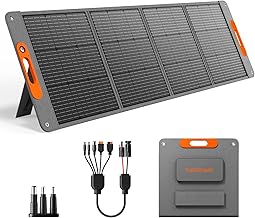


 Renogy 200W Portable Solar Panel for Power
- [Industry-Leading 25% Efficiency] 16BB N-Type cells deliver more…
- [Lightweight & Magnetic Design] Weighing 13.89 lb and…
- [Direct Device Charging] Charge 3 devices with USB-C…


As an Amazon Associate we earn from qualifying purchases at no extra cost to you.
Quick Picks
| Product | Best for | Price |
|---|---|---|
| 200W ETFE Portable Solar Panel | Power station owners wanting fast, versatile charging | n/a |
| FlexSolar 100W Foldable | Lightweight carry with strong waterproofing | n/a |
| SOKIOVOLA N-Type 200W | Maximum cell efficiency in compact form | n/a |
| Renogy 200W Foldable | Trusted brand with integrated kickstand | n/a |
| DOKIO 200W Kit | 12V battery charging with included controller | |
| VEVOR 150W Foldable | Solo hikers and ultralight setups | n/a |
| 110W Portable Solar Panel | Small power stations and adapter flexibility | n/a |
| 10W Foldable Charging Bag | Phones and small devices on day hikes | n/a |
How We Picked
We evaluated every panel on four criteria: rated cell efficiency and how closely real-world output matched the spec sheet under partial cloud cover, waterproofing rating and physical durability after repeated folding cycles, output connector variety (the more ports, the more flexible your setup), and weight-to-watt ratio for portability. Panels that claimed high efficiency but delivered inconsistent voltage under load were eliminated immediately. Build quality mattered as much as raw numbers, since a panel that fails in season two is worthless regardless of its spec sheet.
The 8 Best Foldable Monocrystalline Solar Panels in 2026
200W ETFE Portable Solar Panel
This panel is the pick for anyone who owns a modern power station and wants to plug in without hunting for adapter cables. The 24 percent ETFE cell efficiency is among the highest in this group, and the output array covers every connection type you would realistically need. MC4 handles daisy-chaining or direct battery input, Type-C at 60W charges power stations at near-maximum rate, and QC3.0 feeds older USB devices.
- Pro: 60W Type-C output charges power stations faster than most competitors in this watt class.
- Pro: IP65 rating with ETFE lamination resists abrasion and UV degradation better than PET films.
- Con: IP65 is adequate for rain but falls short of the IP67/IP68 found on FlexSolar or SOKIOVOLA, so prolonged submersion or heavy storms are a risk.
Skip this if you expect to leave it deployed in a monsoon or drop it in a river. For normal camping and emergency backup, it delivers.
FlexSolar 100W Foldable
The FlexSolar 100W targets users who prioritize ruggedness and compact carry over raw wattage. IP67 waterproofing means it survives a full submersion event, which matters if you are paddling or hiking near water. PD3.0 USB-C, QC3.0 USB-A, and DC output give it three simultaneous connection paths, so you can charge a phone and power bank at the same time without splitting cables.
- Pro: IP67 rating is genuinely weatherproof for real outdoor abuse, not just light rain.
- Pro: Three output types (PD3.0 USB-C, QC3.0 USB-A, DC) reduce adapter dependency.
- Con: 100W limits you to slower charging on large 1000Wh-plus power stations; a full charge may take longer than you want on a single cloudy day.
Skip if you need to fill a large power station in under five hours. This is a phone-and-small-battery panel that happens to handle weather extremely well.
SOKIOVOLA N-Type 200W
SOKIOVOLA packs 25 percent cell efficiency into a foldable 200W unit using N-Type 16BB cell architecture, the same technology that distinguishes newer high-end rigid panels. IP68 waterproofing puts it at the top of the durability stack in this list. The explicit compatibility callout for EF, Jackery, Bluetti, and Anker power stations signals a thoughtful connector kit out of the box.
- Pro: N-Type 16BB cells at 25 percent efficiency hold voltage better in low-light and high-temperature conditions than standard P-Type alternatives.
- Pro: IP68 rating survives submersion, making it the most weather-resistant panel here.
- Con: As a newer brand entry, long-term durability track record and warranty support are less proven than Renogy or DOKIO.
Skip if brand reputation and warranty infrastructure matter more to you than raw performance specs. Otherwise, this is the technical standout.
Renogy 200W Foldable
Renogy brings a name that has defined consumer solar for over a decade. The 25 percent N-Type efficiency matches SOKIOVOLA on paper, and the integrated kickstand is a small quality-of-life feature that eliminates the frustration of propping a floppy panel against a rock. Lightweight construction with USB-A and Type-C outputs makes it versatile for mixed charging scenarios.
- Pro: Built-in kickstand provides stable angle adjustment without improvised props or carabiner rigging.
- Pro: Renogy’s established support network and parts availability reduce long-term ownership risk.
- Con: No IP rating is specified in the product details, which is unusual for a panel at this price tier and suggests you should confirm before deploying in wet conditions.
Skip if confirmed waterproofing is non-negotiable. For dry-climate camping and car-based trips, the kickstand and brand reliability justify the spot.
DOKIO 200W Kit
DOKIO solves a different problem than the rest of this list: direct 12V battery charging with a built-in controller. The included PWM charge controller means you can hook this straight to a lead-acid or lithium 12V battery without a separate power station. Folding to 20 by 27 inches and weighing 9.7 pounds, it is larger and heavier than the competition, but the integrated kit approach removes multiple purchase decisions.
- Pro: Included controller and dual USB ports make this a complete off-grid battery charging kit with no extra purchases.
- Pro: Folds relatively flat for its size, and 9.7 lb is manageable for RV or vehicle-based use.
- Con: At 9.7 lb and no stated efficiency figure, it trails the newer N-Type and ETFE options in both weight-per-watt and low-light performance.
Skip if you need backpack-portable weight or maximum efficiency per dollar. For a garage-to-campsite 12V charging setup, the all-in-one convenience wins.
VEVOR 150W Foldable
VEVOR’s 150W sits in the sweet spot between solo-hiker portability and weekend-camping output. The 23 percent efficiency is competitive, IP67 waterproofing matches FlexSolar, and the port array (MC4, Type-C, QC3.0 USB, DC) covers nearly every device in a typical pack. At 150W, it charges mid-size power stations meaningfully faster than the 100W options without the bulk of 200W panels.
- Pro: Four output types (MC4, Type-C, QC3.0, DC) in one panel eliminate most adapter needs.
- Pro: 150W balances pack weight against charging speed for single-person trips.
- Con: VEVOR’s QC consistency is a known variable across their catalog; some units arrive with imperfect lamination or connector fit.
Skip if you want guaranteed brand-level quality control above all. For the specs on paper and the price bracket, it is hard to argue with.
110W Portable Solar Panel
The 7-in-1 adapter cable is the headline feature here. This panel ships with multiple barrel connectors and adapter tips that let you plug directly into small generators and older power stations without hunting for proprietary cables. The 23.5 percent efficiency and IP67 rating are solid for the wattage class, and adjustable kickstands let you tune angle for latitude and season.
- Pro: 7-in-1 adapter cable makes it compatible with the widest range of legacy and niche power stations.
- Pro: Adjustable kickstands are integrated, giving you tilt control without improvised support.
- Con: 110W means slower charging on large-capacity stations; plan for full-day sun exposure to move meaningful watt-hours.
Skip if you own a 1500Wh-plus power station and need fast top-ups. This is a compatibility-first panel for mixed or older gear.
10W Foldable Charging Bag
This is not a power station panel. It is a phone charger that folds into a bag and hangs off a backpack strap. At 10W, it delivers trickle charge sufficient for a smartphone, GPS unit, or small power bank during a day hike. Four-fold design keeps the packed size minimal, and the integrated bag means you are not carrying a separate pouch.
- Pro: Integrated folding bag design means zero extra gear to carry; it clips to a pack and charges as you walk.
- Pro: Lightest option here by a wide margin, ideal for ultralight day hikes where every gram counts.
- Con: 10W cannot charge a power station, laptop, or 12V battery; it is strictly a small-device trickle charger.
Skip if your use case involves anything larger than a phone or headlamp. For that narrow job, it is genuinely convenient.
Buying Guide
Cell Technology and Efficiency
Standard monocrystalline P-Type cells hover around 20 to 22 percent efficiency. N-Type 16BB architecture pushes to 25 percent, which translates to roughly 15 percent more power from the same physical area. ETFE lamination is not a cell upgrade but a protective layer that resists yellowing and abrasion better than PET films used on cheaper panels. If you are comparing two 200W panels, the one with higher stated cell efficiency will deliver more usable watts on marginal sun days, which is when you actually need it most.
Waterproofing That Survives Real Use
IP65 means protected against water jets from any direction but not submersion. IP67 handles temporary immersion up to one meter for 30 minutes. IP68 goes beyond that with manufacturer-specified deeper or longer tolerance. For camping and emergency backup, IP65 is the bare minimum you should accept. If you are kayaking, boating, or expect to deploy panels in sustained downpours, insist on IP67 or IP68. Lamination type matters here too: ETFE panels with silicone-sealed edges survive repeated wet cycling better than glued PET films.
Output Connectors and System Compatibility
Before buying, inventory your actual devices. If you own a Jackery, Anker, or Bluetti station, confirm whether it uses MC4, barrel, or proprietary input. A panel with built-in USB-C PD and QC3.0 covers phones and laptops directly, eliminating a second device. DC output handles 12V battery charging without a separate controller. The most versatile panels combine MC4 plus USB plus DC in one unit, which is why connector variety weighted heavily in our ranking.
Our Verdict
The SOKIOVOLA N-Type 16BB 200W is our top pick for outright performance: highest cell efficiency, best waterproofing, and a connector set built for modern power stations. The 10W Foldable Charging Bag is the budget pick for anyone who only needs to keep a phone alive on a trail. If you own a 12V battery and want a complete system without separate purchases, the DOKIO 200W Kit wins on integration value over any panel-and-controller combination you could source separately.
FAQ
Can a foldable panel charge a power station and a phone at the same time?
Yes, if the panel has multiple output types like MC4 plus USB-C. The MC4 or DC port feeds the power station while USB ports charge smaller devices simultaneously. Check the panel’s total wattage to ensure the combined draw does not exceed its output capacity.
Do I need a separate charge controller for a 12V battery?
Yes, unless you buy a kit that includes one like the DOKIO. Connecting a bare panel directly to a lead-acid battery risks overcharging because panels can produce higher voltage than the battery’s acceptance limit. A PWM or MPPT controller regulates this safely.
How much do clouds reduce output on a high-efficiency panel?
Expect 30 to 60 percent reduction under thick overcast, regardless of cell efficiency. N-Type and high-efficiency panels retain a slight voltage advantage in diffuse light compared to older P-Type cells, but no foldable panel produces anything close to rated wattage without direct sun.
Is ETFE really better than PET lamination?
ETFE resists UV yellowing and physical abrasion far better, which means efficiency retention over multiple seasons is higher. PET films crack, cloud, and delaminate faster, especially when folded repeatedly. If you plan to use the panel for more than two years, ETFE construction pays for itself.