Key takeaways
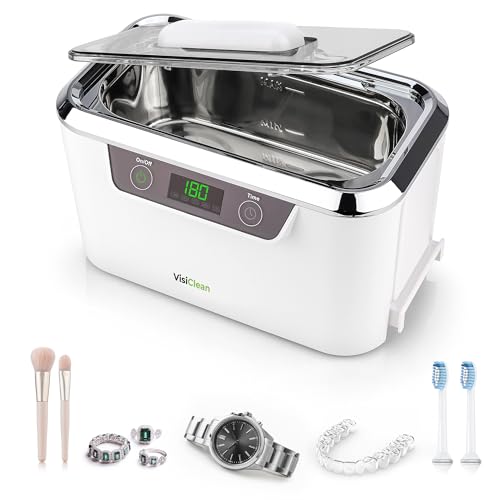
- Best compact jewelry and eyewear cleaner: Magnasonic CD2800. Its roughly 600 ml tank, 42 kHz ultrasonic frequency, and short preset cycles suit rings, earrings, watch bracelets, and glasses without taking much counter space.
- Best all-purpose household option: iSonic P4820. The approximately 2-liter tank provides more usable room for multiple pairs of glasses, retainers, jewelry, and small tools, while digital cycle controls make repeated cleaning easier.
- Best for batches and workshop use: a 3-liter, 40 kHz stainless-steel cleaner such as VEVOR’s 3L ultrasonic cleaner. The larger tank and heater are useful for removable tool parts and several small objects at once, although the machine is louder and less convenient to store.
- Best upgrade for demanding maintenance: Branson 2800 or a comparable laboratory-style unit. These machines cost substantially more, but typically offer more robust construction and better control than consumer countertop cleaners.
The best ultrasonic cleaners match the tank to what you clean most often: the compact Magnasonic CD2800 is a sensible choice for jewelry and glasses, the iSonic P4820 offers more room and control for frequent household use, and a 3-liter stainless-steel benchtop unit is better for batches or larger tools.
Our top picks



As an Amazon Associate we earn from qualifying purchases at no extra cost to you. Ratings are shown as listed on Amazon.
Our top choices by cleaning situation
- Best compact jewelry and eyewear cleaner: Magnasonic CD2800. Its roughly 600 ml tank, 42 kHz ultrasonic frequency, and short preset cycles suit rings, earrings, watch bracelets, and glasses without taking much counter space.
- Best all-purpose household option: iSonic P4820. The approximately 2-liter tank provides more usable room for multiple pairs of glasses, retainers, jewelry, and small tools, while digital cycle controls make repeated cleaning easier.
- Best for batches and workshop use: a 3-liter, 40 kHz stainless-steel cleaner such as VEVOR’s 3L ultrasonic cleaner. The larger tank and heater are useful for removable tool parts and several small objects at once, although the machine is louder and less convenient to store.
- Best upgrade for demanding maintenance: Branson 2800 or a comparable laboratory-style unit. These machines cost substantially more, but typically offer more robust construction and better control than consumer countertop cleaners.
What matters more than the advertising claims
Tank size and usable space
Tank capacity is measured to the rim, not to the recommended fill line. A 600 ml cleaner may hold only around 450–500 ml during normal use, while a 2-liter model may provide roughly 1.5–1.7 liters of working liquid. Check the basket’s internal dimensions rather than relying only on liters.
Small tanks are efficient for one or two pieces of jewelry and use less solution. Larger tanks reduce crowding, which matters because objects packed together can block sound energy and scratch one another. Do not stack jewelry directly in the tank; use the basket or a soft mesh container.
Ultrasonic frequency
Most consumer cleaners operate near 40–43 kHz. Lower frequencies create larger, more forceful bubbles and can remove stubborn grime quickly, but they may be less forgiving on delicate finishes. Frequencies around 42 kHz are a practical general-purpose compromise for jewelry, glasses, and small household parts.
Frequency does not tell you the whole story. Transducer power, tank shape, liquid depth, and how evenly the machine distributes cavitation also affect cleaning. A higher advertised wattage is not automatically better.
Cycle controls and heating
For routine cleaning, a timer with several settings is more useful than a single long cycle. Start with three minutes, inspect the object, and repeat if necessary. A built-in heater can improve degreasing, but heat should be used cautiously around glued components, wax, certain coatings, and temperature-sensitive plastics.
Noise and basket design
Ultrasonic cleaners produce a noticeable high-pitched buzzing, often comparable to a small countertop appliance. Lids reduce splashing and perceived noise but do not make the process silent. Rubber feet help prevent the unit from walking across a counter.
A removable plastic basket is essential. It keeps objects off the tank floor, where direct contact can create marks and transmit vibration unevenly. Look for a basket with handles, enough clearance above the transducers, and openings small enough to retain earrings and screws.
Head-to-head comparison
| Cleaner or type | Approx. tank capacity | Typical frequency | Cycle controls | Best use | Space and noise |
|---|---|---|---|---|---|
| Magnasonic CD2800 | 600 ml | 42 kHz | Five preset cycles, commonly up to 8 minutes | Jewelry, glasses, watch bands, small personal items | Compact; moderate countertop buzz |
| iSonic P4820 | 2 liters | 42 kHz | Digital timer with multiple selectable durations | Several glasses, retainers, jewelry, and small tools | Needs permanent counter or cabinet space |
| VEVOR 3L stainless-steel type | 3 liters | 40 kHz | Digital timer; many versions include temperature control | Batches, tool parts, and workshop maintenance | Larger and generally louder; often heavier |
| Branson 2800 | About 2.8 liters | 40 kHz class | Professional-style timed operation | Frequent, demanding cleaning where durability matters | Benchtop footprint; premium purchase |
Specifications can vary by voltage, revision, and seller configuration, particularly for generic 3-liter machines. Confirm the manual, internal basket dimensions, and electrical rating before buying.
Which cleaner fits your circumstances?
| Your situation | Choose | Why |
|---|---|---|
| Limited space and occasional cleaning | 600 ml compact unit | Lower water use, easier storage, adequate for a few small objects |
| Several household items each week | 2-liter digital unit | Less crowding and more flexible cycle selection |
| Cleaning tool parts or batches | 3-liter stainless-steel unit | More working area and commonly available heating |
| First ultrasonic cleaner | 40–42 kHz consumer model with basket | Simple controls reduce the chance of over-cleaning |
| Frequent professional or workshop use | Professional-grade benchtop model | More durable construction can justify the higher initial cost |
What can and cannot go in an ultrasonic cleaner?
Ultrasonic cleaning is generally suitable for solid gold, platinum, sterling silver, stainless steel, uncoated glass, and many hard plastic items, provided the manufacturer of the item permits immersion. It works well on dirt trapped around metal links and in the grooves of eyeglass frames.
Use caution with porous, layered, coated, glued, or heat-sensitive objects. Avoid ultrasonic cleaning for pearls, opals, emeralds, turquoise, coral, amber, and other softer or porous gemstones unless a qualified jeweler confirms that it is safe. The same caution applies to jewelry with loose stones, foil-backed stones, fragile antique settings, damaged plating, or glued decorative parts.
Never assume that eyeglasses are automatically safe. Remove glasses from the case and check whether the lenses have specialty coatings, whether the frame has loose screws, and whether manufacturer instructions prohibit immersion. Do not put watches in the tank unless they are specifically designed for this treatment and fully water-resistant; water resistance does not guarantee resistance to ultrasonic vibration.
How to use one without damaging your items
- Inspect first. Check stones, screws, plating, solder joints, and coatings. If anything is loose, clean it by hand instead.
- Fill to the marked level. Use clean water and, only when appropriate, a small amount of ultrasonic-compatible detergent. Avoid household solvents, bleach, ammonia, and flammable liquids.
- Run a short empty cycle. A two- to three-minute cycle helps remove dissolved gases from fresh water, improving cavitation.
- Place items in the basket. Keep them separated and fully submerged. Never operate the machine dry.
- Start with three minutes. Inspect the result, then repeat briefly if needed rather than beginning with the longest setting.
- Rinse and dry. Rinse residue with clean water and dry immediately, especially metal items that can spot or tarnish.
- Empty and wipe the tank. Leaving dirty solution inside encourages residue buildup and can shorten the life of seals and controls.
Ownership costs and durability
Water is inexpensive, but detergent, time, and maintenance matter. If a 600 ml cleaner uses 0.5 liters per session and you clean twice weekly, it consumes about 52 liters of water per year. A 2-liter machine filled to 1.6 liters on the same schedule would use about 166 liters. The larger tank is worthwhile only if you need its capacity or clean several items together.
The parts most likely to become inconvenient first are the removable basket, lid, control buttons, and tank finish. Baskets can crack if overloaded, stainless steel can stain if solution is left standing, and mineral deposits can reduce cleaning consistency. Do not scrub the tank with abrasive pads or move a full machine. Keep the exterior dry and allow the tank to cool before wiping it.
For most homes, the best ultrasonic cleaners are not the largest or most powerful models. Choose a compact 600 ml unit for occasional personal items, move to a 2-liter cleaner when crowding becomes a problem, and buy a heated 3-liter or professional unit only when your workload justifies its footprint, noise, and higher cost.