Key takeaways
- The best stand mixer attachments are the ones that match your mixer’s drive system and your cooking routine: choose a metal pasta roller for frequent noodle making, a food grinder for small-batch mince, a slicing/shredding attachment for vegetables, and baking-focused…
The best stand mixer attachments are the ones that match your mixer’s drive system and your cooking routine: choose a metal pasta roller for frequent noodle making, a food grinder for small-batch mince, a slicing/shredding attachment for vegetables, and baking-focused tools such as a flex-edge beater or extra bowl when your priority is dough and cakes.
Our top picks


As an Amazon Associate we earn from qualifying purchases at no extra cost to you. Ratings are shown as listed on Amazon.
Quick picks by baking and cooking situation
| Situation | Best attachment type | Why it earns its space | Typical market range |
|---|---|---|---|
| Weekly fresh pasta | Metal roller and cutter set | Consistent sheets and repeatable cutter widths; usually rolls pasta up to about 6 inches wide | $100–$180 |
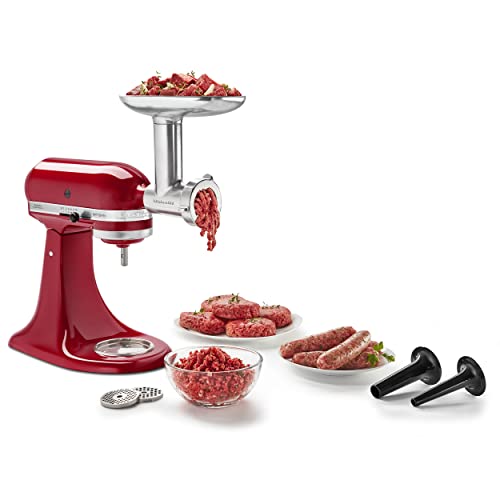
| Occasional mince, sausage, or breadcrumbs | Food grinder | More controlled texture than a food processor and useful for stale bread, cooked vegetables, and meat | $60–$180 |
| Large quantities of vegetables or cheese | Continuous-feed slicer/shredder | Faster than using a box grater and keeps hands away from the cutting drum | $50–$130 |
| Decorative vegetable prep | Spiralizer | Useful for ribbons, spirals, and thin slices, but less versatile than a food processor | $50–$120 |
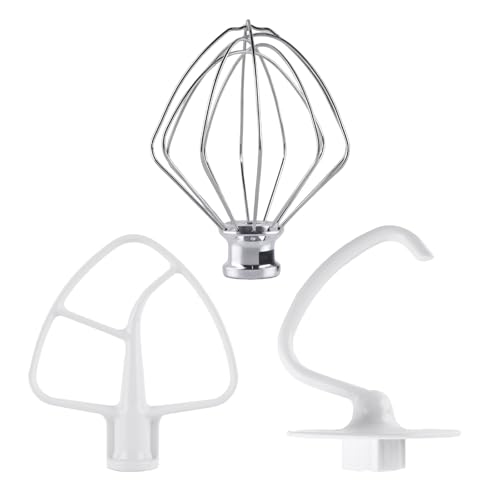
| Frequent cakes and buttercream | Flex-edge beater or extra bowl | Reduces scraping and lets you switch between mixtures without washing immediately | $25–$80 |
What to check before buying
Compatibility is more than the brand name
Most KitchenAid stand mixers accept attachments through the front power hub, including tilt-head and bowl-lift models. However, bowl shape, beater clearance, and the mixer’s instructions still matter. A tall attachment or a bowl-lift machine may need more room underneath than a tilt-head setup. KitchenAid hub attachments are not automatically compatible with Bosch Universal, Ankarsrum, or other mixer systems.
Bosch Universal attachments fit Bosch Universal mixers and use that machine’s own drive arrangement. Ankarsrum attachments are likewise designed for Ankarsrum mixers. Do not rely on a similar-looking coupler, a seller’s generic “universal” wording, or an adapter unless the mixer manufacturer explicitly supports it. An incorrect fit can wobble, damage the hub, or leave metal shavings in food.
Material affects feel, cleaning, and longevity
Stainless-steel rollers and cutters are generally the better long-term choice for pasta because they resist corrosion and retain a smooth surface. Chrome-plated parts can also work well, but chipped plating is a reason to stop using an attachment. Aluminum grinder bodies are light and common; stainless-steel cutting knives and plates are more important than a shiny exterior because they determine how cleanly food is cut.
Plastic housings reduce weight and price, especially on slicers and shredders. They are adequate for normal home batches but can flex when a user forces hard vegetables through the feed tube. Metal does not make an attachment automatically better: it adds weight, can be harder to store, and may still contain plastic gears or pusher parts that eventually wear.
Head-to-head: the attachments bakers use most
Pasta roller versus hand-crank roller
A stand-mixer pasta roller is faster for repeated batches and leaves both hands available to guide the dough. A typical roller has seven or eight thickness settings and produces a sheet roughly 6 inches wide. Cutter attachments commonly include a narrow spaghetti-style cutter and a wider fettuccine-style cutter.
The trade-off is cleaning and storage. Flour and dough can enter the cutter slots, and most manufacturers advise brushing or tapping the attachment clean rather than immersing it. A hand-crank roller costs less and stores easily, but it demands more coordination. For pasta once or twice a year, the hand-powered option is often better value; for weekly pasta, the stand-mixer version is more convenient.
Food grinder versus food processor
A grinder is the better tool when texture matters. Its plate size controls the result: a plate around 4.5 mm makes a fine-to-medium mince, while a plate around 6 mm produces a coarser grind. Grinding meat very cold, cutting it into approximately 2.5 cm pieces, and feeding it steadily reduces smearing.
A food processor is more flexible for chopping onions, making pesto, or blending dips. It is usually faster for a single small batch, while the grinder is more suitable for mince, sausage mixtures, breadcrumbs, and some cooked vegetables. Do not put bones, frozen solid meat, or fibrous scraps through a household grinder unless its manual specifically permits them.
Slicer/shredder versus food processor
A stand-mixer slicer or shredder is appealing when you already have the mixer on the counter and need several cups of cheese, carrots, or potatoes. Typical drums use stainless-steel cutting surfaces and produce slices or shreds in a consistent thickness. A continuous-feed design can process roughly 1–2 kg of produce in a few minutes, depending on the food and how often the chute needs clearing.
A food processor n