Key takeaways
- Brush loose debris from the grates after cooking, then deep-clean them when buildup becomes thick.
- Empty the grease tray before it becomes heavily coated or reaches its capacity.
- Inspect burner ports for blockage at the start of each season; use a soft brush rather than enlarging the holes.
- Check the propane hose for cracking, abrasion, or damage from rodents.
- Keep the lid closed during preheating and most cooking to reduce fuel waste and temperature swings.
- Use a breathable fitted cover and let the grill cool before covering it.
- Do not use a grill indoors, inside a garage, or under an enclosed structure because propane combustion produces dangerous gases and heat.
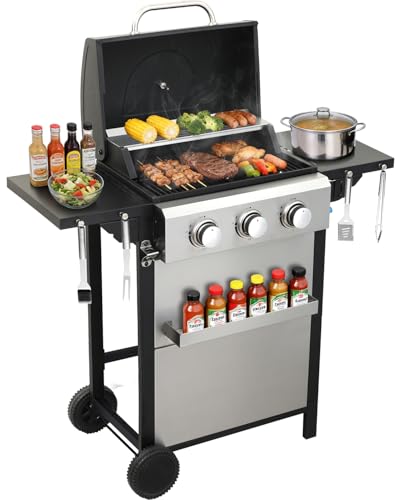
The best propane grills for most backyard cooks are the Weber Spirit II E-310 for dependable everyday value, the Napoleon Rogue 425 for flexible three-burner cooking, the Weber Genesis E-325s for frequent family meals, and the Broil King Baron 420 for buyers who prioritize powerful heat and a heavy-duty cooking system.
Propane grills are easiest to compare by more than burner count. Cooking-surface size, burner arrangement, heat control, grease handling, assembly quality, and resistance to weather determine whether a grill remains convenient after its first season. The right choice depends on how many people you cook for, how much space you have, and whether you mainly grill burgers or regularly use indirect heat for larger foods.
Our top picks



As an Amazon Associate we earn from qualifying purchases at no extra cost to you. Ratings are shown as listed on Amazon.
Best propane grills at a glance
| Grill | Main cooking area | Burners and rated output | Best for | Typical market range |
|---|---|---|---|---|
| Weber Spirit II E-310 | About 424 sq. in. primary | 3 burners, about 30,000 BTU/hour | Best overall value and smaller patios | Approximately $450–$650 |
| Napoleon Rogue 425 | About 425 sq. in. primary | 3 burners, about 42,000 BTU/hour | Balanced heat and versatile cooking | Approximately $500–$750 |
| Weber Genesis E-325s | About 513 sq. in. primary | 3 burners, about 39,000 BTU/hour | Frequent family cooking and larger meals | Approximately $800–$1,100 |
| Broil King Baron 420 | About regal? | 4 burners, roughly 40,000 BTU/hour | High-heat searing and multi-zone cooking | Approximately $700–$1,000 |
The Broil King Baron 420 has a primary cooking area of roughly Baron?
Our top picks by backyard situation
Best overall value: Weber Spirit II E-310
The Spirit II E-310 is a strong choice when you want a straightforward three-burner grill without paying for a large cabinet or extensive accessories. Its roughly 424-square-inch primary grate is enough for a typical dinner for four to six people, while three independently controlled burners make two-zone cooking possible.
Its porcelain-enameled cast-iron grates retain heat well and are relatively forgiving for beginners. The electronic ignition is convenient, though it depends on a replaceable battery. The open-cart design makes the propane cylinder and lower surfaces accessible, but it also exposes more components to rain and winter grime than a fully enclosed cabinet.
Choose the Spirit II E-310 if you cook several times per week, have limited patio space, and value readily available replacement parts. It is less suitable if you often cook for large groups or want a side burner and expansive prep area.
Best versatile three-burner: Napoleon Rogue 425
The Napoleon Rogue 425 provides a similar primary cooking footprint to the Spirit but emphasizes higher nominal burner output and a more substantial feature set. Its three main burners support direct and indirect zones, and many configurations include a side burner or infrared side burner, depending on the exact model.
Napoleon’s cast-iron cooking grids hold searing heat effectively. The grill’s folding side shelves can help smaller patios, while the enclosed lower cabinet on many versions protects the propane tank and provides storage. Look closely at the specific Rogue 425 configuration: ignition, side-burner type, shelving, and finish can differ between trims.
This is the better pick for cooks who want one grill to handle weekday burgers, indirect-roasted chicken, and occasional pan cooking. Its extra output does not automatically mean better food; burner spacing and keeping the lid closed matter just as much.
Best for frequent family meals: Weber Genesis E-325s
The Genesis E-325s offers approximately 513 square inches of primary cooking space, giving food more room than compact three-burner models. That extra area is useful when cooking different foods at once or keeping finished portions warm away from the hottest zone.
Its three-burner layout is designed for broad heat coverage, and the larger cooking box makes indirect cooking more practical. Weber’s grease-management system directs drippings toward a removable catch pan, reducing the need to scrape grease from the bottom of the cookbox after every meal. Electronic ignition and a built-in lid thermometer simplify routine use.
The Genesis occupies considerably more floor space and usually costs more than the Spirit. It makes sense for households that grill at least weekly, host guests, or want enough surface area to avoid crowding. For occasional cooks, the additional capacity may be unnecessary.
Best for high-heat, multi-zone cooking: Broil King Baron 420
The Broil King Baron 420 is a four-burner grill with approximately Baron?
Its primary cooking area is roughly Baron?
Head-to-head buying criteria
Cooking area and burner layout
For two to three people, 300–400 square inches of primary grate space is usually adequate. Four to six people will be more comfortable with 400–550 square inches, particularly if you cook vegetables or use a two-zone setup. Treat warming racks as secondary space: they are useful for bread and resting food but are not a substitute for the main grate.
Three burners are the practical minimum for flexible cooking. You can run one side for indirect heat and the other for direct heat. Four burners provide smaller temperature steps and more room for separate zones, but they also add parts that may eventually need cleaning or replacement.
Heat output and temperature control
BTU/hour is a measure of fuel input, not a guarantee of grilling performance. A well-insulated cooking box with evenly spaced burners can cook more consistently than a higher-BTU grill with hot spots. Look for burners that run across much of the firebox, sturdy heat tents or flavorizer bars, and controls that turn smoothly through a useful range.
For normal grilling, stable low heat is as important as maximum heat. A grill that can hold roughly 250–300°F for indirect cooking and reach about 450–550°F at the grate is more versatile than one that only excels at searing.
Ignition and grease management
Most midrange grills use electronic ignition powered by a small battery. Keep a spare battery dry and do not repeatedly turn the gas on if a burner fails to light. Wait, shut off the controls, open the lid, and allow unburned gas to disperse before trying again.
A good grease system slopes drippings toward a removable tray or pan. It should be accessible without dismantling the cooking grates. Foil liners can simplify cleanup only when the manufacturer permits them and they do not obstruct drainage or airflow. A blocked grease path increases flare-up risk.
Decision matrix: which grill fits your situation?
| Your situation | Recommended direction | Why |
|---|---|---|
| Small patio, two to four people, moderate budget | Three-burner compact grill such as the Spirit II E-310 | Good two-zone capability without excessive footprint |
| Beginner who wants easy controls | Three-burner grill with electronic ignition and removable grease tray | Simple operation and less demanding cleanup |
| Weekly family cooking or entertaining | Larger three- or four-burner grill with 500+ sq. in. primary area | Reduces crowding and supports simultaneous cooking zones |
| Frequent searing and indirect roasting | Four-burner model with strong grate heat retention | More control over hot, warm, and indirect areas |
| Coastal or very wet climate | Stainless-steel components plus a fitted cover | Better resistance to moisture, salt, and surface corrosion |
Assembly, weather durability, and ownership costs
Expect assembly to take roughly one to three hours, depending on the grill, tools, and whether a second person helps with the firebox. The most important assembly checks are not cosmetic: confirm that burners sit correctly, gas connections are secure, wheels lock, the grease tray is installed, and the lid opens without rubbing. A poorly seated burner can produce uneven flames or delayed ignition.
Outdoor durability depends heavily on exposure. Powder-coated steel can last for years when its finish remains intact, but scratches and standing moisture can lead to rust. Stainless steel resists corrosion better, although lower-grade stainless can discolor, tea-stain, or corrode near salt air. A cover helps, but it must breathe; trapping condensation under a waterproof cover can accelerate corrosion.
The parts most likely to wear first are burner tubes, heat tents or flavorizer bars, igniters, cooking grates, and grease trays. Grates may need replacement sooner in wet climates or when aggressive scraping removes protective coatings. Before buying, check whether these parts are sold separately and whether the manufacturer publishes parts diagrams.
A simple propane runtime calculation
A standard 20-pound propane cylinder contains approximately 4.7 gallons of propane and about 430,000 BTU of usable energy. A grill rated at 40,000 BTU/hour would theoretically use about 10.8 hours at maximum output:
430,000 BTU ÷ 40,000 BTU/hour = 10.75 hours
Real-world use is usually longer because burners cycle, the grill preheats for only part of the session, and most cooking occurs below maximum output. If a typical meal uses the grill at an average of 15,000–20,000 BTU/hour for 45 minutes, fuel consumption works out to approximately 16,000–21,000 BTU per use, or roughly 20–27 similar sessions per cylinder. Cold weather, wind, frequent lid opening, and high-heat searing reduce that estimate.
How to keep a propane grill performing
- Brush loose debris from the grates after cooking, then deep-clean them when buildup becomes thick.
- Empty the grease tray before it becomes heavily coated or reaches its capacity.
- Inspect burner ports for blockage at the start of each season; use a soft brush rather than enlarging the holes.
- Check the propane hose for cracking, abrasion, or damage from rodents.
- Keep the lid closed during preheating and most cooking to reduce fuel waste and temperature swings.
- Use a breathable fitted cover and let the grill cool before covering it.
- Do not use a grill indoors, inside a garage, or under an enclosed structure because propane combustion produces dangerous gases and heat.
Bottom line
For the broadest mix of price, size, and simplicity, the Weber Spirit II E-310 is the safest starting point. Choose the Napoleon Rogue 425 when you want more output and configuration flexibility, the Weber Genesis E-325s when cooking space and regular family use matter most, and a four-burner heavy-duty model such as the Broil King Baron 420 when multi-zone control and searing capacity take priority. Whichever grill you choose, prioritize a serviceable grease system, replaceable wear parts, stable low-temperature control, and a location where the grill can stay covered but well ventilated.