
Key takeaways
- Width: 30-inch is the most common size, 36-inch adds a fifth burner or more power, and 24-inch or narrower fits compact kitchens.
- Burner output: Makers list outputs in BTU. A high-output burner helps with boiling and searing, while a low-simmer burner helps with sauces. Compare the lowest and highest output rather than the total.
- Grates: Continuous cast-iron grates let you slide pots across burners. Reviewers often call them sturdy but heavy to clean.
- Controls: Front knobs are easy to use, while side or top knobs can suit certain layouts. Check clearance for the knobs if the cooktop sits above drawers.
- Ignition and flame failure: Many cooktops include an electric spark ignition and some include flame-out detection that stops the gas flow. The maker’s specification will state what is included.
For most kitchens, a 30-inch sealed-burner gas cooktop from Bosch, GE, Samsung, Frigidaire or Whirlpool covers everyday cooking, while a 36-inch model with a high-output burner suits serious cooks and a 24-inch or 15-inch unit suits small kitchens. This guide explains how to choose by size, burner layout, controls and safety features, and where installation rules matter more than the product itself.
Our top picks


As an Amazon Associate we earn from qualifying purchases at no extra cost to you.
Installation and safety come first
Gas appliances must be installed by a qualified professional in line with the maker’s instructions and local codes. That includes the gas connection, ventilation clearance above the cooktop and the countertop cutout. If you smell gas, leave the area, avoid switches and flames, and call your gas supplier or emergency services. Using a cooktop converted for propane requires the maker’s conversion kit and a qualified installer. Treat the specifications below as general guidance and follow the manual for your model.
Key choices
- Width: 30-inch is the most common size, 36-inch adds a fifth burner or more power, and 24-inch or narrower fits compact kitchens.
- Burner output: Makers list outputs in BTU. A high-output burner helps with boiling and searing, while a low-simmer burner helps with sauces. Compare the lowest and highest output rather than the total.
- Grates: Continuous cast-iron grates let you slide pots across burners. Reviewers often call them sturdy but heavy to clean.
- Controls: Front knobs are easy to use, while side or top knobs can suit certain layouts. Check clearance for the knobs if the cooktop sits above drawers.
- Ignition and flame failure: Many cooktops include an electric spark ignition and some include flame-out detection that stops the gas flow. The maker’s specification will state what is included.
At a glance
| Brand and line | Best for | Key stated features | Limits |
|---|---|---|---|
| Bosch gas cooktops (e.g. 500 and 800 series) | Sleek, European-style kitchens | The maker lists sealed burners, stainless or black glass finishes and continuous grates on many models | Fewer extremely high-output burners than pro-style units |
| GE and GE Profile gas cooktops | General family kitchens | Sealed burners, optional power burners, various finishes | Features vary a lot by tier |
| Samsung gas cooktops | Tech-focused buyers | Smart features on some models; sealed burners and cast-iron grates | App features depend on the model |
| Frigidaire and Whirlpool | Budget to mid-range kitchens | Straightforward gas cooktops in 30-inch and 36-inch sizes | Simpler burner power and finishes |
| KitchenAid and Café | Premium home cooks | Higher power burners, heavy grates, designer finishes | Premium tier |
| Pro-style brands such as Wolf and Thermador | Serious cooks | Very high output and heavy-duty construction | Premium; need powerful ventilation |
Mainstream brands
Bosch focuses on clean design and continuous grates, which many reviewers like for sliding heavy pans. GE and GE Profile offer a wide line-up at several price points, including models with a power burner and griddle options. Samsung includes a few cooktops with connected features, though buyers should check whether the app functions matter to them. Frigidaire and Whirlpool deliver reliable basics for those prioritising cost.
Premium and pro-style
KitchenAid, Café, Wolf, Thermador and similar brands offer burners with higher maximum output and more refined simmer control. Reviewers who cover cooking appliances generally note that very high burner power needs correct ventilation and a gas supply that can deliver the required flow. Always confirm this with the installer. Because power and weight are higher, so is the cost.
Size and cutout notes
- Match the cutout size to the model’s installation guide. Do not assume two 30-inch cooktops share the same cutout.
- Check clearance to combustible materials above and beside the cooktop and the required hood distance.
- Measure the cabinet depth below the cooktop, because burners and gas connections require space.
- If replacing an older unit, ask the installer whether the gas line and shut-off valve are suitable.
Budget tiers
- Budget: Frigidaire, Whirlpool and entry GE models with sealed burners and basic grates.
- Mid-range: Bosch, Samsung and GE Profile with continuous grates and a power burner.
- Premium: KitchenAid, Café, Wolf and Thermador, usually with higher outputs and heavier construction.
Care notes
- Clean spills promptly with the cleaners the maker recommends. Avoid harsh abrasives on glass or stainless finishes.
- Remove burner caps and heads as the manual directs, and let them dry fully before reassembling.
- If the flame is yellow or uneven, turn the burner off and consult the manual or a technician.
- Install a working carbon monoxide alarm and ensure range-hood ventilation is used when cooking.
Pick X if…
| If you… | Pick |
|---|---|
| Want a sleek design and sturdy grates | Bosch gas cooktop |
| Want wide choice at many price points | GE or GE Profile |
| Care about smart connectivity | Samsung model with app features |
| Need a straightforward budget cooktop | Frigidaire or Whirlpool |
| Cook with large pans and high heat | 36-inch with power burner |
| Have limited counter space | 24-inch or 15-inch cooktop |
Alternatives
- Induction cooktops: Offer fast heating and easy cleaning, but need compatible magnetic cookware and an electrical circuit.
- Gas ranges: Combine the cooktop and oven in one appliance, useful when replacing both.
- Portable gas burners: Suitable only for outdoor or specifically approved use.
Burner layout and cookware fit
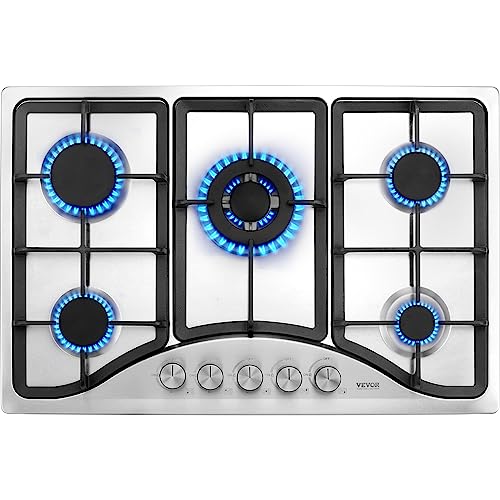
Look at where the burners sit relative to one another. A 30-inch cooktop usually has four burners, and a layout with one large and one small burner on each side suits mixed cooking. On a 36-inch model, a centre burner or a dedicated oval griddle burner can accommodate a long pan or griddle. Check that the largest pot you own, plus a pan beside it, can sit on adjoining burners without touching, and that the grates are stable under a heavy stockpot. Cast-iron grates are heavy but stable, and reviewers often prefer them over lighter metal grates.
Simmer and low-heat control
Many cooks care as much about the lowest flame as the highest. Makers sometimes state a simmer output in BTU for at least one burner. A true low setting helps with melting chocolate, holding a sauce and keeping rice from scorching. Some premium models advertise a dedicated simmer burner or precise low control, while basic models may cycle the flame on and off. If low heat matters to you, read independent reviews that discuss simmering and compare them with the maker’s claim.
Cleaning and durability
Sealed burners limit spills from reaching the cooktop interior, and a continuous surface makes wiping easier. Stainless steel resists chips but shows fingerprints, while black glass or ceramic surfaces look sleek but can scratch. Brass or aluminium burner caps usually need occasional careful cleaning to keep the ports clear. Follow the manual on which cleaners to use, avoid soaking the ignition parts, and let everything dry before use.
Gas type and local requirements
Most cooktops ship set up for natural gas and need a conversion kit for propane. Some regions require specific clearances or approved flexible connectors, and some cities and states are restricting new gas hookups in new construction. Check your building rules before choosing gas over induction, particularly in a renovation. If you rent or are replacing a unit for a landlord, confirm who is responsible for the installation and what the lease allows.
Ventilation and kitchen air quality
Gas cooking releases combustion by-products into the room, so many health and building organisations advise running a range hood that vents outdoors whenever you cook. Recirculating hoods filter grease but do not remove gases. Match the hood’s airflow rating to the cooktop’s total burner output as the hood maker advises, and ask a contractor whether make-up air is needed for a powerful hood. This is a safety and comfort point worth weighing alongside the cooktop itself.
Frequently Asked Questions
Can I install a gas cooktop myself?
Local codes often require a licensed professional for gas connections. A qualified installer can also check ventilation and clearances, so follow the maker’s manual and local regulations.
What does BTU mean on a cooktop?
BTU is a unit of heat output, and a higher number means more heating power. Check both the highest burner for boiling and searing and the lowest for simmering.
Are continuous grates better?
Many cooks like them because pots slide between burners, but they are heavier to clean. Individual grates are lighter and can be easier to remove.
Can a gas cooktop run on propane?
Many can, but they need the correct conversion kit installed by a qualified technician. Do not attempt the conversion without the maker’s instructions.
Do I need a range hood?
A ventilation system is strongly advised with gas cooking because it removes combustion by-products, moisture and cooking fumes. Follow the cooktop and hood makers’ guidance on distances and airflow.
What if the burner will not light?
Check that the burner cap is seated correctly and the ignition is clean and dry. If the problem persists, call a technician rather than forcing it.
FAQ
Can I install a gas cooktop myself?
What does BTU mean on a cooktop?
Are continuous grates better?
Can a gas cooktop run on propane?
Do I need a range hood?
What if the burner will not light?
More from Amazon
Programs that pair well with the guide above. Offers and eligibility are set by Amazon and may change.
Free shipping on eligible items, Prime Video and more. Eligible new members can start with a free trial.
Start a Prime free trialAudiobooks and podcasts to listen to on the go. Eligible new members can start with a free trial.
Try Audible freeAd-free music streaming. Eligible new subscribers can start with a free trial.
Try Music Unlimited freeA free business account with business pricing and bulk-buying tools for work, shop or home office.
Create a business accountAs an Amazon Associate we earn from qualifying purchases.







