
Key takeaways
- LED engine and colors: RGB gives basic color mixing. RGBW, RGBA or RGBAW+UV add white, amber and ultraviolet for better pastels, skin tones and blacklight effects.
- Beam angle: narrow beams (around 10 to 25 degrees) throw farther. Wide beams (40 degrees or more) cover close areas. The maker lists the angle on the spec sheet.
- DMX channels and modes: fixtures list several modes with different channel counts. More channels allow finer control but need more DMX capacity on the controller.
- Standalone modes: built-in programs, sound activation and master/follower modes let you run a show without a console. Useful for DJs.
- Wireless DMX: some fixtures include built-in receivers. This saves cable but you must still confirm compatibility with your transmitter.
- Flicker and dimming: if you shoot video or stream, look for makers that list high refresh rates or flicker-free operation, and reviewers who confirm it.
- Fan noise: theatres and small venues often need a silent or low-noise mode, which some makers list.
For small stages, bands and mobile DJs, LED wash lights such as the Chauvet DJ SlimPAR Pro H USB or the ADJ Mega Tripar Profile Plus are the most practical starting point, while moving heads like the Chauvet DJ Intimidator series add motion for larger rooms, and theatre-style fixtures like the ETC Source Four LED suit venues that need controlled, sharp-edged light. Match the fixture to the room, the control method and the mounting setup before looking at features.
Our top picks


As an Amazon Associate we earn from qualifying purchases at no extra cost to you.
Stage Lighting at a Glance
| Fixture type and example | Best for | Key stated traits | Limits |
|---|---|---|---|
| LED par wash (Chauvet DJ SlimPAR Pro H USB) | Color washes on bands, small stages, uplighting | Maker lists RGBAW+UV LEDs, DMX control and a low-profile housing | No beam shaping; soft edges |
| LED par with profile (ADJ Mega Tripar Profile Plus) | Stage and event washes | Maker lists a tri-color LED engine, DMX and wireless options on some versions | Check fixture mode and dimming features |
| Moving head spot or wash (Chauvet DJ Intimidator line) | DJs, clubs, bigger rooms | Maker lists pan/tilt motion, gobos or color effects, and DMX or standalone modes | Heavier, more complex, needs a controller to shine |
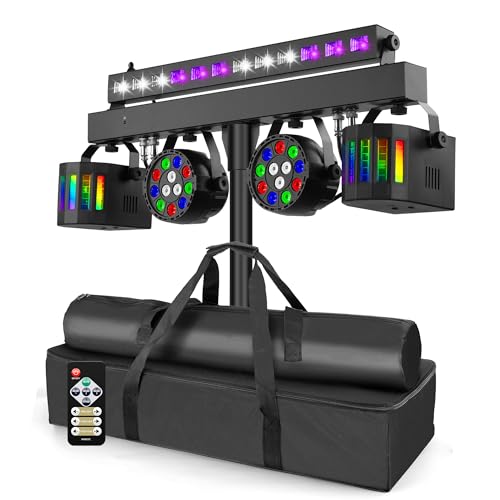
| All-in-one bar (Chauvet DJ GigBAR line) | Mobile performers wanting fast setup | Maker lists multiple effects in one stand-mounted package | Less flexible than separate fixtures |
| Theatre ellipsoidal (ETC Source Four LED) | Theatres, churches, schools | Maker lists shutters, gobo slots, interchangeable lens tubes and a tunable LED engine | Premium tier, needs rigging and a console |
Start With the Job the Light Must Do
Wash lights
A wash light spreads color over an area, such as the performers or a backdrop. LED pars are the common modern version. Their soft-edged beam blends well with neighbors, which is why a row of pars across the back can paint a stage evenly.
Spot and profile lights
A spot light has a defined beam with sharp edges and often accepts gobos, which are patterned discs that project shapes. Profile fixtures such as the ETC Source Four LED can be shuttered to keep light off a screen or a ceiling. Theatre and church lighting designers favor these for control.
Effects
Strobes, lasers, derbys and moving head beams create the visual flash that DJs and clubs want. Laser products in particular have local legal requirements on power, audience scanning and registration. Follow the maker’s safety instructions and local regulations, and do not point lasers at people, aircraft or reflective surfaces.
Key Specs to Compare
- LED engine and colors: RGB gives basic color mixing. RGBW, RGBA or RGBAW+UV add white, amber and ultraviolet for better pastels, skin tones and blacklight effects.
- Beam angle: narrow beams (around 10 to 25 degrees) throw farther. Wide beams (40 degrees or more) cover close areas. The maker lists the angle on the spec sheet.
- DMX channels and modes: fixtures list several modes with different channel counts. More channels allow finer control but need more DMX capacity on the controller.
- Standalone modes: built-in programs, sound activation and master/follower modes let you run a show without a console. Useful for DJs.
- Wireless DMX: some fixtures include built-in receivers. This saves cable but you must still confirm compatibility with your transmitter.
- Flicker and dimming: if you shoot video or stream, look for makers that list high refresh rates or flicker-free operation, and reviewers who confirm it.
- Fan noise: theatres and small venues often need a silent or low-noise mode, which some makers list.
Control Options
DMX512 is the standard protocol. A simple controller with sliders handles a handful of fixtures. Software on a laptop with a USB-DMX interface, or an app-based controller, handles more fixtures and complex scenes. Some Chauvet DJ and ADJ products also support wireless control from a phone. Plan the number of DMX channels you need and add a splitter when running multiple lines. Make sure each fixture gets its own DMX address and that cable runs use proper DMX cable rather than microphone cable where the maker advises it.
Mounting, Rigging and Electrical Safety
Lights can be heavy and are often hung over people, so rigging is a safety issue, not just a convenience. Use truss, stands or clamps rated for the load, add a secondary safety cable on every overhead fixture and follow the maker’s weight and mounting instructions. For permanent installation or rigging over an audience, hire a qualified rigger and electrician, and follow local codes.
- Check each fixture’s power draw and the circuit capacity before plugging several in. Do not overload a circuit or daisy-chain beyond the maker’s stated maximum.
- Keep ventilation space around fixtures, especially older halogen or high-output units that run hot.
- Use outdoor-rated fixtures with an ingress protection (IP) rating for patios and tents. Indoor lights are not weatherproof.
- Haze and fog machines affect beam visibility and fire detectors. Confirm venue rules about smoke effects.
- Flashing and strobe effects can trigger photosensitive reactions in some people. Post a warning where required and follow venue policy.
Budget Tiers
Budget: small LED pars and all-in-one bars from consumer-oriented brands. They offer quick color and effects for home studios and small gigs, with limited dimming smoothness. Mid-range: Chauvet DJ and ADJ fixtures with better LED engines, DMX control and sturdier housings. Premium: theatre-grade fixtures such as ETC Source Four LED and professional moving heads from Chauvet Professional or Elation, with better optics and support.
Pick X If You Want…
| If you want… | Pick | Why |
|---|---|---|
| Simple color washes on a band stage | Chauvet DJ SlimPAR Pro H USB or ADJ Mega Tripar Profile Plus | LED pars with DMX control |
| Quick setup for a mobile act | Chauvet DJ GigBAR line | Multiple effects on one stand |
| Motion and gobos for a club | Chauvet DJ Intimidator moving heads | Pan/tilt, beam and pattern effects |
| Sharp-edged theatrical light | ETC Source Four LED | Shutters, gobos and interchangeable lenses |
| Minimal budget for a home studio | Compact LED pars | Low cost and low power |
Alternatives
- Rented fixtures: a local lighting company can supply and rig fixtures for one-off events, which avoids buying gear you use twice a year.
- Smart bulbs and LED strips: fine for ambiance at home but not intended for stage output or DMX control.
- Fresnel and PAR can fixtures: older tungsten designs still found in theatres, hotter and less efficient than LED.
- Follow spots: an operator-controlled spotlight for solo performers in larger rooms.
Buying Checklist Before You Order
Measure the stage and the throw distance, which is the gap between the fixture and the performers. Then match beam angles to that distance, because a narrow beam on a close stage makes hot spots, and a wide beam from far away washes out. Count the DMX channels you will need and compare against your controller. Look at the power draw per fixture and the number of fixtures a single circuit can handle. Confirm that the housing has a mounting bracket that suits your truss clamps, and that the fixture lists a safety cable attachment point. Ask whether the unit has a built-in fan and how loud it is, because fan noise matters in a quiet room. Consider ambient light too: LEDs read bright in a dark club and much weaker in a daylight church service. Finally, plan the cabling: spare DMX and power cables, extension leads and gaffer tape are small items that decide whether setup takes ten minutes or an hour.
If you are unsure, start with a small number of versatile wash fixtures and one controller, then add effects after a few events show what the room actually needs. Resist buying every effect at once. Keep the manuals, note each fixture’s DMX address on a label and pack cases so that lights and cables stay together between gigs.
Frequently Asked Questions
How many lights do I need for a small stage?
A common starting setup is two to four LED washes aimed from the front and sides, plus a few for back light. The right number depends on stage width, ceiling height and the lights’ beam angle. Consider adding fixtures gradually after testing placement.
Do I need a DMX controller?
Not always. Many fixtures run in sound-active or automatic modes without one. A controller becomes valuable when you want exact color, timing and scenes, or when you run moving heads.
What is the difference between a wash and a spot light?
A wash gives broad, soft-edged color coverage. A spot gives a defined, sharper beam that can carry patterns. Many stages use both for different effects.
Are LED stage lights safe for cameras?
Some LEDs can cause flicker or banding on video if their refresh rate is low. Look for makers that list high refresh rates or flicker-free modes, and read reviewer reports from video users. Testing with your own camera settings is the surest approach.
Can I hang stage lights myself?
For small home setups using stands, yes, if you follow the weight ratings. For hanging fixtures over people, use rated truss and clamps with safety cables, and hire a qualified rigger and electrician for permanent installations.
Are laser lights allowed in any venue?
Not always. Laser use is regulated by local law and by venue rules, especially for audience-scanning effects. Follow the maker’s manual and local regulations, and ask the venue before using any laser effect.
FAQ
How many lights do I need for a small stage?
Do I need a DMX controller?
What is the difference between a wash and a spot light?
Are LED stage lights safe for cameras?
Can I hang stage lights myself?
Are laser lights allowed in any venue?
More from Amazon
Programs that pair well with the guide above. Offers and eligibility are set by Amazon and may change.
Free shipping on eligible items, Prime Video and more. Eligible new members can start with a free trial.
Start a Prime free trialAudiobooks and podcasts to listen to on the go. Eligible new members can start with a free trial.
Try Audible freeAd-free music streaming. Eligible new subscribers can start with a free trial.
Try Music Unlimited freeA free business account with business pricing and bulk-buying tools for work, shop or home office.
Create a business accountAs an Amazon Associate we earn from qualifying purchases.







