Key takeaways
- Small households and flavor variety: a multi-jar maker with individual glass or plastic cups.
- Families: a large single-container maker or an electric multicooker with a yogurt mode.
- Thick Greek-style yogurt: a maker with a built-in or add-on strainer.
- Minimal gear: a multicooker you already own, plus a thermometer.
- Dairy-free yogurts: a maker with adjustable temperature and the maker’s own guidance on non-dairy milks.
For most households, a multi-jar countertop yogurt maker from a brand such as Euro Cuisine or Dash suits people who want a few flavors at once, a large-batch maker or a multicooker with a yogurt setting suits families who eat yogurt daily, and a Greek-style strainer kit suits anyone who wants thick yogurt without extra steps. The best yogurt makers are less about gadgets and more about batch size, temperature steadiness and how easy the jars are to clean.
Our top picks


As an Amazon Associate we earn from qualifying purchases at no extra cost to you.
Quick answer by buyer
- Small households and flavor variety: a multi-jar maker with individual glass or plastic cups.
- Families: a large single-container maker or an electric multicooker with a yogurt mode.
- Thick Greek-style yogurt: a maker with a built-in or add-on strainer.
- Minimal gear: a multicooker you already own, plus a thermometer.
- Dairy-free yogurts: a maker with adjustable temperature and the maker’s own guidance on non-dairy milks.
Yogurt makers at a glance
| Type | Best for | Typical stated features | Limits |
|---|---|---|---|
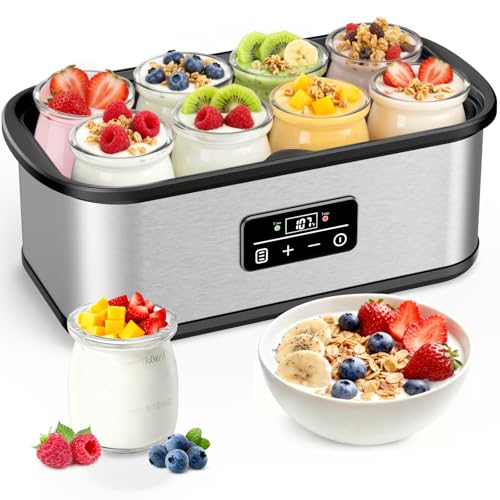
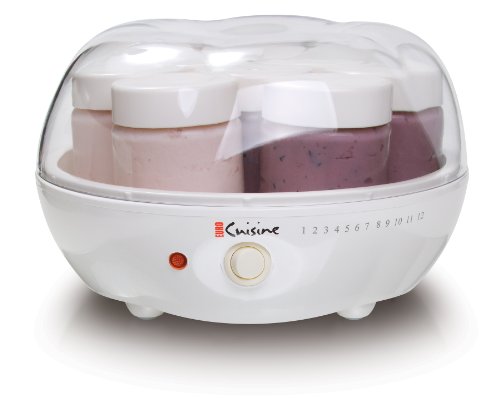
| Multi-jar maker (for example Euro Cuisine and Dash lines) | Singles and couples, flavor variety | Several individual jars with lids, fixed warm temperature, simple timer or no timer | Small jar volume, more cups to wash |
| Single large-container maker | Families, batch cooking | One container around a quart or more, steady low heat, sometimes auto shut-off | Less variety per batch |
| Greek yogurt maker with strainer (for example Cuisinart models) | Thick, high-protein style yogurt | Container plus strainer basket, time-set heating | Strain yields less final volume, more parts |
| Multicooker with yogurt function (for example Instant Pot models that list a yogurt setting) | People who already own a multicooker | Programmable yogurt mode, inner pot, optional jars | Large footprint, small batches waste space |
| Manual method (oven light, insulated cooler, thermometer) | Occasional makers | No dedicated device | Temperature drift, more attention |
How yogurt making works, and why it matters for the machine
Yogurt is made by warming milk, cooling it to a moderate temperature, adding a starter containing live cultures and holding it warm for several hours. The machine’s job is to hold a steady, gentle warmth. Cheaper makers use a simple heating element with a fixed temperature, and reviewers generally report that this is adequate for dairy milk. Higher-end models add timers, automatic shut-off, or temperature settings that help with non-dairy bases. Food safety guidance from public health agencies advises using pasteurized milk and keeping the finished yogurt refrigerated, so follow the maker’s manual for milk heating steps and storage times.
Multi-jar makers
This category is widely stocked and generally the easiest to start with. Typical designs include a heated base with a stack of lidded jars. The maker lists the jar count and size for each model, and the exact number varies between models. The benefit is variety: you can vary flavors or add fruit to individual jars. Cleaning is also easy because jars are small enough to fit in a dishwasher if the maker says they are dishwasher-safe. The downside is that you must fill and lid multiple jars, and a heated base without a timer needs you to watch the clock. If you eat yogurt daily as a family, you will empty these jars quickly.
Large-container and Greek-style makers
Single large containers make a bigger batch in one go, which suits families and meal-preppers. Greek-style models add a strainer so excess whey drains off, leaving a thicker texture. Cuisinart is one brand that markets a Greek yogurt maker with a strainer, and other makers offer similar designs. Many people get a similar result by straining regular yogurt through a fine mesh sieve lined with cheesecloth or a clean cloth, which costs less but is messier. The maker’s strainer is convenient if you strain every batch, and unnecessary if you rarely do.
Multicookers with a yogurt setting
If you already own a multicooker, a yogurt mode may remove the need for a dedicated machine. Instant Pot’s yogurt function is probably the best-known example, and the maker’s manuals describe a heating and incubating cycle. Reviewers who use this method commonly note that it makes a good-size batch and that you can use the inner pot or insert jars. The compromise is the footprint and the time the pot is tied up. It also makes less sense if you want a small amount, since a full pot of yogurt is more than many people need. Models differ in whether they include a yogurt mode, so read the manual before counting on it.
Fit, capacity and cleaning notes
- Capacity: match volume to how much you eat. A household that eats yogurt every day may find small jar sets too limiting.
- Counter space: multicookers are tall and wide, while jar makers are compact.
- Materials: glass jars are easy to clean and resist stains, while plastic ones are lighter and shatter-resistant. Check the maker’s guidance on dishwasher use and on whether the base can be submerged. Most heating bases cannot.
- Timer and shut-off: a timer or automatic shut-off is convenient, but only rely on those features if the maker states them.
- Starter: use a plain yogurt with live cultures or a powdered starter, as directed in the manual.
Budget tiers
| Tier | What to expect | Trade-off |
|---|---|---|
| Budget | Simple multi-jar base, fixed temperature, often no timer | More supervision, plastic parts |
| Mid-range | Greek-style or large-container makers, timers, glass jars | More parts to clean, larger size |
| Premium | Multicookers with yogurt modes and programmable settings, or higher-end dedicated makers with adjustable temperature | Cost, size, and more features than a casual maker needs |
Pick X if you…
| If you… | Pick |
|---|---|
| Want to try yogurt-making with little risk | Basic multi-jar maker |
| Feed a family | Large-container maker or multicooker with yogurt setting |
| Like thick, Greek-style yogurt | Greek yogurt maker with strainer |
| Already own a multicooker | Try its yogurt mode first |
| Make non-dairy yogurt | A maker with adjustable temperature and the maker’s own non-dairy guidance |
| Have little counter space | Compact jar maker or the manual method |
Alternatives
- Insulated cooler method: warm milk and starter in jars, held in a cooler with warm water. Low cost, more variation.
- Sous-vide circulator: if you already own one, it can hold the temperature precisely.
- Buying cultured yogurt: if you only want thick yogurt occasionally, a ready-made tub may simply be more convenient.
Frequently Asked Questions
Is a yogurt maker better than using a multicooker?
Not necessarily. A multicooker with a yogurt mode can make good yogurt, especially in large batches. A dedicated maker is smaller, easier to store and often better for singles or couples.
How long does homemade yogurt take?
Incubation times vary by recipe and machine, commonly several hours up to overnight. Follow your maker’s manual because starter strength and temperature affect timing. A longer incubation generally yields a tangier result.
Why is my homemade yogurt runny?
Common reasons include milk that was not heated as directed, an old or weak starter, a temperature that drifted, or moving the jars while setting. Straining the finished yogurt thickens it. If a batch smells or looks off, discard it.
Can I make non-dairy yogurt in a yogurt maker?
Many people do, though results vary by plant milk. Some need a thickener or a specific starter, so read the maker’s guidance and the starter instructions.
How long does homemade yogurt keep?
Refrigerate it promptly and use it within the time suggested by your recipe or maker, which is often about one to two weeks. When in doubt, throw it out, especially if there is mold or an off smell.
Do I need to sterilize the jars?
Clean jars thoroughly and rinse well. Some recipes call for scalding them with hot water as an extra step. Follow the maker’s manual and food-safety guidance.
FAQ
Is a yogurt maker better than using a multicooker?
How long does homemade yogurt take?
Why is my homemade yogurt runny?
Can I make non-dairy yogurt in a yogurt maker?
How long does homemade yogurt keep?
Do I need to sterilize the jars?
More from Amazon
Programs that pair well with the guide above. Offers and eligibility are set by Amazon and may change.
Free shipping on eligible items, Prime Video and more. Eligible new members can start with a free trial.
Start a Prime free trialAudiobooks and podcasts to listen to on the go. Eligible new members can start with a free trial.
Try Audible freeAd-free music streaming. Eligible new subscribers can start with a free trial.
Try Music Unlimited freeA free business account with business pricing and bulk-buying tools for work, shop or home office.
Create a business accountAs an Amazon Associate we earn from qualifying purchases.