Key takeaways
- Solar security cameras that state 24/7 continuous recording on the listing, with AOV low-frame-rate modes, panel and battery specs, and storage explained.
Most solar security cameras do not record continuously. They sleep, wake when a sensor trips, save a short clip and sleep again, because a battery fed by a small panel cannot power a sensor and radio at full rate around the clock. Shoppers who buy on the words solar and wireless alone often discover this gap only after an incident leaves them with a clip that starts halfway through the event.
This guide applies a strict double test: the camera must run on solar power and its listing must state continuous, 24/7 recording. Only two models passed both checks with a verifiable listing, and both use the same honest compromise, recording at a low frame rate while nothing moves and switching to full rate when activity is detected. That always-on video approach is explained in the buying sections, because understanding it matters more than any single specification below.
Quick Picks
As an Amazon Associate we earn from qualifying purchases.
| Product | Best for | Key spec from title |
|---|---|---|
| MUBVIEW 24/7 Continuous Recording Wireless Outdoor Security Camera (ZY-Q8) | Continuous recording with a card included | 24/7 Continuous Recording, 2K Solar Powered, 360° PTZ |
| TKENPRO Solar Security Camera | Continuous recording with a larger stated panel | 24/7 Continuous Recording, 2K Color Night Vision, 360° Panoramic View |
How to Choose
Understand what continuous recording means on solar power
True full-frame recording, day and night, would drain a battery camera quickly, so solar models that offer continuous recording use an always-on video mode instead. The camera writes a continuous timeline at a very low frame rate while the scene is still, then jumps to full frame rate the moment its detection spots a person, vehicle or animal. You keep an unbroken record with no gaps, and events themselves are captured in full motion. When a listing claims 24/7 recording, look for this low-frame-rate explanation in its text. A listing that only promises motion clips, however long, is a different product category and was excluded from this guide.
Panel output and battery size decide winter reliability
Continuous recording spends energy all night, so the daytime harvest has to repay it. Compare the panel wattage and battery capacity stated on each listing: the two cameras here pair their always-on modes with a 9000mAh battery on the MUBVIEW and an 8W panel on the TKENPRO, figures that show the power budget this recording style needs. Placement matters as much as specification. A panel shaded by eaves or trees for half the day halves the harvest, and short winter days shrink it further. Mount the panel with the clearest southern sky view your property allows, and expect the low-frame-rate mode to carry more of the load in December than in June.
Storage fills fast when a camera never stops
Event cameras sip storage; continuous cameras drink it. A camera writing a timeline all day needs a large microSD card and a loop recording setting that overwrites the oldest footage, otherwise the card fills and recording stops at the worst moment. One model here includes a 32GB card and states support for cards up to 256GB, which is the practical ceiling to plan around. Work out your retention expectation before buying: continuous footage at low frame rates stretches a card much further than full-rate video, but anyone who wants a fortnight of complete history should budget for the largest supported card from the start.
Connectivity and detection still matter
An always-on timeline is only useful if alerts reach you and the camera stays connected. Both cameras here use 2.4GHz WiFi, which reaches further through walls than faster bands but must be strong at the mounting point, so test your signal where the camera will sit before drilling. Detection quality shapes the full-rate footage: the listings describe AI detection that distinguishes activity and triggers the switch to high frame rate, plus pan and tilt coverage, 360 degrees on both models here, so one camera watches a whole yard. Color night vision, stated on the TKENPRO listing, also helps identification after dark when continuous recording is hardest to power.
The 2 Best Options
MUBVIEW 24/7 Continuous Recording Wireless Outdoor Security Camera (ZY-Q8)
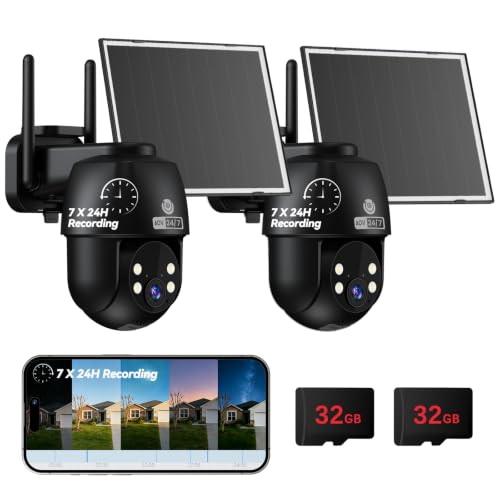
The MUBVIEW ZY-Q8 is built around its always-on recording claim, which its listing text describes plainly: the camera records 24/7 by default rather than saving motion clips only, so the whole night can be rewound. Listing material describes the power system as a 10W solar panel feeding a 9000mAh heated battery that can charge even below 32°F, a detail that matters for continuous recording through cold snaps when ordinary batteries refuse charge. A 32GB microSD card is included and the listing states support for cards up to 256GB, with no monthly fee for the local recording. The camera offers 2K resolution, 360° pan and tilt, auto tracking and 8X zoom per its title, on a 2.4G WiFi connection.
Specs
- Brand: MUBVIEW
- Model name: ZY-Q8
- Recording stated on listing: 24/7 continuous recording
- Resolution stated on title: 2K
- Power stated in listing material: 10W solar panel, 9000mAh heated battery, charges even below 32°F
- Storage: 32GB microSD card included, supports up to 256GB
- Coverage stated on title: 360° PTZ, auto tracking, 8X zoom
- Connectivity: 2.4G WiFi
Best for: Buyers who want continuous recording running from day one, with a storage card in the box and no subscription needed for local footage.
Watch out for: Panel output figures for this model vary between sources, and continuous recording depends on good sun; verify the current listing details and mount the panel in full daylight.
ASIN: B0GCN64RPM
TKENPRO Solar Security Camera
The TKENPRO listing states its special features directly: 24/7 continuous recording, a rechargeable battery with an 8W solar panel, and AI smart detection out to 98ft. Its description explains the energy strategy behind the claim, recording at a low frame rate when there is no activity to conserve power and switching instantly to a high frame rate when motion is detected. That transparency is what a buyer should look for in this category. The camera records 2K video with color night vision, offers a 360° panoramic view with human auto tracking, carries an IP65 rating in its listing title, and connects over 2.4GHz WiFi. For a sunny mounting point, it is the more explicit of the two listings about how its continuous mode actually works.
Specs
- Brand: TKENPRO
- Recording stated on listing: 24/7 continuous recording, low frame rate when idle, high frame rate on motion
- Power stated on listing: Rechargeable battery and 8W solar panel
- Resolution: 2K, with color night vision
- Detection stated on listing: AI smart detection, 98ft; human auto tracking
- Coverage: 360° panoramic view
- Rating stated on title: IP65
- Connectivity: 2.4GHz Wi-Fi
Best for: Buyers with a sunny mount who want the continuous recording method explained on the listing itself, plus color night vision.
Watch out for: The camera supports 2.4GHz WiFi only, so confirm your network broadcasts that band and reaches the mounting point before installation.
ASIN: B0GXZ14QWY
Which One Fits Your Situation
You want continuous footage with no ongoing fees
Choose the MUBVIEW. Its listing centers on local recording to the included microSD card with no monthly fee, and the card in the box means the timeline starts the day the camera goes up. Add the largest supported card when you order if you want more than a few days of retained history, because continuous footage, even at low idle frame rates, accumulates steadily.
Your mounting point gets strong sun all day
Choose the TKENPRO. Its 8W panel and openly described low-frame-rate strategy suit a site where the panel can harvest from morning to evening, keeping the battery ahead of the overnight spend. The color night vision and 98ft stated detection range also make it the stronger fit for a wide, dark yard where events begin far from the camera.
Your property is cold in winter
Look closely at the MUBVIEW’s stated battery heating, which its listing material says allows charging below 32°F. Cold is the hidden enemy of solar continuous recording, because a battery that cannot accept charge on a freezing morning starts the night partly empty. Whichever camera you choose, winter retention will be shorter than summer retention, so plan card size and expectations around the hardest month, not the easiest.
You are comparing a cheaper solar camera that records clips
Recognize that it is a different tool. A motion-only camera can run for months on a small panel precisely because it sleeps, and for a quiet side gate that may be enough. But it cannot show you what happened before the trigger moment. If your reason for shopping is an unbroken record, hold the line on the continuous recording requirement, even though it narrows the field to the two models above.
Common Mistakes
- Assuming any solar camera records continuously, when most record motion-triggered clips only.
- Reading a 24/7 claim without checking for the low-frame-rate explanation that shows how the camera sustains it.
- Mounting the panel where the camera looks best rather than where the sun actually falls through the day.
- Fitting a small memory card, then losing recording when the card fills because loop overwrite was never enabled.
- Placing the camera beyond reliable 2.4GHz WiFi range, so the timeline exists on the card but alerts and live view fail.
Frequently Asked Questions
Do solar cameras really record 24/7?
A small number do, using always-on video: a continuous low-frame-rate timeline that switches to full frame rate when activity is detected. Both listings in this guide state 24/7 continuous recording and describe that method. Most solar cameras instead record only motion clips, which is why the recording mode must be checked on the listing rather than assumed from the word solar.
What happens on cloudy days or in winter?
The battery bridges shortfalls, but a run of grey days reduces the harvest while the overnight spend stays the same. Large stated batteries and panels, panel placement in unobstructed sun, and features such as the MUBVIEW’s stated heated battery all help. Expect the low-frame-rate mode to do more work in winter, and check the battery level in the app during the darkest weeks.
How much storage does continuous recording need?
More than event recording by a wide margin, even at low idle frame rates. The MUBVIEW includes a 32GB card and states support up to 256GB; fitting the largest supported card and enabling loop recording, which overwrites the oldest footage first, is the practical setup. Decide how many days of history you need, then size the card to that goal rather than to the box contents.
Can a solar continuous camera replace a wired system?
For a single viewpoint without mains power, it can cover the same job: an unbroken timeline, alerts and remote viewing. A wired system still wins where several cameras must record at full frame rate indefinitely, because its power is unlimited. The solar option trades that ceiling for installation anywhere the sun reaches, with no cable run and no electrician.
FAQ
Do solar cameras really record 24/7?
What happens on cloudy days or in winter?
How much storage does continuous recording need?
Can a solar continuous camera replace a wired system?
More from Amazon
Programs that pair well with the guide above. Offers and eligibility are set by Amazon and may change.
Free shipping on eligible items, Prime Video and more. Eligible new members can start with a free trial.
Start a Prime free trialAudiobooks and podcasts to listen to on the go. Eligible new members can start with a free trial.
Try Audible freeAd-free music streaming. Eligible new subscribers can start with a free trial.
Try Music Unlimited freeA free business account with business pricing and bulk-buying tools for work, shop or home office.
Create a business accountAs an Amazon Associate we earn from qualifying purchases.