
Best humidifier nursery shopping has one non-negotiable rule before any feature comparison: choose cool mist. Warm mist units heat water and present a burn risk around small children, so this guide compares seven cool mist models on cleaning, noise and coverage.
As an Amazon Associate we earn from qualifying purchases.
By Daniel Foster
The Safety Rules That Come Before Features
The best humidifier nursery decision starts with safety because the unit sits in a room with an infant for eight to twelve hours at a stretch, which raises the stakes on two things most product pages barely mention: burn risk and bacterial growth in the tank. Both are design questions, not usage questions.
The Decisive Numbers: Mist Type, Coverage and Noise
Mist type is the first filter and the reason the best humidifier nursery shortlist is shorter than the general one. Cool mist units, whether ultrasonic or evaporative, produce no hot water and no steam, removing the scald risk that warm mist models carry in a child’s room.
Coverage and tank size determine whether it runs through the night. A nursery of 150-250 sq ft (14-23 m2) is typically served by a 1-1.5 gallon (4-6 L) tank giving 12-24 hours at a moderate output, and running dry at 3 am is the most common complaint about undersized units.
Noise decides whether it stays in the room. Ultrasonic models run around 25-35 dB, quiet enough to disappear under white noise, while evaporative units include a fan and typically sit at 35-45 dB. Some parents prefer the fan hum; others find it wakes a light sleeper, which is why noise belongs on any best humidifier nursery checklist.
Space and Fit: Placement in a Nursery
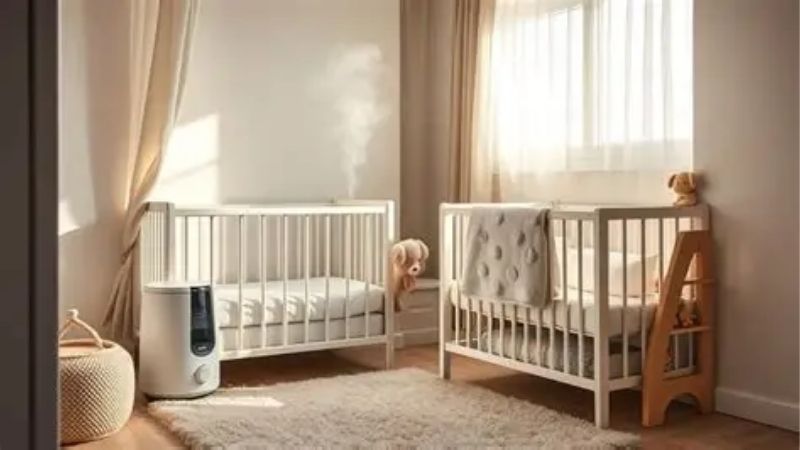
Place the unit on a hard, level surface at least 3 ft (0.9 m) from the cot, out of a child’s reach, with the cord routed so it cannot be pulled or reached. Never place a humidifier inside or hanging on the cot itself, and keep it off soft carpet where mist can dampen the floor covering.
Mist output needs clearance. Directing the nozzle at a wall, a curtain or wooden furniture leads to damp patches and eventually mould on those surfaces, so allow 12 in (30 cm) of clear space above and around the outlet. Measure the intended shelf or table before ordering, including the height needed to lift the tank out for refilling.
Cleaning, Mould and White Dust
The tank is the failure point in every humidifier. Standing water grows bacteria and mould within days, which is then dispersed into the room, so the tank should be emptied and dried daily and cleaned thoroughly every few days according to the manual. A wide tank opening that admits a hand is worth more than any smart feature.
Ultrasonic models also produce white dust when run on hard water, which is mineral residue settling on nearby surfaces. Distilled water eliminates it, and demineralisation cartridges reduce it. Evaporative models avoid white dust entirely because the wick traps minerals, at the cost of a wick that needs replacing every one to three months.
7 Cool Mist Humidifiers for a Child’s Room
The best humidifier nursery options are all cool mist, and these are chosen on ease of cleaning, tank size and noise. Amazon prices move constantly, so the tiers below are indicative rather than fixed.
| Model | Type | Tank (approx.) | Price tier |
|---|---|---|---|
| Honeywell HCM350 | Evaporative, cool mist | 1 gal / 3.8 L | Mid |
| Levoit Classic 300S | Ultrasonic, cool mist | 6 L | Mid |
| Canopy Nursery Humidifier | Evaporative, no-mist | ~2.5 L | Premium |
| Crane Drop | Ultrasonic, cool mist | 1 gal / 3.8 L | Budget-mid |
| Frida Baby 3-in-1 | Ultrasonic, cool mist | ~2.5 L | Mid |
| Levoit OasisMist 4.5L | Ultrasonic, cool mist | 4.5 L | Mid |
| Pure Enrichment MistAire | Ultrasonic, cool mist | 1.5 L | Budget |
Honeywell HCM350: The Easy-Clean Benchmark
For parents who want the best humidifier nursery option on hygiene alone, this is it: an evaporative design with a tank and parts that the manufacturer states are dishwasher-safe on the top rack, plus an antimicrobial-treated wick, makes this the least demanding unit here to keep hygienic. No white dust because the wick traps minerals.
It has a fan, so it hums at around 35-45 dB, which some parents use as white noise and others find intrusive. Wicks are a recurring consumable, typically every one to three months, and the unit is bulkier than a slim ultrasonic tower.
Levoit Classic 300S: Big Tank, App Control
A 6 L tank runs well past a full night at moderate output, and the app allows humidity targets and schedules to be set without opening the door. The top-fill design means refilling without carrying a full tank to the bathroom.
As an ultrasonic unit it produces white dust on hard water, so distilled water or a demineralisation cartridge is effectively required. The base needs regular cleaning around the transducer, which is fiddlier than a simple wick swap.
Canopy Nursery Humidifier: Designed Around Cleaning
Canopy’s approach avoids airborne mist entirely, evaporating water through a paper filter so nothing wet is projected into the room. Components are dishwasher-safe and the filter is replaced rather than cleaned, which sidesteps the main hygiene failure mode.
It is the most expensive option here and relies on a subscription-style filter replacement schedule, so factor the recurring cost. Output is gentler than a strong ultrasonic unit, which suits a small nursery better than a large room.
Crane Drop: Simple and Child-Friendly
A one-gallon tank, a single control dial and a rounded body that survives being knocked. Crane’s units are widely used in nurseries because they are inexpensive, quiet and produce a reliable 24 hours of output on the lower setting.
There is no humidistat on the basic model, so it runs at a set output rather than to a target humidity, which can over-humidify a small room. The tank opening is narrower than the Honeywell, making thorough cleaning slightly more awkward.
Frida Baby 3-in-1: Nursery-Specific Design
Built for the use case, with a detachable nightlight and a diffuser tray, and a tank that separates for cleaning. The controls are simple enough to operate in the dark without waking a sleeping child, which is a real consideration.
The tank is smaller than the large ultrasonic units, so a full night at higher output is not guaranteed. Essential oils should not be used around infants without advice from a paediatrician, so the diffuser function is best left unused in a baby’s room.
Levoit OasisMist 4.5L: Balanced Middle Ground
A 4.5 L tank, a built-in humidistat that holds a target percentage, top filling and a genuinely quiet sleep mode. Holding a set humidity rather than running at fixed output is the feature that prevents a small room becoming damp.
White dust remains a consideration on hard water, and the sensor needs the unit to be positioned away from the mist stream to read accurately. Cleaning the base is a weekly task rather than a monthly one.
Pure Enrichment MistAire: The Compact Entry
A 1.5 L tank in a small footprint at the lowest price here, with an automatic shutoff when empty and an optional nightlight. For a small nursery or as a second unit, it covers the basics without complication.
The small tank means refilling daily and it will not run a full night at higher output. There is no humidistat, and the compact base is more awkward to clean around than the larger models.
Running a Humidifier Safely in a Nursery
With the best humidifier nursery models the routine still matters more than the machine, because the risks in this category come almost entirely from maintenance and placement.
Target Humidity and Over-Humidifying
The EPA suggests keeping indoor relative humidity between 30 and 50 percent, and that range applies to a nursery as much as anywhere else. Above roughly 60 percent, conditions favour mould and dust mites, which is the opposite of the intended outcome.
An inexpensive hygrometer placed across the room from the unit tells you what is actually happening, since built-in sensors sitting near the mist stream frequently read high. If the windows are fogging in the morning, output is too high regardless of what the display says.
Cleaning Routine and Water Choice
Empty and dry the tank daily rather than topping it up, and clean the tank and base thoroughly every few days following the manufacturer’s instructions. Refilling a tank that still holds yesterday’s water is the single most common mistake in this category.
Use distilled water in ultrasonic models to avoid white dust and reduce mineral scale, and replace wicks and filters on schedule in evaporative units. A wick left past its life becomes a damp surface in a warm room, which defeats the purpose of choosing an evaporative design.
What This Is Not, and When to Buy
A humidifier is a comfort measure for dry indoor air, not a treatment for any condition. Anything to do with an infant’s breathing, congestion or sleep is a conversation for a paediatrician, and no product page should be read as guidance on those questions.
Demand for humidifiers rises sharply as heating systems come on and indoor air dries out, which means autumn and early winter are both the peak need and the peak price period. Prime Big Deal Days in early October and Black Friday and Cyber Monday in late November are the next two windows where discounts are common, and both fall before the driest months.
Frequently Asked Questions
These are the questions parents ask most often in best humidifier nursery research once the cool mist decision is settled.
Cool mist or warm mist for a baby’s room?
Cool mist, without exception. Warm mist units heat water to produce steam and present a scald hazard in a room with a child, which is why paediatric guidance consistently favours cool mist for nurseries regardless of any perceived comfort difference.
Where should the humidifier go?
On a hard, level surface at least 3 ft (0.9 m) from the cot, out of reach, with the cord secured and the mist directed into open space rather than at a wall or furniture. Never place it inside or attached to the cot.
How often does it need cleaning?
Empty and dry the tank daily and clean it thoroughly every few days per the manual. Standing water grows bacteria and mould quickly, and a humidifier disperses whatever is in the tank into the room, so cleaning is the core of safe operation.
See More:
- Best noise cancelling headphones Bose
- Best deal on air fryer
- Best buy Bella air fryer
- Best deals air fryer
- Best blender bottle
Final Thoughts on Nursery Humidifiers
The best humidifier nursery choice is cool mist, sized so the tank lasts the night, quiet enough not to wake a light sleeper, and above all easy to empty and clean by hand. Measure the shelf or table it will sit on and keep it 3 ft from the cot, use a separate hygrometer to hold 30 to 50 percent, and treat the daily clean as part of the product rather than an optional extra.
Our top picks
 Levoit Top Fill Humidifiers for Bedroom
- 𝙁𝙖𝙨𝙩 𝙃𝙪𝙢𝙞𝙙𝙞𝙛𝙞𝙘𝙖𝙩𝙞𝙤𝙣 𝘼𝙡𝙡 𝙉𝙞𝙜𝙝𝙩: Runs for up to…
- 𝙀𝙖𝙨𝙮 𝙏𝙤𝙥-𝙁𝙞𝙡𝙡 𝘿𝙚𝙨𝙞𝙜𝙣: LEVOIT listened to feedback from…
- 𝙈𝙪𝙘𝙝 𝙀𝙖𝙨𝙞𝙚𝙧 𝙛𝙤𝙧 𝘾𝙡𝙚𝙖𝙣𝙞𝙣𝙜: Easily clean the inside…


As an Amazon Associate we earn from qualifying purchases at no extra cost to you.





Write Your Review
No reviews yet. Be the first to share your experience!