
Best buy space heater searches usually start with a cold room and end in confusion, because almost every plug-in model shares the same 1,500 W ceiling. What separates them is heat delivery, safety cutoffs and noise, and this guide compares seven on those grounds.
As an Amazon Associate we earn from qualifying purchases.
By Daniel Foster
Why Almost Every Heater Claims the Same Power
Every best buy space heater comparison runs into the same electrical wall. A standard North American 120 V outlet on a 15 A circuit safely supports around 1,500 W continuous, which is roughly 5,100 BTU per hour. That electrical limit, not engineering ambition, is why nearly every plug-in heater tops out at the same figure and why coverage claims cluster around the same room sizes.
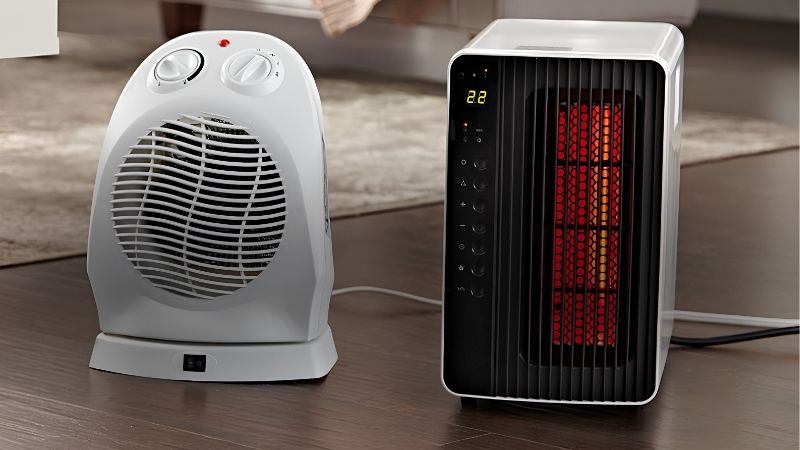
The Decisive Numbers: Wattage, Coverage and Safety Cutoffs
Wattage tells you the ceiling, and 1,500 W realistically warms 150-200 sq ft (14-19 m2) as supplemental heat rather than as a primary source. Any listing claiming to heat a much larger area from a standard outlet is describing marketing rather than physics.
Safety features are the specification that should actually decide a best buy space heater purchase. Look for tip-over shutoff, overheat shutoff and a UL or ETL listing mark, all three of which appear on reputable units and are the baseline rather than a premium feature.
Heating method changes how the warmth feels. Ceramic fan heaters raise air temperature quickly and cool quickly; oil-filled radiators warm slowly and hold heat after switching off; infrared heaters warm objects and people directly rather than the air. The right best buy space heater therefore depends on whether you want fast warmth or steady warmth.
Space and Fit: Clearance Is a Requirement, Not a Suggestion
Manufacturers and fire safety bodies consistently advise keeping at least 3 ft (0.9 m) of clearance around a running heater, free of curtains, bedding, furniture and paper. That clearance dictates placement far more than the physical footprint of the unit.
Footprints range from about 7 x 7 in (18 x 18 cm) for a small ceramic to 14 x 24 in (36 x 61 cm) for an oil-filled radiator on castors. Measure the floor area where the heater will sit including the clearance zone, then confirm a wall outlet is within the cable length, because extension leads are not appropriate here.
Electrical Safety and What Goes Wrong
Plug a heater directly into a wall outlet, never into a power strip, surge protector or extension cord, because 12.5 A of continuous draw exceeds what most of those are designed to carry. Running two heaters on the same circuit is also a common cause of tripped breakers.
The failure points are the thermostat drifting, the fan bearing becoming noisy, and the plug or outlet warming through poor contact. A plug that feels warm to the touch is a signal to stop using that outlet. Heaters appear regularly in CPSC recall notices, so it is worth checking the recall list for any model before purchase.
7 Heaters Worth Considering on Amazon
The best buy space heater for a bedroom is rarely the right one for a garage. These picks cover ceramic, oil-filled and infrared designs at different price points, chosen on safety features, noise and heat delivery. Prices change frequently, so treat tiers as approximate.
| Model | Type | Rated power | Price tier |
|---|---|---|---|
| Dreo Solaris Slim H3 | Ceramic tower | 1,500 W | Mid |
| Vornado VH200 | Ceramic vortex | 1,500 W | Mid |
| Lasko 755320 | Ceramic tower | 1,500 W | Budget |
| De’Longhi TRD40615E | Oil-filled radiator | 1,500 W | Mid |
| Dr Infrared DR-968 | Infrared cabinet | 1,500 W | Mid |
| Honeywell HCE200B UberHeat | Compact ceramic | 1,500 W | Budget |
| Heat Storm Deluxe Wall Heater | Infrared, wall-mount | 1,000 W | Budget-mid |
Dreo Solaris Slim H3: Quiet and Well-Featured
As an all-round best buy space heater for a living room or office, this is the easiest to recommend: an oscillating ceramic tower with a genuinely accurate thermostat, a low noise floor and both tip-over and overheat protection. The thermostat holding a set temperature rather than cycling wildly is the practical difference from cheaper towers.
It is taller than a small ceramic and needs a stable flat surface, and the remote is easy to lose. Like every 1,500 W unit it is supplemental heat for one room rather than a replacement for central heating.
Vornado VH200: Even Heat Across a Room
Vornado’s circulation approach moves warmed air around the whole room instead of blasting a narrow cone, which produces a more even result at a given wattage. Build quality is a clear step above the budget tier.
It has no oscillation and no remote, and the fan is always running when heating, so it is not silent. The compact footprint is an advantage in a small office where a tower would be intrusive.
Lasko 755320: The Budget Standard
A ceramic tower with oscillation, a timer and overheat protection at a price that makes it easy to put one in a second room. For occasional use in a cold bedroom it does the job without complication.
The thermostat is coarse, cycling noticeably between too warm and too cool, and the plastic housing feels light. Fan noise sits at the higher end, which some find distracting in a bedroom overnight.
De’Longhi TRD40615E: Silent, Steady Warmth
An oil-filled radiator has no fan, so it is effectively silent, and the thermal mass keeps radiating after the element cycles off. For an overnight bedroom heater, that combination is hard to beat.
It warms slowly, taking 20-30 minutes to make a difference, and it is heavy even on castors. Surface temperatures are lower than a ceramic element but still warm, so the clearance rule applies as it does to every heater here.
Dr Infrared DR-968: Cabinet Infrared With a Fan
Infrared elements combined with a blower give both radiant warmth and air movement, and the cabinet stays cooler to the touch than a bare ceramic grille. Coverage at the top of the 1,500 W range makes it suitable for a larger room or a workshop.
The cabinet is bulky and the wood-effect finish suits a garage better than a living room. Fan noise is moderate, and the remote functions are limited compared with newer app-connected models.
Honeywell HCE200B UberHeat: Small and Simple
A compact ceramic block with two heat settings, tip-over and overheat protection, sized for a footwell, a small office or a bathroom landing. It heats a small area quickly and takes almost no floor space.
There is no thermostat display and no timer, so it runs at a setting rather than to a temperature. It is not suited to a large room, and the fan is audible in a quiet space.
Heat Storm Deluxe Wall Heater: Off the Floor Entirely
Mounting on the wall removes the tip-over risk and the floor clearance problem, which is the strongest argument for this design in a small bathroom or a room with pets and children. It runs at 1,000 W, drawing less current than the others here.
Installation requires drilling and is not an option in many rentals, and lower wattage means slower heating of a larger space. Wall-mounted units also warm the wall behind them, so follow the stated clearance from the mounting surface.
Running a Heater Without Raising Your Risk
The best buy space heater is only as safe as the way it is run, and space heaters are a recurring cause of home fires, and the difference between safe and unsafe use comes down to a short list of habits.
The Rules Worth Following Exactly
Plug directly into a wall outlet, keep 3 ft (0.9 m) of clear space in every direction, place the unit on a hard level surface rather than carpet where possible, and switch it off when leaving the room or going to sleep unless the manufacturer explicitly supports unattended use.
Check that the model carries a UL or ETL mark and confirm it is not subject to a current recall before buying. Never use a heater to dry clothing, and keep it away from bedding, curtains and upholstered furniture, which is where most incidents begin.
Running Costs and Circuit Limits
A 1,500 W heater running continuously uses 1.5 kWh per hour, so eight hours a night is 12 kWh. Multiply by your electricity rate to see the real cost, which frequently exceeds what people expect and often makes better insulation or draught-proofing the cheaper intervention.
Two 1,500 W heaters on the same 15 A circuit will trip the breaker, since together they draw about 25 A. Spreading heaters across circuits, or using one heater and closing doors to concentrate the warmth, avoids the problem entirely.
On the Retailer Phrase and Buying Timing
Many people typing this phrase are browsing a particular retailer’s heater range. The models above are all available on Amazon, and where a retailer-exclusive variant exists the difference is usually the model suffix or bundled accessories rather than a different heater, so compare specifications line by line.
Heaters follow the seasonal appliance pattern rather than a fixed sale calendar, with demand and pricing rising as temperatures drop. Prime Big Deal Days in early October and Black Friday and Cyber Monday in late November both fall before the coldest weather, which makes them the more sensible windows to buy in than a cold snap in January.
Frequently Asked Questions
These best buy space heater questions come up constantly, and most trace back to the same 1,500 W limit.
Can a space heater replace central heating?
For a single room, sometimes; for a house, no. At 1,500 W the practical coverage is 150-200 sq ft (14-19 m2) as supplemental heat, and running several units simultaneously will overload circuits and cost more than most central systems.
Ceramic or oil-filled?
Ceramic if you want warmth quickly in a room you occupy for a few hours; oil-filled if you want silent, steady heat overnight. Oil-filled radiators take longer to warm a room but continue radiating after the element cycles off.
Is it safe to leave one running overnight?
Follow the manufacturer’s guidance, and where it advises against unattended operation, do not. Where overnight use is supported, use a model with tip-over and overheat protection, keep the clearance zone clear, and never run it on or near bedding.
See More:
- Best noise cancelling headphones Bose
- Best deal on air fryer
- Best buy Bella air fryer
- Best deals air fryer
- Best blender bottle
Final Thoughts on Choosing a Space Heater
Every plug-in best buy space heater shares the same 1,500 W ceiling, so the decision is really about heating method, thermostat accuracy, noise and safety cutoffs. Measure the room and the clearance zone before ordering, plug directly into a wall outlet, and check for a UL or ETL mark and any active recall. Get those right and the remaining choice is simply how you prefer the warmth to feel.
Our top picks

 Amazon Basics Ceramic Space Heater
- Choose from three settings to suit your needs…
- Weighing just 3 lbs and sized at 7.5“L…
- Built-in Tip-Over Protection, Overheat Protection, and a Power…


 Space Heater
- Efficient and Fast Heating: The indoor small-space heater…
- Wide-Angle Auto Oscillation: This portable heater supports wide-angle…
- Smart Remote Control Operation: Equipped with a remote…


As an Amazon Associate we earn from qualifying purchases at no extra cost to you.





Write Your Review
No reviews yet. Be the first to share your experience!