
Best energy-saving space heater claims deserve scrutiny, because every electric resistance heater converts essentially all the electricity it draws into heat. Savings therefore come from thermostat accuracy, zone heating and runtime control rather than from efficiency, and this guide compares seven models on exactly those terms.
As an Amazon Associate we earn from qualifying purchases.
Our top picks


 Space Heater
- Efficient and Fast Heating: The indoor small-space heater…
- Wide-Angle Auto Oscillation: This portable heater supports wide-angle…
- Smart Remote Control Operation: Equipped with a remote…


As an Amazon Associate we earn from qualifying purchases at no extra cost to you.
By Daniel Foster
Where Savings Genuinely Come From
The physics behind any best energy-saving space heater is unusually simple, which makes the marketing unusually misleading. A 1,500 watt heater draws 1,500 watts whether it is ceramic, infrared, oil-filled or micathermic, and it delivers close to the same heat either way.
Wattage, Thermostat Accuracy and Runtime: The Numbers That Decide It
On any best energy-saving space heater, wattage sets the maximum draw, and 1,500 watts is the ceiling on a standard 120 volt outlet, equal to roughly 5,100 BTU per hour. Running that for one hour consumes 1.5 kilowatt hours, and the bill follows directly from hours multiplied by rate.
Thermostat accuracy is the first real lever. A crude bimetallic thermostat can overshoot by several degrees before cutting out, then let the room drop several degrees before restarting, which wastes energy at both ends. Digital thermostats holding within about a degree cycle far less wastefully.
Runtime control is the second. Timers, eco modes that step down to 750 watts once a set point is reached, and occupancy features all reduce total hours at full draw. That reduction, not the heating element type, is what a genuinely economical unit delivers.
Space and Fit: Coverage, Placement and the Zone Heating Idea
Coverage claims should be read against room size honestly. A 1,500 watt unit maintains a small to medium insulated room of roughly 150 to 200 square feet; larger open spaces will run it continuously without reaching a comfortable temperature.
The actual saving comes from turning the central heating down and warming only the occupied room. That works when the door can be closed and the room is small, and it fails in an open plan where the heat disperses. Measure the room and decide whether zone heating is realistic before buying.
Heater Types and What They Change
Ceramic units heat air quickly with a fan and cool quickly when off, which suits short occupancy. Oil-filled radiators heat slowly and continue radiating after the element cuts out, which smooths temperature swings in a room occupied for hours.
Micathermic panels sit between the two, warming partly by convection and partly by radiation from a flat surface with no fan. They run silently, which matters in a bedroom, though they warm a room more slowly than a fan-forced ceramic unit of identical wattage.
Infrared panels warm surfaces and people directly rather than air, which feels effective in a draughty room where heated air escapes. None of these is more efficient in energy terms; they simply deliver the same heat in patterns that suit different situations.
Seven Models Compared on Control
The best energy-saving space heater candidates below are ranked by the features that actually reduce consumption. Each names a real drawback. Figures reflect manufacturer specifications and pooled owner reports rather than measurement conducted here.
1. Dr. Infrared DR-968 — Accurate Thermostat, Dual Element
A 1,500 watt infrared and convection hybrid with a digital thermostat, a 12-hour timer and a low setting at 1,000 watts. The thermostat holds temperature tightly, which is where the consumption benefit actually appears.
The cabinet is bulky and the fan is audible at high speed. It heats slowly compared with a fan-forced ceramic unit.
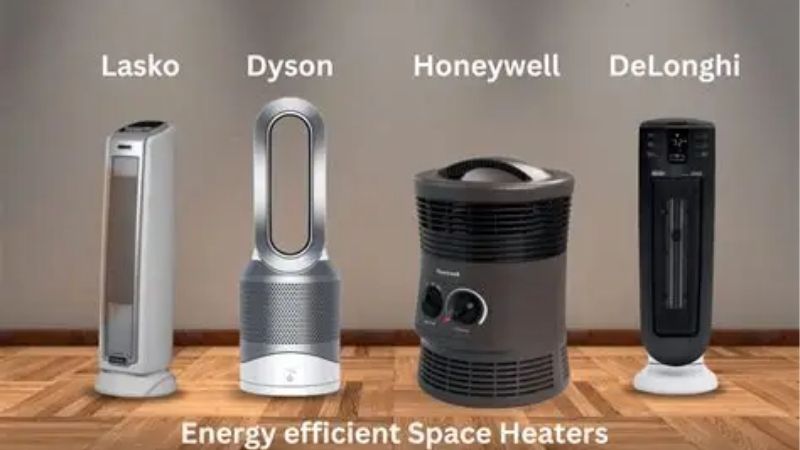
2. De’Longhi TRD40615E — Oil-Filled Thermal Mass
An oil-filled radiator with digital control and an eco mode that adjusts power to maintain a set point. Retained heat means the element runs less often once the room is warm, which suits a home office occupied all day.
It takes a long time to warm a cold room from scratch and is heavy to move between rooms. Surface temperatures are high enough to warrant care around children.
3. Dreo Solaris Slim — Precise Digital Control
A slim tower with a digital thermostat, multiple modes including an eco setting, a timer and quiet operation at lower speeds. The narrow footprint suits a bedroom or an office corner without dominating the room.
Maximum output is the usual 1,500 watt ceiling, so it will not heat a large space. App and remote features add complexity some owners will not use.
4. Vornado OSCTH1 — Circulation Rather Than Blast
Vornado focuses on moving warmed air around the whole room instead of producing a hot stream in one direction, which reduces the cold-corner effect that makes people raise the set point unnecessarily.
It is not silent and the oscillation mechanism adds moving parts. Output remains capped at 1,500 watts like everything else on a standard outlet.
5. Heat Storm HS-1500 Wall Mount — Zone Heating Without Floor Space
A wall-mounted infrared panel that warms people and surfaces directly, freeing floor space and avoiding the tip-over risk entirely. Wall mounting also keeps it away from furniture and curtains.
Installation is semi-permanent and needs an outlet nearby. Infrared warmth is directional, so it feels uneven if you move around the room.
6. Lasko Ceramic Tower with Digital Thermostat — Budget With Real Control
The economical option that still includes a digital thermostat and timer rather than a simple dial, which is the feature that separates a wasteful cheap heater from a sensible one.
Build quality is basic and the fan noise is noticeable at the high setting. Thermostat precision is good rather than excellent.
7. Dreo Atom One — Small Room and Desk Use
A compact unit sized for a desk or a very small room, where heating a few square feet around a person is far cheaper than raising the temperature of a whole floor.
Coverage is genuinely limited and it cannot serve as a room heater. The small body offers less thermal inertia, so temperature fluctuates more.
| Model | Type | Thermostat | Low setting | Best for |
|---|---|---|---|---|
| Dr. Infrared DR-968 | Infrared and convection | Digital | 1,000 W | Tight temperature holding |
| De’Longhi TRD40615E | Oil-filled radiator | Digital with eco | Variable | All-day occupancy |
| Dreo Solaris Slim | Ceramic tower | Digital | 900 W | Bedrooms and offices |
| Vornado OSCTH1 | Ceramic circulator | Digital | 750 W | Even room temperature |
| Heat Storm HS-1500 | Infrared wall panel | Digital | Variable | No floor space |
| Lasko ceramic tower | Ceramic | Digital | 900 W | Budget with control |
| Dreo Atom One | Compact ceramic | Digital | 700 W | Desk and very small rooms |
Prices move frequently across retailers, so check the current figure at the moment of purchase rather than relying on any published number.
Using One Without Raising the Bill
The best energy-saving space heater matters less than the habits around it, because a well-chosen unit used badly costs more than a basic one used deliberately, and the difference is entirely in runtime and room selection.
Habits That Actually Reduce Consumption
Close the door of the room being heated and lower the central thermostat by a few degrees at the same time. Running a space heater alongside unchanged central heating adds cost without removing any, which is the most common mistake.
Use the timer rather than leaving the unit running, and set the thermostat to a comfortable temperature rather than the maximum. Draught-proofing the room, particularly around windows and under doors, reduces required runtime more reliably than any feature on the heater itself.
Safety and What Fails Over Time
Plug directly into a wall outlet, never an extension lead or power strip, since these units draw close to the circuit limit. Confirm a UL or ETL listing and the presence of tip-over and overheat protection before buying.
Heating elements and fan motors are the wear points, with dust accumulation the main accelerant. Vacuum the intake grille periodically. Oil-filled radiators have no fan and correspondingly fewer failure modes, which contributes to their long service life.
Seasonal Demand and Buying Timing
Stock builds through early autumn and thins during the first cold snap, when popular models sell out quickly. Buying in September or early October avoids that scramble entirely and gives a wider choice of models.
Promotion clusters around Prime Big Deal Days in early October and Black Friday through Cyber Monday at the end of November, both of which land before the coldest months in most regions. January clearance is a smaller second window.
Frequently Asked Questions
These questions come up repeatedly from readers trying to identify the best energy-saving space heater rather than the most heavily marketed one.
Is infrared cheaper to run than ceramic?
Not at the same wattage. Both convert essentially all supplied electricity to heat, so a 1,500 watt unit costs the same per hour either way. Infrared can feel effective sooner in a draughty room, which may reduce runtime.
Does an oil-filled radiator save money?
Indirectly. It stores heat and continues radiating after the element cuts out, so the element runs a smaller proportion of the time once the room is warm. Over a long occupancy that reduces total consumption.
Can a space heater replace central heating?
For one closed room, often yes, and that is where any best energy-saving space heater earns its keep. Trying to heat a whole house with several units usually costs more than the central system, since electricity is typically a more expensive heat source per unit of energy.
Do eco modes make a real difference?
They do when they genuinely step wattage down rather than simply cycling the element. Combined with an accurate thermostat, that is the mechanism behind most of what any best energy-saving space heater claims to deliver.
See More:
- Best low price dash cam
- Projector screens at Best Buy
- Best buy projector screens
- Best projector for games
- Best projector for gaming
Final Thoughts on Cutting Heating Cost
The best energy-saving space heater is the one with an accurate digital thermostat, a usable timer and a real low-wattage setting, used in a closed room while the central heating is turned down. The element technology matters far less than any of that.
Measure the room, check that it can actually be closed off, and plug the unit directly into a wall outlet with a UL or ETL listing confirmed. Then draught-proof the window before deciding the heater is the problem.


Write Your Review
No reviews yet. Be the first to share your experience!