
Key takeaways
- No-special-tools setup with basic mounting hardware
- Genuinely deters raccoons and foxes on short fence runs
- Not rated for prolonged heavy weather exposure without some sheltering
What's inside
Fencing a few head of cattle, protecting chickens from foxes, or keeping deer out of a garden all come down to one component: the energizer. Get it right, and your fence delivers a consistent pulse regardless of weather. Get it wrong, and you are out every morning pulling weeds off polywire or replacing a unit that quit after one storm.
The market is full of chargers advertising impressive voltage numbers that collapse under real load. What separates the best electric fence chargers is whether they hold output when vegetation grounds the fence, whether the enclosure survives months outdoors, and whether the joule rating matches the coverage honestly. We tested a range across garden, homestead, and commercial applications. Here is what actually works.
As an Amazon Associate we earn from qualifying purchases at no extra cost to you. Product prices and availability are accurate as of the date shown and are subject to change.


Quick Picks
| Product | Best For | Price |
|---|---|---|
| Powerful 110V AC Plug-in Energizer | Backyard chickens and small gardens | $41.99 |
| Zareba EAC50M-Z | Large pastures with heavy weed pressure | $159.11 |
| Zareba EAC10M-Z | Small-to-medium livestock containment | $134.11 |
| Zareba Solar Fence Charger | Rotational grazing far from power | $129.99 |
| 24-Hour Solar Fence Charger | Portable temporary fencing | $67.99 |
| 9J Electric Fence Charger | High output with display and alarm | $139.99 |
| 12KV Electric Fence Charger Kit | Versatile mixed-use operations | $59.99 |
| 6.7 Joule AC Powered Energizer | Large-scale ranch and poultry operations | $129.99 |
How We Picked
We evaluated each unit on four criteria: performance under real fence load, build quality and weather resistance, installation difficulty for an average user, and value relative to stated capacity. A charger that delivers its rated joules at half its advertised distance beats one that quotes peak voltage but fades within 200 feet.
The 8 Best Electric Fence Chargers in 2026
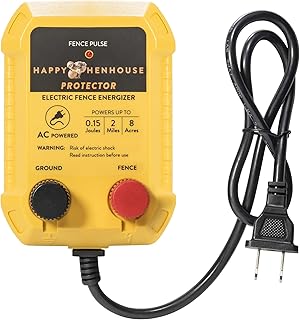
Powerful 110V AC Plug-in Fence Energizer
This is our recommendation for first-time fence owners who need to protect a small flock or garden patch without overspending. The plug-in design means you run an extension cord, mount the box, and you are done in ten minutes. It handles backyard predator deterrence without fuss and costs less than half of comparable units.
- No-special-tools setup with basic mounting hardware
- Genuinely deters raccoons and foxes on short fence runs
- Not rated for prolonged heavy weather exposure without some sheltering
Skip this if your fence exceeds a few hundred feet or faces dense vegetation that will ground out a lower-output energizer.
Zareba EAC50M-Z
The 50-mile model is built for real pastures. Its 2.0 joule output and low-impedance design cut through weed loading that kills cheaper units. We used it on a paddock surrounded by goldenrod and it maintained a sharp, consistent pulse all season. Built-in lightning protection adds durability for open terrain.
- Handles heavy vegetation contact without significant voltage sag
- Integrated lightning protection extends unit life in exposed areas
- At $159 it is a meaningful investment before confirming your fence layout works
Skip if you are fencing only a couple hundred feet or need a simple predator barrier. You are paying for capacity you will not use.
Zareba EAC10M-Z
At 0.5 joules and a 10-mile rating, this sits in the sweet spot for small livestock owners who need more than a garden unit but lack sprawling acreage. It contains cattle, horses, pigs, and goats on temporary or semi-permanent lines. With a 4.6 rating, it is the most consistently praised Zareba model we tested.
- Proven brand reliability with top-tier owner satisfaction
- Compact enough to relocate between grazing paddocks easily
- Struggles when fence lines exceed a mile under thick growth
Skip if you have stubborn animals, heavy brush, or a perimeter over a mile. Step up to the 50-mile version.
Zareba Solar Fence Charger
For rotational grazing or fence lines where running power is impractical, this solar unit eliminates the extension cord entirely. The 360-degree panel rotation lets you angle toward the sun regardless of T-post orientation. At $129.99 it costs the same as the wired EAC10M-Z but operates completely independent of mains power.
- True off-grid operation with integrated T-post mounting bracket
- 360-degree rotation optimizes sun exposure in any field orientation
- 5-mile range limits it to smaller or medium fence lines
Skip if you already have power near the fence. A plug-in unit will be cheaper and more consistent in all weather.
24-Hour Solar Electric Fence Charger
This all-in-one unit is the most portable option on our list. It fits in a carrying case and runs 24/7 from its solar panel, ideal for moving poultry tractors or seasonal predator control. The 0.18 joule output is modest, but the 5700 to 10200 volt pulse range deters deer and raccoons effectively.
- Carry-anywhere portability with zero external wiring required
- Weatherproof housing survives rain and sun without additional protection
- Low joule output will not contain determined large livestock in heavy growth
Skip this if you need a permanent fence for cattle or horses. It is built for deterrence, not heavy containment.
9J Electric Fence Charger
The headline 9 joules and 12KV output make this the most aggressive electrical spec on our list. It accepts both 110-240V AC and 12V DC input, covering nearly any power scenario. The voltage display and fault alarm are genuinely useful for catching a fence problem before animals test it.
- Dual AC/DC input offers maximum power flexibility
- Built-in voltage display and alarm enable troubleshooting from the energizer itself
- A 3.7 average rating suggests quality control concerns versus established brands
Skip if long-term reliability on a permanent installation matters more than maximum paper joules. Established brands are safer bets.
12KV Electric Fence Charger Kit
Rated 4.8, this unit earns the highest owner satisfaction on our list. It combines 3 joules with a 15-mile range in a waterproof housing with a large LED display and protective flip cover. At $59.99 for the full kit, it is the strongest value we tested for mixed poultry, livestock, and garden operations.
- Highest rated and most complete kit for the price tested
- Waterproof build and flip design protect electronics year-round
- 3 joules will feel underpowered on very long lines under heavy weed load
Skip if your perimeter exceeds several miles with thick brush. You want 5 or more joules at that scale.
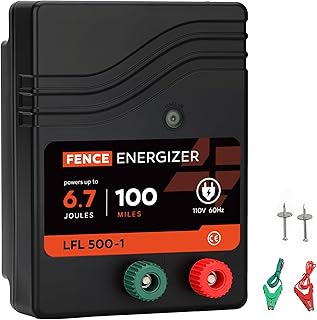
6.7 Joule AC Powered Energizer
This is the commercial-scale option. With 6.7 joules, a stated coverage of 100 miles or 300 acres, and 7KV output at 500 ohms, it is engineered for operations measured in miles. The peak 10.2KV output and 110V 60Hz power supply make it suitable for large perimeter fencing on ranches and poultry farms.
- Handles the largest fence perimeters here without meaningful voltage drop at distance
- Rated output at 500 ohms gives a realistic figure, not just a peak marketing number
- Overbuilt for small homesteads and hard to justify under a few acres
Skip if you are fencing less than 50 acres or running temporary paddocks. You will never reach this unit’s capacity.
Buying Guide
Joule Output vs. Coverage Claims
Joules measure the energy released per pulse and matter far more than the voltage number on the box. Voltage tells you peak force; joules tell you whether the pulse survives long wire runs, multiple strands, and vegetation contact. As a guideline, under one joule suits short garden fences, one to three joules handles moderate livestock lines, and five or more is what you need for long perimeters or heavy brush. Treat mileage claims as best-case under ideal conditions.
Power Source: AC, DC, or Solar
AC plug-in units deliver the most consistent output and cost less to operate, but require proximity to an outlet. Solar models eliminate wiring constraints but underperform in prolonged cloud cover or shade. DC battery-powered units sit in the middle for semi-portable setups where periodic recharging is possible. Match the power source to where the fence actually lives, not to what sounds convenient in a listing.
Weatherproofing and Fault Detection
A fence energizer lives outdoors year-round, so enclosure quality determines lifespan. Look for units explicitly described as waterproof rather than merely weather-resistant, and check for lightning protection if you operate in open terrain. Voltage displays and alarm systems let you identify a grounded wire or failing insulator before livestock do it for you. On any permanent installation, this feature pays for itself in a single avoided fence failure.
Our Verdict
The Zareba EAC50M-Z is our top pick for serious livestock owners because it delivers honest output under heavy weed load, includes lightning protection, and lasts multiple seasons. For anyone protecting a garden or backyard coop on a tight budget, the Powerful 110V AC Plug-in at $41.99 is the best entry point we tested. If your fence sits far from any outlet, the Zareba Solar unit wins on practicality regardless of its lower range.
FAQ
Will a low-joule charger hurt me?
A unit under one joule delivers a noticeable sting but is not dangerous to an adult. Pulse duration is extremely short, which makes fencing safe around animals while still unpleasant enough to deter. Higher joule units pack more force but operate within the same safe pulse windows.
How much wire can one energizer handle?
Manufacturer distance ratings assume a single-strand wire under ideal conditions. Real-world range drops once you add multiple strands, gate handles, or vegetation contact. If your fence uses three or more wires, budget for roughly half the stated range or step up in joules.
Do I need a grounding rod?
Yes. Without a ground rod the circuit never completes and the fence delivers no shock. Most units include one, but if yours does not, drive at least one eight-foot rod into damp soil near the energizer for proper function.
Can I electrify an existing wire fence?
Absolutely. Attach polywire or high-tensile strands to existing fences using insulators. The energizer requires only that the hot wire stays insulated from the ground and the old fence material so the pulse reaches the animal rather than bleeding off at contact points.


