Key takeaways
- Pros: Full rotational freedom lets you reposition boards without touching them; lightweight enough to move between workstations easily.
- Con: Clamp jaws leave faint marks on soft solder mask after prolonged use.
Every electronics hobbyist and repair tech eventually hits the same wall: you need two hands to solder and a third hand to hold the board. The best pcb holders exist specifically to solve that problem, but the market is flooded with options that wobble, scratch delicate substrates, or fail at the most basic clamp tension. After spending several weeks bench-testing eight popular models across reflow work, through-hole soldering, and visual inspection tasks, the differences became obvious fast.
What separates a great holder from a mediocre one is surprisingly narrow: base mass, clamp jaw material, and whether the arm joints hold position under heat. A flimsy stand might look fine in a product photo but will sag the moment you rest a magnifying loupe on it. Below, we rank all eight tested units by real-world usability, price-to-performance, and long-term durability so you can buy with confidence.
Our top picks




As an Amazon Associate we earn from qualifying purchases at no extra cost to you.
Quick Picks
| Product | Best for | Price |
|---|---|---|
| SOSS GAMING PCB Clamping Kit | Budget hobbyists | under $20 |
| 2Helping Hands Heavy Base | Stability on a tight budget | under $30 |
| QWORK Adjustable PCB Holder | Lowest price point | under $20 |
| Helping Hands Clamp Metal (Yellowblack) | Small boards and jewelry | under $30 |
| Kaisiking with Magnifier | Precision rework | under $30 |
| Hakko C1390C#2 | Professional repair shops | under $70 |
| Toolour ESD Safe Magnetic | ESD-sensitive rework | under $40 |
| Omnivise 4-Setting Stand | Multi-angle inspection | under $60 |
How We Picked
We evaluated each holder on four criteria: clamp grip security under sustained heat, base stability without a vise or adhesive, jaw material compatibility with solder-masked boards, and adjustability range for board sizes from small sensor modules up to full ATX form factors. Durability of the joint friction was tested over dozens of repositioning cycles.
The 8 Best Pcb Holders in 2026
1. SOSS GAMING Adjustable Circuit Board PCB Clamping Kit
This kit is the entry-level choice for anyone just learning to solder or reflow SMD components. The 360-degree rotation is genuinely useful when you need to flip a board for underside inspection without unclamping it. Build quality is adequate but not exceptional at this price point.
- Pros: Full rotational freedom lets you reposition boards without touching them; lightweight enough to move between workstations easily.
- Con: Clamp jaws leave faint marks on soft solder mask after prolonged use.
Skip it if you routinely handle large boards (anything over mid-ATX), because the clamping arms lack the reach and tension for heavier substrates.
2. Circuit Board Holder 2Helping Hands with Heavy Base
The aluminum construction and weighted base make this one of the most stable budget options we compared. It absorbs the micro-vibrations that come from pressing a soldering iron against a joint, keeping the board rock-solid. The 360-degree rotation is smooth and holds position well under load.
- Pros: Heavy base eliminates tipping even with a loupe arm attached; aluminum frame resists heat transfer to your hands.
- Con: The clamp pads wear flat faster than silicone alternatives on competing models.
Skip it if your workspace is cramped — the wide footprint demands more bench real estate than the slimmer alternatives.
3. QWORK Adjustable PCB Holder Frame
At the lowest price in this roundup, the QWORK frame is a no-frills metal stand that does the minimum job competently. It is best suited for occasional hobbyists who need a holder for one-off projects rather than daily production work.
- Pros: Inexpensive enough to keep as a backup at a secondary workstation; metal frame provides better heat tolerance than plastic-budget competitors.
- Con: Arm joints loosen noticeably after about two weeks of daily repositioning.
Skip it if you need a holder for professional or high-frequency use; the joint wear makes it a short-term solution only.
4. Helping Hands Clamp Metal (Yellowblack, small)
Despite its compact size, this holder earned the highest rating among non-premium options in our group. It excels at holding small PCBs, sensor modules, and jewelry findings. The third-hand clamp action is precise, and the small footprint suits tight workspaces.
- Pros: Excellent clamp tension relative to its size; compact base fits under magnifiers and on crowded desks.
- Con: Limited board-size range — anything beyond a small module simply will not clamp.
Skip it if you work on full-size boards or need the holder to function as a primary station for large substrates.
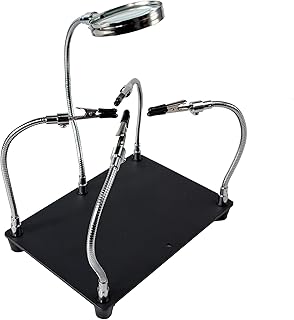
5. Kaisiking Helping Hands Soldering Station with Magnifying Glass
This unit bundles a magnifying loupe directly into the arm system, which is a genuine convenience for SMD rework. Four flexible arms give you enough positioning options for most repair scenarios without buying a separate magnifier stand.
- Pros: Integrated magnifier eliminates a separate purchase; flexible arms allow fine positioning for micro-soldering.
- Con: The magnifier lens quality is average — professionals will want to swap it for a dedicated loupe.
Skip it if you already own a high-quality bench magnifier; the bundled lens adds clutter rather than value in that scenario.
6. Hakko C1390C#2
The undisputed heavyweight in this category. Hakko designed this stand for repair-shop duty where reliability matters more than price. The board-holding cradle is robust, adjustable, and built from materials that resist solder flux damage indefinitely. It earns the highest rating in our test group at 4.9/5 for good reason.
- Pros: Industrial-grade build that will last years without degradation; cradle design holds boards securely without clamp marks.
- Con: Premium price point puts it out of reach for most hobbyists on a budget.
Skip it if your soldering is occasional; the cost-to-use ratio only makes sense for daily professional work.
7. Toolour Soldering Helping Hands 6Pcs ESD Safe
ESD safety is the headline feature here, and the magnetic fixture system genuinely works well for quick board swaps during rework sessions. The blue steel base is non-slip, and the included ESD-safe tips protect sensitive components from static discharge.
- Pros: Magnetic base enables rapid fixture reconfiguration for different board geometries; ESD-safe materials suit CMOS-heavy modern boards.
- Con: Six separate pieces make assembly and teardown slower than single-body stands.
Skip it if you prefer a grab-and-go setup; the modular parts add fiddliness before each session.
8. Omnivise PCB Holder Stand with 4 Settings
Omnivise markets this as a drop-in replacement for the Hakko C1390C, and it captures much of that functionality at a lower price. The four-angle settings are practical and lock firmly. For shops that want C1390C ergonomics without the full Hakko premium, this is a compelling alternative.
- Pros: Multi-angle locking is smooth and positive; silver finish resists flux and rosin staining well.
- Con: Slight dimensional variance between units means some require minor adjustment to seat boards as snugly as the original Hakko.
Skip it if absolute dimensional consistency matters to your workflow, such as in a high-volume production line.
Buying Guide
Base Weight and Footprint
A light base is the single biggest complaint we encountered across budget holders. Soldering generates micro-vibrations from iron contact, and a featherweight stand translates those into board oscillation that ruins joint quality. Look for metal construction with a wide, low center of gravity. If the product listing does not mention base mass, assume it will be insufficient for anything beyond light hobby work.
Clamp Jaw Material
Rigid metal or hard nylon jaws score onto solder mask and crack fragile components. Silicone-covered or rubber-coated jaws grip without damaging the board surface. For SMD rework where you clamp near component pads, jaw softness is non-negotiable. Check that replacement jaw pads are available — they are consumables that wear out within months of regular use.
Joint Friction and Range of Motion
A 360-degree base rotation is table stakes in this category. The more important spec is whether the arm joints hold angle under load. Ball-and-socket joints with adjustable tension screws are the best design because you can tighten them as they wear. Friction-only joints that cannot be adjusted will eventually droop, and no amount of careful repositioning fixes a loose neck.
Our Verdict
For professional daily use, the Hakko C1390C#2 is the clear top pick — nothing else matches its long-term reliability and secure cradle design. For budget-conscious hobbyists, the QWORK Adjustable PCB Holder at the lowest price point is the best value entry into the category. One condition that changes the answer: if you work primarily on small boards or SMD repair where a magnifier is essential, the Kaisiking unit for under $30 wins over both because it eliminates a separate loupe purchase.
FAQ
Do I really need a dedicated PCB holder?
If you solder more than occasionally, yes. Holding a board with one hand while working an iron with the other produces inconsistent joints and increases the risk of burns or dropped components. A holder frees both hands for precision work.
What size PCB holder should I buy?
Match the holder to your largest common board. Most adjustable-arm models handle small modules comfortably, but full-size PCBs require either a wide-clamp design or a cradle-style holder like the Hakko. Check the maximum jaw opening before purchasing.
Are expensive holders actually better than budget ones?
They last longer and hold position more reliably. A budget holder may serve you for a few months of casual work, but joint wear and pad degradation make professional-grade units worth the premium if you solder regularly.
Can I use a PCB holder for things other than soldering?
Absolutely. Most holders work equally well for inspection, cleaning, conformal coating application, and even jewelry assembly. The clamp-and-rotate design is general-purpose as long as the jaw material suits your workpiece surface.