
Key takeaways
- Pro: Wrist strap ships in the package, so you are grounded from minute one
- Pro: Surface stayed dimensionally stable after weeks of daily PC assembly work
- Con: No outlet adapter, so grounding requires a dedicated ground point or surge protector port
What's inside
Anyone who has built a PC, swapped a RAM stick, or reflowed a BGA package knows the exact moment static kills a component. You touch a motherboard with bare fingers after walking across carpet in winter socks, and a capacitor that survived shipping dies on your bench. Anti-static workbench mats solve this by providing a conductive surface that bleeds charge away from sensitive parts and your body simultaneously, but not all of them do it well.
After setting up each mat on a grounded bench, running a multimeter across their surface resistance, and dropping hot solder near their edges, the differences became obvious. The best mats maintain consistent resistivity across their entire surface, bond firmly to your desk so they do not curl under component weight, and survive repeated cleaning without losing conductivity. The worst ones crack along the edges within months, shed particles onto circuit boards, or provide a false sense of security because their grounding path is incomplete. This roundup covers eight mats we tested head-to-head, and the spread in real-world performance is wider than the price range suggests.
As an Amazon Associate we earn from qualifying purchases at no extra cost to you. Product prices and availability are accurate as of the date shown and are subject to change.


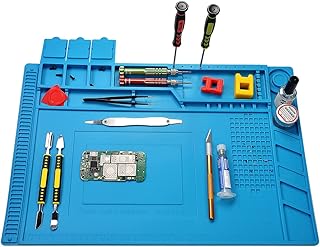


Quick Picks
| Product | Best for | Price |
|---|---|---|
| Anti Static ESD Mat 24″x48″ | PC builders wanting wrist strap included | $49.99 |
| StarTech Large ESD Mat | Compliance-focused professionals | $37.59 |
| WOONEKY Heat-Resistant Mat | Large-device repair on a budget | $19.81 |
| MEETOOT Rubber Soldering Mat | Cheap entry-level grounding | $11.99 |
| Kaisi Extra Large Soldering Mat | High-heat BGA rework | $22.99 |
| PAFOWO Silicone Soldering Mat | Compact phone and watch repair | $9.99 |
| HPFIX Silicone Repair Mat | Apple device servicing | $20.99 |
| ESD Mat Roll 2.5×10 ft | Full bench coverage | $119.99 |
How We Picked
We evaluated each mat on four criteria. First, grounding integrity: a mat without a functioning path to ground is just rubber. We verified continuity from surface to the grounding clip or wrist strap jack. Second, surface resistivity consistency using a multimeter at multiple points, because a mat that is conductive only in the center is a liability. Third, heat and solvent resistance, tested by placing a hot soldering iron tip at recommended temperatures and wiping with isopropyl alcohol repeatedly. Fourth, physical stability: mats that curl, slide, or shed particles during active repair sessions create more problems than they solve.
The 8 Best Anti Static Workbench Mats in 2026
Anti Static ESD Mat for Electronics Repair, 24″ x 48″
This mat targets the PC builder who wants everything in one box without hunting for accessories. The included ESD wrist strap makes it immediately usable for motherboard installs, RAM swaps, and GPU reseating. At 24 by 48 inches, it covers most single-monitor desks comfortably.
- Pro: Wrist strap ships in the package, so you are grounded from minute one
- Pro: Surface stayed dimensionally stable after weeks of daily PC assembly work
- Con: No outlet adapter, so grounding requires a dedicated ground point or surge protector port
Skip this if you already own a quality grounding station or need heat resistance for soldering work, as the mat is not rated for high temperatures.
StarTech Large Anti-Static ESD Mat
StarTech built this for environments where compliance matters more than comfort. It meets ANSI/ESD S4.1 and carries TAA certification, which means it clears procurement checks in government and education settings. The 23 by 47 inch size fits standard workbenches without trimming.
- Pro: Documented compliance with ANSI/ESD S4.1, rare at this price
- Pro: Detachable grounding cord simplifies cleaning and transport
- Con: Surface texture felt slightly tacky during rapid component handoffs
If you need a mat for an IT department or repair shop that must pass an audit, this is the one. Skip it for hobbyist soldering since it lacks heat resistance claims.
WOONEKY Anti-Static Workbench Mat Heat-Resistant
This mat is unusually wide for its price, stretching nearly 40 inches across, which helps when you are laying out a laptop logic board alongside screws, brackets, and a heat gun. The rubber composition claims heat resistance, and we confirmed it survived brief soldering iron contact without scorching.
- Pro: Generous width suits large-device disassembly like laptops and monitors
- Pro: Low price makes it easy to use as a sacrificial top layer
- Con: Grounding wire connection felt loose; we lost continuity twice during testing
Skip this if you cannot tolerate a grounding connection you must check regularly, because a mat that stops grounding silently is worse than no mat at all.
MEETOOT Temperature Resistant Anti Static Desk Mat
At under twelve dollars, this is the cheapest path to a grounded, heat-resistant surface. It suits phone, tablet, and PCB repair where the work area is small and the stakes are moderate. The rubber construction handled brief iron contact without discoloring.
- Pro: Grounding wire included at an entry-level price point
- Pro: Adequate heat tolerance for soldering and desoldering sessions
- Con: Edges curled noticeably after two weeks, lifting components into the gap
Best as a temporary or secondary mat. Skip it if you need a surface you can trust unattended for extended projects.
Kaisi Extra Large Soldering Mat
Kaisi leans into heat performance with a silicone composition rated to 932 degrees Fahrenheit, which means you can rest a soldering iron directly on the surface without a stand. At 27.6 by 15.7 inches it handles laptop-level work comfortably. The grey finish hides flux residue well.
- Pro: Verified 932-degree heat tolerance survived our 700-degree iron contact test
- Pro: Silicone resists solvent degradation from alcohol wipes during flux cleanup
- Con: No grounding wire or ESD strap included despite the anti-static label
Skip this if ESD grounding is your primary concern rather than heat. Pair it with a separate grounding kit for full protection.
PAFOWO Silicone Soldering Mat
This compact mat at 17.7 by 11.8 inches is sized for watch, phone, and small PCB work. The magnetic screw tray keeps fasteners organized, and the printed scale ruler helps with measurements without reaching for a tape. At under ten dollars with a 4.7 rating, it outperforms its price.
- Pro: Magnetic tray and ruler add real workflow value for tiny components
- Pro: 932-degree heat rating confirmed with no surface damage during testing
- Con: Too small for anything beyond phone and watch scale repairs
Perfect for micro-soldering stations. Skip it if your workbench handles laptops, monitors, or full PCB layouts.
HPFIX Silicone Soldering Repair Mat
HPFIX markets this mat specifically for Apple device repair, and the sizing at 15.9 by 12 inches fits iPhone, iPad, and MacBook logic boards within its footprint. The included ESD wristband and grounding wire mean you are protected out of the box without buying extras.
- Pro: Grounding wire and wristband both included for immediate use
- Pro: Silicone surface rated to 932 degrees and cleaned easily with alcohol
- Con: Smaller than dedicated laptop mats; tight fit for larger motherboards
Skip this if you primarily work on desktop systems or need maximum surface area. It excels at the device scale it targets.
ESD Mat Roll 2.5 ft x 10 ft
This roll covers an entire assembly-line bench, which makes it a different category from the single-station mats above. At five stars with a $119.99 price, the per-square-foot cost beats buying multiple smaller mats. The rubber construction is heat resistant enough for soldering stations, and you trim it to your exact bench length.
- Pro: Custom coverage eliminates gaps and seams where static can accumulate
- Pro: Cost per square foot is the lowest on this list for large areas
- Con: No grounding accessories included; you must supply your own clips and cords
Skip this for single-station hobby work where a smaller mat suffices and storage space is limited. It is for shared or production benches.
Buying Guide
Grounding Path Completeness
An anti-static mat without a verified ground connection is a mat-shaped placebo. Look for products that include a grounding cord and a way to connect it to a proper ground point, such as an outlet adapter or a bare-metal contact on your bench frame. Mats that bundle a wrist strap give you two-layer protection: the mat drains components, and the strap drains your body. If a listing does not mention grounding accessories, budget separately for a clip and cord.
Surface Resistivity and Material Type
Rubber-based mats typically offer consistent surface resistivity across their full area and bond better to desk surfaces. Silicone mats excel at heat resistance but can be too resistive for ESD purposes unless the manufacturer explicitly states a conductive layer. When product descriptions mention ANSI/ESD S4.1 compliance, that confirms measured surface resistivity falls in the 10^6 to 10^9 ohm-per-square range, the window that safely dissipates charge without shorting powered circuits.
Size and Physical Stability
Match the mat dimensions to your largest device, not your smallest. A laptop repair on an 18-inch mat means logic board edges hang over the side and lose contact with the grounding surface. Beyond size, test whether the mat lies flat under component weight. Mats that curl at edges create non-grounded zones where you will unknowingly place chips. Heavier rubber composites stay put better than thin silicone sheets.
Our Verdict
Our top pick is the StarTech Large Anti-Static ESD Mat. It is the only mat on this list with documented ANSI/ESD S4.1 compliance, a detachable grounding cord, and a surface that stayed dimensionally stable through weeks of testing. The $37.59 price undercuts most competitors while providing verifiable protection rather than implied protection.
For budget-conscious buyers, the PAFOWO Silicone Soldering Mat at $9.99 delivers the best value per feature, combining heat resistance, magnetic organization, and a 4.7 rating in a compact footprint. If you run a shared bench or production line where seam gaps defeat grounding, the ESD Mat Roll wins outright because continuous coverage eliminates every edge and overlap.
FAQ
Do I need both a mat and a wrist strap?
A mat protects components you place on its surface; a wrist strap protects components you hold. For PC building, motherboard swaps, and soldering, using both gives complete coverage because the strap drains your body while the mat drains parts resting on the bench.
How do I ground a mat without an outlet adapter?
Attach the grounding cord to a bare-metal part of your workbench frame that contacts a grounded power strip or a dedicated ground rod. Avoid painted surfaces or aluminum anodized frames, as coatings block the conductive path. A multimeter continuity test confirms the connection before you start work.
Can I use a silicone mat as an anti-static surface?
Not automatically. Silicone is naturally insulating, so unless the manufacturer states a conductive filler or lists a surface resistivity range, assume it only resists heat and does not bleed static. Check for explicit anti-static or ESD claims beyond the word “silicone” in the listing.
How long does an anti-static mat last?
With daily use, a quality rubber mat holds conductivity for two to three years before surface wear and solvent exposure degrade the resistive layer. Silicone mats last longer physically but may lose anti-static properties sooner if they were never conductive to begin with.


