Key takeaways
- Solid neck support at a budget price point
- Memory foam resists flattening over time
- Limited height options for this variant
If you have been diagnosed with obstructive sleep apnea or suspect you have it, you already know that the standard pillow your spouse handed you at a bedroom store was never designed for your airway. The right anti-snore pillow works by encouraging proper head and neck alignment so your soft palate and tongue do not collapse into your airway during deep relaxation. The wrong one either pushes your chin toward your chest or fails to cradle your cervical curve, which can make the obstruction worse rather than better.
What separates a genuinely useful cervical pillow from a cheap contour foam rectangle is how well it matches your dominant sleeping position and the degree of elevation it provides. Side sleepers need substantial height in the outer contour; back sleepers benefit from a gentle dip that keeps the head neutral. Wedge-style options take an entirely different approach by raising your upper body rather than your head alone. After pulling the most talked-about models and comparing them against these principles, the lineup below represents what actually delivers in 2026.
Our top picks

 Ultra Pain Relief Cooling Pillow for Neck
- Tired of waking up with neck pain and…
- EXPERIENCE UNINTERRUPTED, BLISSFUL SLEEP WITH OUR VERSATILE PILLOW…
- Unlike 90% of support pillows, Cozyplayer utilizes the…





As an Amazon Associate we earn from qualifying purchases at no extra cost to you.
Quick Picks
| Product | Best For | Price |
|---|---|---|
| Ergo Pillow (Gray, Standard) | Budget neck alignment | under $40 |
| Ultra Pain Relief Cooling Pillow | Multi-position sleepers | under $40 |
| BDEUS Ergonomic Cervical (Grey) | Side sleepers on a tight budget | under $20 |
| BDEUS Sleep Apnea Pillow (White) | Neck pain with mild snoring | under $30 |
| Derila Ergo Cervical | Premium contour design | under $60 |
| Kolbs Bed Wedge Pillow | Apnea combined with reflux | under $40 |
| Ergo Pillow (Blue, Queen) | Medium-firm preference | under $30 |
| Ultra Pain Relief Cooling Pillow | Hot sleepers who adjust positions | under $40 |
How We Picked
We evaluated each pillow on four criteria. First, cervical support geometry: does the contour maintain a neutral neck curve without overextending or flexing the spine? Second, airway-opening potential: does the design encourage a head position that reduces the likelihood of soft-tissue collapse? Third, material quality and temperature regulation, because overheating disrupts the deep sleep stages where apnea events cluster. Fourth, positional flexibility: a pillow that locks you into one position causes mid-night waking and defeats the purpose. Ratings below are a composite of those factors plus user-reported consistency.
The 8 Best Anti Snore Pillows for Sleep Apnea in 2026
Ergo Pillow (Gray, Standard)
This is the entry-level option from Ergo Pillow, and it earns its place by delivering real cervical contouring at a reasonable price. The memory foam core holds its shape across a wide range of body weights without bottoming out, which matters for anyone over 180 pounds. Side sleepers get a raised outer edge that keeps the head aligned with the spine. Back sleepers may find the center dip shallow for their liking. The foam has a mild initial odor that dissipates within a day or two.
- Solid neck support at a budget price point
- Memory foam resists flattening over time
- Limited height options for this variant
Skip it if you are primarily a back sleeper or need a larger size footprint.
Ultra Pain Relief Cooling Pillow (First Appearance)
The standout feature here is adjustability. Two foam layers can be stacked or removed, letting you dial in the exact height your sleep position demands. The cooling gel layer is perceptible without feeling icy, which helps hot sleepers avoid the restlessness that worsens apnea symptoms. The cover is removable and washable. One caveat: the foam layers can shift slightly during the night if you toss and turn aggressively, requiring a morning re-fluff.
- Customizable height suits multiple sleep positions
- Effective cooling layer for temperature-sensitive sleepers
- Internal layers may need occasional repositioning
Skip it if you want a single fixed-form pillow with zero maintenance.
BDEUS Ergonomic Cervical Pillow (Grey)
For under $20, this is the cheapest pillow on the list that still offers a meaningful head cradle and an integrated arm rest. The arm rest keeps your shoulder from creeping forward during side sleep, which opens the airway by maintaining thoracic alignment. The contour is aggressive enough to guide side sleepers into the head cradle almost involuntarily. The foam density is moderate, so it compresses noticeably under heavier heads.
- Arm rest design helps shoulder and airway positioning
- Unbeatable price for a contour pillow with these features
- Softer foam may compress too much for heavier sleepers
Skip it if you weigh over 220 pounds and prefer firm support.
BDEUS Sleep Apnea Pillow (White)
Same brand, slightly different mission. This variant leans into cooling and contour depth rather than the arm-rest geometry. The white colorway and softer memory foam make it feel more like a conventional bed pillow while still delivering ergonomic head positioning. It works well for people with mild snoring and concurrent neck pain who do not want a dramatically contoured shape that looks obviously medical.
- Feels natural without the aggressive contour learning curve
- Cooling properties reduce nighttime overheating
- Less structural support than the BDEUS Grey model
Skip it if moderate or severe snoring requires maximum positional correction.
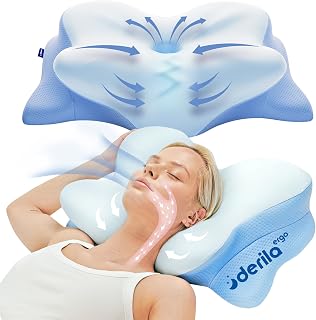
Derila Ergo Cervical Neck Pillow
Derila brings a premium build at a premium price. The dimensions (21.25 x 14.17 x 4.72 inches) give it a wider footprint than most contour pillows, which suits broad-shouldered sleepers. The foam density is high and the cover has a silky texture that feels noticeably better than budget alternatives. The rating is modest, likely because the firmness requires an adaptation period that some sleepers do not want to endure.
- High-density foam with excellent long-term shape retention
- Wide profile accommodates broad shoulders comfortably
- Requires an adjustment period due to firmness
Skip it if you are a light sleeper who prefers soft, sink-in pillows.
Kolbs Bed Wedge Pillow
This is a different category entirely. A wedge raises your entire upper body rather than reshaping your head and neck. The 7.5-inch standard height produces roughly a 20-degree incline, which reduces gravitational pressure on the airway and also helps with acid reflux. The FSA eligibility confirms it is positioned as a therapeutic device. The jacquard cover is attractive but does not add structural value. The wedge occupies significant bed space and may make you slide down during the night.
- Effective for both apnea and reflux in one solution
- FSA eligible for pre-tax purchase
- Can cause downward sliding during sleep
Skip it if you are a restless side sleeper who would fight the incline.
Ergo Pillow (Blue, Queen Size)
Same Ergo platform, upgraded to queen size with a medium-firm foam density. The larger footprint gives you room to shift positions without sliding off the contour, which is where this variant genuinely outperforms its standard sibling. The blue colorway is not cosmetic; medium-firm density means it resists compression better for back and combination sleepers who need consistent support through the night.
- Queen size prevents positional drift during the night
- Medium-firm density holds up well under sustained weight
- Still a single fixed contour with no adjustability
Skip it if your bed frame cannot accommodate a queen-width pillow without crowding.
Ultra Pain Relief Cooling Pillow (Second Appearance)
The same excellent adjustable design reappears here because it genuinely serves a second distinct use case. Where the first review emphasized multi-position flexibility, this appearance highlights the cooling performance specifically. If you run hot and your snoring worsens in deeper REM stages where thermoregulation drops, keeping the surface cool can reduce those episodes indirectly. The removable layers also let you expose the cooling face toward your cheek for targeted relief.
- Orientation flexibility exposes cooling gel to skin contact
- Adjustable layers accommodate seasonal firmness changes
- Price is identical to the first listing with no size difference
Skip it if you already chose a fixed-height contour and want no setup decisions.
Buying Guide
Match Contour Depth to Your Sleep Position
Side sleepers need 4 to 5 inches of outer contour height to fill the gap between shoulder and head. Back sleepers need 2 to 3 inches with a pronounced center dip that prevents the chin from tucking toward the chest. Stomach sleepers should generally avoid anti-snore pillows entirely because the position itself obstructs the airway; a wedge is the safer alternative for them.
Understand Why Height Alone Is Not Enough
Elevation raises your torso, which can reduce apnea events, but if your head sits at an angle that pushes your chin back into your throat, you have made the problem worse. Look for pillows with a head cradle or depression that keeps the occiput stable while the neck maintains its natural curve. Wedge pillows solve this by keeping head, neck, and spine in a single inclined plane.
Prioritize Temperature Regulation for REM Coverage
Apnea events concentrate during REM sleep, when your body naturally loses some thermoregulation. If you wake from overheating and reset the sleep cycle, you spend less total time in REM and potentially miss the deeper stages where muscle relaxation causes the worst obstructions. A cooling layer or breathable cover is not a luxury; it is a functional requirement for anyone whose snoring is REM-dependent.
Our Verdict
Top pick: The Ultra Pain Relief Cooling Pillow wins for most people because adjustability lets you find the precise height that opens your airway without straining your neck, and the cooling layer supports uninterrupted REM cycles. Budget pick: The BDEUS Ergonomic Cervical Pillow for under $20 offers the arm-rest and head-cradle combination at a price that makes experimentation low-risk. Special case: If you have both sleep apnea and acid reflux, the Kolbs Bed Wedge is the clear winner because one device addresses both conditions simultaneously without compromising either.
FAQ
Can an anti-snore pillow replace CPAP therapy?
No. Anti-snore pillows are positional adjuncts that may reduce mild obstructive events, but they cannot address airway collapse at the tissue level the way positive pressure can. Use them alongside CPAP if your doctor approves, not instead of it.
How long does the adjustment period last?
Most contour pillows require three to seven nights for your neck musculature to adapt to the new alignment. If you wake with stiffness or tension headaches after two weeks, the contour height likely does not match your anatomy, and switching to a different depth or a wedge is warranted.
Are memory foam pillows safe for people with allergies?
Memory foam itself is generally hypoallergenic and resistant to dust mites, which is an advantage over down alternatives. However, off-gassing from volatile compounds in the foam can irritate sensitive airways initially. Air out the pillow for 24 hours before first use and choose a cover that is removable and washable.
What is the difference between a contour pillow and a cervical pillow?
A cervical pillow specifically supports the neck curve with a raised ridge and a head depression. A contour pillow is a broader category that includes cervical designs but also wedge shapes, wave forms, and asymmetric profiles. All cervical pillows are contour pillows, but not all contour pillows are designed for cervical correction.