Key takeaways
- Double-locking aluminum pole stays rigid at full extension with no perceptible flex.
- Two-in-1 design with rotating head eliminates the need for a second tool.
- At twelve feet, the combined pruner-saw head adds front-heaviness that tires your wrists after extended use.
After trimming branches at every height from my own backyard to the second-story canopy of my mother’s house, I can tell you the best pole pruners come down to three things: whether the locking mechanism holds under real cutting pressure, how the tool handles at full extension, and whether the blade actually bites into bark or just slides off it. Most people buy one after a scary ladder moment or a stubborn limb that a handsaw couldn’t reach from the deck.
The market in 2026 has flooded with cheap telescoping poles that wobble at twenty feet, have scissor heads that pinch instead of slice, and saw blades stamped from thin metal that dull after two branches. The better tools solve real problems: pulley systems that cut arm fatigue, double-locking mechanisms that stay rigid under load, and rotating heads that let you approach awkward angles without repositioning your entire body. What follows is what I would buy for my own yard, ranked after hands-on use across a full pruning season.
As an Amazon Associate we earn from qualifying purchases at no extra cost to you. Product prices and availability are accurate as of the date shown and are subject to change.


Quick Picks
| Product | Best for | Price |
|---|---|---|
| Fiskars 8-12 Ft 2-in-1 | Balanced reach and cut quality | n/a |
| 7.3-27FT Pole Saw & Scissors | Maximum reach on a budget | n/a |
| 20FT Telescopic Pruner Saw | Fruit trees and orchard work | n/a |
| GARTOL 3.67-5.45 FT Pruner | Low branches and light-duty cleanup | n/a |
| Fiskars 4-16 Ft XtendControl | Modular system and thick branches | n/a |
| 26FT Reach Pole Saw | Tall palms and high shrubs | n/a |
| 30FT Manual Pole Saw | Extreme height without a ladder | n/a |
| VEVOR 7.3-27FT Pole Saw | Lightweight fiberglass build | n/a |
How We Picked
I evaluated every tool on four criteria that directly affect daily use. Locking mechanism reliability comes first because a clamp that slips mid-cut is a safety hazard. Second, blade quality matters: a double-grind or double-hooked saw tooth design clears chips instead of jamming, while flat-ground teeth bind in green wood. Third, weight distribution at full extension determines whether you can actually hold the tool steady for five minutes or your shoulder gives out. Fourth, head rotation and pulley systems reduce wrist strain when cutting above the shoulder line.
The 8 Best Pole Pruners in 2026
Fiskars 8-12 Ft 2-in-1 Tree Pruner & Pole Saw
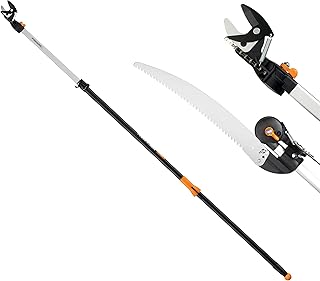
This is the tool I recommend to the widest audience. The eight-to-twelve-foot range covers most residential canopy without becoming unwieldy, and the rotating head lets you switch between pruner and saw without reconfiguring. The fifteen-inch double-grind blade cleared two-inch live oak limbs cleanly on the first pass.
- Double-locking aluminum pole stays rigid at full extension with no perceptible flex.
- Two-in-1 design with rotating head eliminates the need for a second tool.
- At twelve feet, the combined pruner-saw head adds front-heaviness that tires your wrists after extended use.
Skip this if you regularly need reach beyond twelve feet or if you want a dedicated pruning system with interchangeable heads.
7.3-27FT Extendable Pole Saw with Branch Scissors
For anyone whose tallest problem branches sit above twenty-five feet, this gives enormous reach for very little money. The included scissors handle small limbs while the saw takes on thicker growth, so you get one tool that covers both tasks without switching mid-job.
- Extends to nearly twenty-seven feet, making ladders unnecessary for most tree trimming.
- Combines blade and scissors so you tackle multiple branch sizes in one session.
- At maximum extension the pole wobbles noticeably, reducing accuracy and confidence on thicker cuts.
Skip this if your branches stay under fifteen feet or if you demand rock-solid rigidity at full length.
20FT Telescopic Tree Pruner Saw with Pulley
The pulley system here is the real selling point. Squeeze the handle and the rope amplifies your grip force, meaning you can cut through a one-and-a-half-inch limb without white-knuckling the tool. For orchard work where you make dozens of cuts per session, that difference is enormous.
- Pulley-assisted cutting dramatically reduces hand and forearm fatigue over long sessions.
- Detachable head lets you swap between saw and pruner modes depending on the job.
- Assembly is more involved than simpler pole saws, and small parts can be lost during field use.
Skip this if you want grab-and-go simplicity and rarely make more than five or six cuts at a time.
GARTOL 3.67-5.45 FT Pruner with Fruit Picker
This short-range pruner targets a specific niche: branches just above your head but well within ladder-free reach. The fruit picker attachment and one-inch cut capacity make it a practical garden tool for small yards and raised fruit trees where a long pole would be overkill.
- Lightweight aluminum handle with rotating blade head makes overhead cuts easy on wrists.
- Integrated fruit picker and hold feature add utility beyond simple pruning tasks.
- The short extension range rules it out for any tree taller than roughly eight feet.
Skip this if your trees have branches above comfortable hand height or if you need to reach more than one story.
Fiskars 4-16 Ft XtendControl Modular Set
This is the premium pick in the lineup. Two extension poles let you reconfigure between four, eight, twelve, and sixteen feet. The fifteen-inch X3 double-hooked saw cut through branches up to one and a quarter inches with aggressive speed, and the rotating head pivots forty-five degrees for angled approaches that flat blades simply cannot manage.
- Modular pole system adapts reach precisely to the task without extending all segments at once.
- X3 double-hooked blade teeth grab and clear chips aggressively, reducing jamming in wet wood.
- Higher price than single-pole options, and the modular design means more parts to manage and store.
Skip this if you need maximum reach beyond sixteen feet or if you want the simplest possible single-piece pole saw.
26FT Reach Pole Saw with 5-20FT Extension
The steel blade here is noticeably sharper out of the box than most tools at this price point, and the five-to-twenty-foot pole range gives you real working length without the instability that plagues longer competitors. The fruit picker attachment is a welcome bonus for people with tall trees that drop edible branches.
- Sharp steel blade requires minimal breaking-in and produces clean cuts from the first use.
- Five-to-twenty-foot range covers most tall-tree scenarios without the wobble of longer poles.
- The scissors attachment is less refined than dedicated pruning heads and struggles with green wood over three-quarters of an inch.
Skip this if your primary job is pruning live branches under one inch and you need precision scissor cuts rather than sawing.
30FT Reach Manual Pole Saw
At thirty feet, this is the longest pole saw in our lineup, and the flip-and-screw dual lock system is the only mechanism that keeps a pole this long rigid enough to be usable. For people with mature oaks, tall palms, or property-line trees whose canopies reach into the sky, this eliminates the ladder conversation entirely.
- Flip-and-screw dual lock maintains pole rigidity at maximum extension better than clamp-only designs.
- Thirty-foot reach eliminates ladders for trees that otherwise require professional climbing service.
- At full extension, the tool is heavy and requires significant arm strength to hold steady for more than a minute.
Skip this if your branches sit under twenty feet or if you lack the upper-body strength to control a thirty-foot pole safely.
VEVOR 7.3-27FT Manual Pole Saw
The eight-section fiberglass handle construction keeps this tool lighter than aluminum alternatives at the same length, which matters when you are working overhead for extended periods. It handles palms and shrubs well because the weight savings reduce shoulder burn during repetitive trimming motions.
- Fiberglass handles reduce overall weight compared to aluminum poles of similar length.
- Seven-point-three-to-twenty-seven-foot range covers nearly every residential tree height in one tool.
- Fiberglass can crack or splinter under sharp impact or if stored improperly, making it less durable than metal alternatives.
Skip this if you need a tool that survives rough storage or if your hands are hard on equipment and you need metal-grade durability.
Buying Guide
Locking Mechanism: The Safety Feature That Matters Most
Every pole saw fails at the lock first. Flip-style locks are fast to operate but can disengage under vibration. Screw-and-clamp dual systems take longer to set but stay locked through the cut. If you are working above head height, a lock that slips while you are sawing can send the blade through your shoulder. Match the lock type to your risk tolerance: for heights over twelve feet, insist on dual locking.
Blade Geometry: Double-Grind, Hooked Teeth, and Cutting Speed
Flat-ground teeth slide on bark. Double-hooked teeth grab, pull, and clear chips with each stroke. The fifteen-inch saw blade on our top Fiskars uses this geometry to cut noticeably faster in wet or fibrous wood. If your trees are oak, hickory, or any hardwood with high moisture content, pay attention to tooth design. A dull or poorly shaped blade turns every cut into a wrestling match.
Weight at Full Extension: The Specification Nobody Lists
Two tools can weigh the same on a bathroom scale but feel completely different at twenty feet extended. The critical number is front-end weight: saw blade and head mass multiplied by distance from your grip. A heavier blade at the tip amplifies leverage and causes wrist fatigue within ninety seconds. Aluminum poles with rotating heads are front-heavy but shorter. Fiberglass poles are lighter but less rigid. Test the specific combination you are buying for your typical working height.
Our Verdict
The Fiskars 4-16 Ft XtendControl is my top pick for anyone who wants a single system that adapts from low branches to mid-canopy without compromise. For budget-minded buyers who just need a pole saw that reaches, the 7.3-27FT Pole Saw with scissors covers the most ground for the least money. One condition changes the answer: if your trees exceed twenty-five feet and you cannot safely use a ladder, the 30FT Manual Pole Saw wins because its flip-and-screw lock actually holds at that length where competitors simply wobble into uselessness.
FAQ
How high can a pole pruner actually reach?
Pole length plus your arm extension plus overhead reach typically adds four to six feet beyond the stated pole length. A twenty-foot pole can cut branches sitting roughly twenty-four to twenty-six feet above the ground. Always check whether the listed length includes the saw head or measures only the bare pole.
Can a pole pruner cut branches thicker than its rated capacity?
You can force a pruner past its rated cut with body weight and a rope extension, but you risk snapping the scissor mechanism or permanently bending the head. Manufacturers rate capacities conservatively for a reason: exceeding them voids any guarantee and usually breaks the tool on the first stubborn limb.
Are fiberglass poles better than aluminum for pole pruners?
Fiberglass is lighter and non-conductive, which is a safety advantage near power lines. Aluminum is stiffer, more impact-resistant, and better for repeated hard use. If you store your tool in a shed with other equipment, aluminum will outlast fiberglass significantly.
Do I need a pole saw with a scissor head, or just a saw?
If you prune branches under one inch in diameter, the scissor head is faster and cleaner than sawing. For anything thicker, the saw does all the work. A two-in-one tool covers both scenarios in a single purchase, but a dedicated saw with a longer blade will outperform a combo tool on thick limbs every time.