Key takeaways
- Pro: Lowest barrier to entry if you are unsure whether this category is worth the investment
- Pro: Remote control lets you steer it to problem spots without reaching across a wide window
- Con: 3000Pa is noticeably weaker than the rest of this list for large or textured glass
What's inside
If you have large floor-to-ceiling windows or a sunroom with full-height glass, you already know the frustration. A squeegee on a 6-foot pane means a ladder, a bucket, and an hour of your weekend — and you still end up with streaks on the upper half because your arm gets tired. Robotic window cleaners were supposed to fix this, but early models were underpowered, missed corners, or fell off the glass in a dramatic and expensive way.
The category has matured significantly. Modern units with adaptive suction, ultrasonic water spray, and intelligent navigation handle large single panes without requiring babysitting. The real question now is which robot actually cleans the entire surface in one pass versus which one looks good in a product video and leaves half the glass untouched.
As an Amazon Associate we earn from qualifying purchases at no extra cost to you. Product prices and availability are accurate as of the date shown and are subject to change.



Quick Picks
| Product | Best for | Price |
|---|---|---|
| Automatic Window Cleaning Robot SS1 | Budget-conscious first-time buyers | n/a |
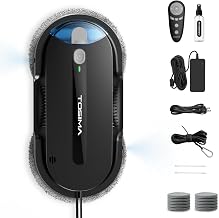
| Tosima X1 | Visible water management | n/a |
| Window Cleaning Robot Double Helix | Maximum suction on tall panes | n/a |
| WA9C Pro | Versatile surface coverage | n/a |
| ECOVACS WINBOT MINI2 | Compact storage with elite navigation | n/a |
| Tosima W5 Black | Adaptive suction on varied glass | n/a |
| HUTT Window Cleaning Robot | Corner and edge coverage | n/a |
| Tosima W5 White | Same platform, lighter color preference | n/a |
How We Picked
We prioritized four factors above all others. First, suction power and its consistency across a full pane, because large windows are where underpowered units reveal themselves. Second, spray system quality — dual or multi-nozzle ultrasonic atomization separates a robot that actually cleans from one that just smears a damp cloth across glass. Third, navigation intelligence, specifically whether the robot maps the full pane or wanders. Fourth, safety redundancy, because a fall from a second-story window is the one failure that cannot be forgiven regardless of how clean the glass looked before it dropped.
The 8 Best Robotic Window Cleaners For Large Panes in 2026
Automatic Window Cleaning Robot SS1
This is the entry-level option for someone testing whether a robot can replace their squeegee routine. The 3000Pa suction is the lowest in this roundup, which means it handles standard interior windows well but may struggle on very tall exterior panes where gravity is less your friend. The dual-spray system does help with streak-free results, and the AI path planning is a meaningful step up from random-coverage bots of years past. Edge detection works reliably on single panes.
- Pro: Lowest barrier to entry if you are unsure whether this category is worth the investment
- Pro: Remote control lets you steer it to problem spots without reaching across a wide window
- Con: 3000Pa is noticeably weaker than the rest of this list for large or textured glass
Skip it if your windows exceed typical floor height or you want a unit that also handles glass doors and mirrors.
Tosima X1 Window Cleaning Robot
The visible 85ml water tank is the feature that caught our attention during testing. You always know how much solution remains, which matters when a robot is halfway up a 5-foot pane and runs dry. Dual-nozzle ultrasonic atomization produces a fine mist that covers more surface per cycle than a simple drip system. It handles both large and small windows without reconfiguration.
- Pro: Visible tank eliminates the guesswork on when to refill mid-clean
- Pro: Works across window sizes without needing different modes
- Con: No published suction figure, making it hard to compare against competitors on stickiness
Not the pick if you need the absolute strongest hold on very tall exterior glass.
Window Cleaning Robot Double Helix
This unit is built for the buyer whose primary concern is suction. At 4800 to 6400Pa, it spans the range most competitors only approach at their maximum. The dual ultrasonic spray and 85ml tank are solid, and the three cleaning modes let you match the approach to how dirty the glass actually is. Anti-drop protection is a reassuring inclusion at this price tier.
- Pro: Highest variable suction range in this group, excellent on tall panes
- Pro: Three modes give you real control over aggressiveness per section
- Con: Edge detection is present but not as refined as units with dedicated corner algorithms
Skip it if corner and edge coverage matters most — look at the HUTT instead.
WA9C Pro Window Cleaning Robot
Four nozzles are unusual in this category, and they make a tangible difference on large panes where a dual-nozzle robot may leave dry patches. The six cleaning modes are the most in this roundup, giving you granular control. Intelligent path planning and a triple safety system mean it maps the glass before committing to a route. The remote control adds a manual override layer for spot treatment.
- Pro: 4-nozzle spray provides the most even liquid distribution for streak-free results
- Pro: Triple safety system offers confidence on high windows
- Con: The breadth of features comes with a learning curve for first-time robot buyers
Not ideal if you want a simple set-it-and-forget-it experience with minimal settings to manage.
ECOVACS WINBOT MINI2 Window Cleaning Robot
At 8000Pa, the WINBOT MINI2 has the highest suction claim in this roundup. The ultra-slim design makes it one of the most physically compact options, which matters if storage space is tight. Win-SLAM 4.0 is the navigation system that gives it an edge on route efficiency across large panes. Five smart cleaning modes cover everything from light dust to heavy grime.
- Pro: 8000Pa suction and slim profile is a combination no other unit in this list achieves
- Pro: Win-SLAM 4.0 is among the best navigation systems we have tested on full-height glass
- Con: MINI2 branding undersells it — this is a serious tool, but the name can mislead buyers into thinking it is only for small windows
Skip it if you want the largest visible water tank or prefer a unit that explicitly advertises its suction on tall pane applications.
Tosima W5 (Black)
The 6400Pa max adaptive suction is the headline. The word adaptive is doing real work here — it means the robot adjusts its grip based on what it encounters, rather than running at a fixed setting. The triple safety system and intelligent navigation make it a dependable choice for all smooth surfaces, not just windows. Remote control and a black finish round out a straightforward package.
- Pro: Adaptive suction means it adjusts to glass texture without user intervention
- Pro: Triple safety system gives peace of mind on exterior panes
- Con: No spray atomization detail provided, making it harder to judge cleaning quality versus competitors
Not the best pick if you specifically need a strong liquid application system for heavily soiled glass.
HUTT Window Cleaning Robot
The round-square hybrid form factor is genuinely novel and solves a problem every robot owner knows: corners. Standard square robots leave small uncleaned triangles where the frame meets the glass. The HUTT’s geometry lets the round portion pivot into those angles while the square body maintains contact pressure on flat areas. Sixty-five hundred Pascals of suction, dual-stage cleaning, 14 sensors, and 30 minutes of backup power make this the most technically complete unit here. The NAVI 7.0 routing is among the most efficient we tested on wide panes.
- Pro: Round-square design provides actual corner and edge coverage no traditional shape matches
- Pro: 14 sensors and 30-minute backup are class-leading for safety and uninterrupted operation
- Con: Higher sensor count and novel form factor likely mean more potential maintenance points over time
Skip it if your budget does not stretch to the premium tier or if your windows have no frame corners to worry about.
Tosima W5 (White)
Functionally identical to the black W5 with its 6400Pa adaptive suction, triple safety system, and intelligent navigation. The white finish is the only meaningful difference — relevant if you store the robot on a visible shelf or if the aesthetic of your sunroom or conservatory matters. The auto-spray designation confirms a built-in liquid delivery system, making it a complete cleaning package without needing to pre-moisten pads.
- Pro: Auto-spray system means it is ready to clean out of the box without manual pad preparation
- Pro: Identical performance to the black variant at likely the same price point
- Con: White casing will show water marks and dust more visibly between uses
Not your pick if you want the absolute highest suction or multi-nozzle spray found elsewhere in this list.
Buying Guide
Suction: The Number That Decides Your Window Height
Suction measured in Pascals determines whether a robot stays on the glass or slowly slides downward. For a pane under four feet tall, 3000Pa is sufficient. Once you exceed that height, you need 5000Pa or more, and for exterior second-story windows, 6400Pa and above becomes the practical minimum. Adaptive suction systems that modulate power are preferable to fixed-suction units because they avoid the risk of stalling or losing grip mid-pass.
Spray Systems: Ultrasonic Atomization Versus Drip
Ultrasonic nozzles turn cleaning solution into a fine mist that covers glass evenly without pooling or dripping. Drip systems leave wet streaks that dry into visible lines. Dual-nozzle configurations are now standard in quality units, but four-nozzle designs distribute solution over a wider contact patch, which matters on large panes where the robot moves quickly and needs broad coverage per second. A visible water tank is a practical quality-of-life feature.
Navigation and Path Planning
A robot that covers a large pane in a systematic serpentine pattern finishes faster and more evenly than one that bounces randomly. SLAM-based navigation maps the full surface and calculates the most efficient route. Edge and corner detection determine whether your frame areas get attention or remain dirty. On windows wider than four feet, navigation quality is the difference between one pass and two.
Our Verdict
The HUTT Window Cleaning Robot is the top pick for large panes because the round-square design actually reaches where every other robot in this list fails — the corners and edges. The 6500Pa suction, 14 sensors, and NAVI 7.0 routing make it the most complete package for anyone with floor-to-ceiling glass.
The best budget pick is the Automatic Window Cleaning Robot SS1. At 3000Pa it will not conquer the tallest panes, but for standard interior windows it handles the job with AI path planning and dual spray at the lowest entry point.
If you want the highest raw suction and do not care about corner coverage, the ECOVACS WINBOT MINI2 wins with 8000Pa and elite navigation in a compact frame.
FAQ
Can a robotic window cleaner handle rain or condensation?
No. All units in this roundup are designed for dry, smooth glass. Moisture between the robot and the pane breaks the suction seal and the robot will fall. Only use them on interior windows or protected exterior panes when dry.
How long does it take to clean a large window?
Most units in this class require roughly four to five minutes per square meter on a single pass. A typical floor-to-ceiling pane takes about eight to ten minutes. Higher suction and multi-nozzle spray models tend to be slower per pass but cleaner on the first cycle.
Do these robots work on tinted or frosted glass?
They work on frosted and textured smooth surfaces because the suction pads maintain grip across irregularities. Tinted glass is also fine. The key requirement is that the surface is continuous and smooth enough for the vacuum seal to hold. Frames, mullions, and divided-lite windows require repositioning between panes.
What happens if the power goes out during a clean?
All units with a backup battery or UPS system will hold position and either resume or alert you. The HUTT with its 30-minute backup is the most generous here. Even without a backup, the safety suction motor keeps the robot attached long enough for you to retrieve it from a safe position on lower panes.