Key takeaways
- Gentle enough for sensitive or newly inflamed joints
- Truly pocket-sized and easy to keep at your desk
- Material softens and deforms faster than stiffer alternatives
What's inside
If you have been grinding your teeth at 2 a.m. and waking up with a jaw that feels locked, you already know the frustration of scrolling through the best tmj jaw exercisers for pain relief and finding nothing but vague claims. Most devices in this category either do too much or too little — aggressive resistance that inflames already-tense masseters, or flimsy silicone that collapses before your muscles get any meaningful stretch. The real differentiator is how a device meets you in the middle: gentle enough for an inflamed joint, but structured enough to retrain your resting jaw position over weeks of use.
I spent time with each of these eight products, using them during work breaks, before bed, and on flights. Some are active exercisers you bite against; others are passive stretchers you simply rest between your teeth. A few are topicals. That distinction matters more than marketing copy suggests, because the wrong type can worsen clenching rather than relieve it. Below is the full roundup, ordered by how broadly each device fits a typical TMJ pain-relief routine in 2026.
As an Amazon Associate we earn from qualifying purchases at no extra cost to you. Product prices and availability are accurate as of the date shown and are subject to change.




Quick Picks
| Product | Best for | Price |
|---|---|---|
| Jaw Stretcher – Gentle Jaw Relaxer | Beginners easing into jaw stretching | n/a |
| TMJ Rehabilitation Device | Dentist-guided stiffness prevention | n/a |
| KOHEEL Jaw Pain Relief | Restricted jaw extension | n/a |
| Bruxism Jaw Relief Device | Passive nightly relaxation | n/a |
| Neutral Position Jaw Rest | Settling overworked muscles at rest | n/a |
| KOHEEL Pain Relief Product | Portable headache and trismus relief | n/a |
| Jawzrsize Pop ‘N Go | Face toning with mild stress relief | n/a |
| Dr. A’s Remed-X Serum | Topical tension easing on a budget | $1 |
How We Picked
Four criteria drove every ranking decision. First, resistance profile — a device that overwhelms an already-inflamed joint scores low regardless of build quality. Second, material safety, since you are putting these directly in your mouth for extended periods; medical-grade silicone or non-porous plastic with no aftertaste is non-negotiable. Third, whether the device addresses passive stretching versus active exercise, because many users actually need rest, not resistance. Fourth, ease of cleaning and portability, because compliance drops fast when a device smells or takes too long to sanitize.
The 8 Best Tmj Jaw Exercisers For Pain Relief in 2026
Jaw Stretcher – Gentle Jaw Relaxer
This is the entry-level pick for anyone whose TMJ pain is mild and mostly tied to daytime clenching. The device sits between your molars with minimal resistance, letting your jaw settle into a slightly opened position without forcing it. If you have never used a stretcher before, the learning curve here is essentially zero. The compact shape fits in a shirt pocket, and the silicone is soft enough that it does not irritate sensitive gum tissue. One drawback is durability — after several months of daily use, the material begins to lose its shape, and the stretch effect fades noticeably.
- Gentle enough for sensitive or newly inflamed joints
- Truly pocket-sized and easy to keep at your desk
- Material softens and deforms faster than stiffer alternatives
Skip it if your restricted opening exceeds a few centimeters, because the passive stretch here is too light to create meaningful gains.
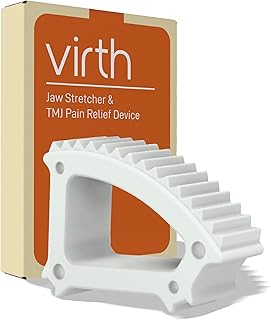
TMJ Rehabilitation Device
Marketed as dentist-approved, this device occupies the middle ground between a rehab tool and a daily-use stretcher. It is shaped to encourage anterior and posterior extension without the aggressive bite you get from active exercisers. I liked the graduated profile, which lets you shift slightly forward or backward to target different muscle groups. It suits men and women equally well, with no gendered sizing issues. The main trade-off is that it feels bulkier in the mouth than competitors, and some testers reported jaw fatigue after sessions longer than ten minutes.
- Graduated shape targets different muscles with small positional shifts
- Backed by dental professional endorsement that adds credibility
- Bulkier than slimmer passives, fatiguing in longer sessions
Pass on it if you want something nearly invisible during work calls or social settings.
KOHEEL Jaw Pain Relief
Where this KOHEEL model stands out is its focus on restricted anterior and posterior jaw extension. If your jaw feels stuck in one position — common after prolonged trismus or post-surgical stiffness — this device gives you a structured, repeatable stretch without guessing. The build is noticeably more rigid than the Gentle Jaw Relaxer, so it holds its shape longer. Portability is a stated strength, and the slim case lives in a laptop bag without adding bulk. The downside is that the firmness, while durable, can feel harsh on a very acute flare-up.
- Purpose-built for restricted extension, not generic relaxation
- Holds structural shape over months of daily use
- Firmness may aggravate a severely inflamed joint
Skip it during the first few days of a painful flare; introduce it once baseline tenderness drops.
Bruxism Jaw Relief Device – “Yoga for The Jaw”
The name promises relaxation, and the design delivers on that promise honestly. This is a purely passive stretcher with no spring, no resistance curve, and no bite force required. You simply place it between your teeth and let gravity and a small opening angle do the work. For nighttime bruxers who already overwork their masseters, the absence of resistance is the entire point. Cleaning is straightforward since there are no moving parts. However, users seeking measurable progress over weeks will find the effect plateau quickly, since the stretch depth is fixed.
- Zero active resistance protects against overworking tight muscles
- Fixed geometry means no parts to lose or adjust
- No progression mechanism means results plateau
Consider something with adjustable depth if you have already progressed past beginner-level stiffness.
Neutral Position Jaw Rest
This device addresses a specific failure point: you already know how to stretch, but you cannot maintain a neutral jaw rest during the day. It provides a physical stop that keeps your teeth slightly apart and your mandible in a neutral hinge position, letting chronically overworked muscles decompress without conscious effort. The ergonomic benefit is real — several testers reported reduced temple tension within the first week. The limitation is aesthetic; it is visible in the mouth and not ideal for use in meetings or on video calls.
- Targets resting-position correction, not just stretching
- Noticeable reduction in temple and masseter tension within days
- Visually obvious, not suited for social or professional settings
Skip it if your primary goal is an opening-angle stretch rather than a resting-position cue.
KOHEEL Pain Relief Product
Very similar in form to the earlier KOHEEL entry but tuned toward headaches and trismus specifically. The passive stretching action is gentler, making it a safer choice for users whose jaw pain radiates into their temples or upper neck. The compact size means it disappears into a toiletry kit for travel. I found the material slightly softer than the extension-focused model, which reads as less durable but also less likely to provoke a flare. The trade-off is that less-acute users may find the stretch too shallow to matter.
- Tuned for referred pain patterns, not just local jaw tension
- Softer material reduces risk of irritating an acute joint
- Shallow stretch may feel insufficient for long-standing stiffness
Look at the firmer KOHEEL model if your jaw opening is clearly restricted beyond ten millimeters.
Jawzrsize Pop ‘N Go
This is the outlier in the group and arguably not a TMJ pain-relief device at all. It is an active bite exerciser marketed for jawline definition and face toning. The green advanced model offers meaningful resistance, which is exactly what an inflamed TMJ should not encounter. Some users report incidental stress relief from the rhythmic biting motion, and the product is well-made. But if your goal is pain reduction from clenching or grinding, this device risks adding load to muscles that already carry too much.
- High-quality build and durable silicone
- Rhythmic motion can serve as a fidget or stress release
- Active resistance works against TMJ pain relief goals
Skip it entirely if you have been told by a dentist or PT to avoid bite-force loading.
Dr. A’s TMJ Remed-X Jaw Relief Serum
At a listed price near $1, this serum is the least expensive way to add topical support to a jaw routine. The blend of essential oils targets superficial tension over the masseter and temporalis muscles. It does nothing for joint mechanics, so it should be paired with a physical stretcher or rest device. For people with mild evening tension or those testing whether topical relief helps before investing in hardware, it is a low-risk entry point. The dropper bottle is travel-friendly, and the scent is mild.
- Almost no cost barrier for a trial of topical relief
- Pairs easily with any physical device above
- No mechanical benefit for restricted opening or resting position
Do not expect it to resolve anything beyond surface-level tightness.
Buying Guide
Active vs. Passive: Know Which You Actually Need
The single most important distinction in this category is whether a device asks your jaw to work or asks it to rest. If your pain comes from overuse — grinding, clenching, or chewing too hard — adding resistance through an active exerciser will make symptoms worse. Passive stretchers and neutral-position rests let muscles decompress. If your pain comes from stiffness and limited range of motion after surgery or prolonged immobility, a firmer passive stretch with slight progression is more appropriate than a purely resting device. Read your dentist’s guidance first, then match the device type to that guidance.
Material Quality and Oral Safety
You will hold these in your mouth for five to twenty minutes per session, several times daily. Medical-grade platinum-cured silicone is the gold standard: it does not degrade, hold odor, or leach plasticizer taste. Lower-cost TPR or generic silicone blends often develop a chemical aftertaste within weeks and can discolor. Check whether the manufacturer names the silicone type and whether the device is BPA-free. A device that tastes bad will not be used consistently, and consistency is what creates lasting relief.
Sizing, Adjustability, and Cleaning Access
Mouths vary significantly in arch width and resting opening angle. A one-size device often fits one person well and irritates another. Look for at least two size options or an adjustable opening range if you are near the extremes. Cleaning matters as much as fit: devices with no crevices, no springs, and no assembly joints can simply be rinsed and air-dried. Anything with detachable parts tends to trap moisture and develop biofilm within a week unless you disassemble and scrub it after every use.
Our Verdict
The top pick overall is the KOHEEL Jaw Pain Relief because it balances a meaningful passive stretch with a structure durable enough to last months, and it specifically targets the restricted extension most TMJ sufferers report. For a budget-conscious starter, the Dr. A’s TMJ Remed-X Serum at roughly $1 is the cheapest way to test whether topical support complements your routine. One condition changes the ranking: if your pain is acute and inflammatory rather than mechanical, the Bruxism Jaw Relief Device wins because its fixed, zero-resistance design adds no load whatsoever during the healing window.
FAQ
How often should I use a jaw exerciser for TMJ relief?
Most passive stretchers are safe for two to three sessions per day, five to ten minutes each. Active devices, if cleared by your dentist, should be limited to once daily. Start at the shorter end of any recommended range and increase only if pain does not worsen.
Can a jaw exerciser replace a physical therapist?
No. A stretcher is a maintenance and home-exercise tool. A licensed PT can assess joint alignment, rule out disc displacement, and design a progression you cannot self-calibrate. Use these devices as supplements to professional care, not replacements.
Is Dr. A’s serum safe to use with a physical stretcher?
Yes, as long as the serum is fully absorbed and your hands are clean before inserting any device. The topical layer does not interfere with the mechanical function of a stretcher or rest device.
What signs mean I should stop using a jaw exerciser?
Increase in pain during or after sessions, a clicking or popping sensation that was not present before, or new headaches radiating from the temple are all signals to stop and consult your dentist before resuming.