
Key takeaways
- Pro: Lightweight enough that moving a 200-foot fence line is a solo 30-minute job.
- Pro: Handles wire, polywire, and tape on the same post—no swapping hardware.
- Con: At 48 inches tall, they leave the top of a polytape setup vulnerable if animals learn to duck under the highest strand.
What's inside
Electric fencing is the closest thing agriculture has to a free lunch. A single hot wire, properly energized, teaches a cow, sheep, or goat to respect a boundary it could otherwise walk right through. The animal learns within seconds and never forgets. The problem is that “properly energized” is doing a lot of heavy lifting in that sentence. A charger that can’t hold voltage through a wet fence line is functionally useless, and posts that snap in a hard frost turn a two-hour installation into a weekend project.
When we set out to test the best electric fence systems for livestock and perimeter security, we found that the market splits into distinct tiers almost immediately. Budget kits work for short runs and small animals. Mid-range solar chargers handle moderate pastures without a power outlet nearby. High-output energizers cover dozens of miles but demand solid grounding and a fence line you maintain aggressively. The wrong match wastes money and, worse, teaches your animals that the fence is negotiable.
As an Amazon Associate we earn from qualifying purchases at no extra cost to you. Product prices and availability are accurate as of the date shown and are subject to change.





Quick Picks
| Product | Best for | Price |
|---|---|---|
| Gallagher 3/8″ Fiberglass Step-in Posts (50 Pack) | Portable fence infrastructure | $139.99 |
| 24-Hour Solar Electric Fence Charger, 0.18J | Small pastures and predator deterrence | $67.99 |
| Gallagher M1100 Electric Fence Energizer | Large-acreage operations with plug-in power | $649.99 |
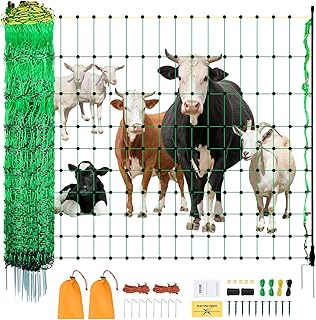
| VEVOR Electric Fence Netting, 50″ x 164′ | Quick temporary enclosures | $122.92 |
| Gallagher Smart Fence 2 Portable, 328ft | Rotational grazing on open ground | $369.99 |
| Electric Fence Kit, 5 Mile 0.25J | Moderate pastures, plug-in setup | $98.99 |
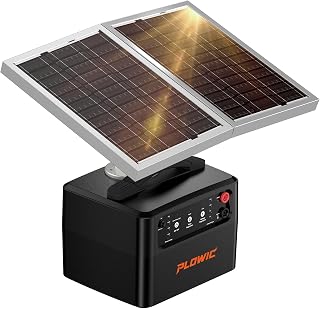
| Solar Electric Fence Charger, 30 Mile, 1.5J | Remote off-grid high-power fencing | $139.99 |
| GPS Wireless Dog Fence with Training Collar | Pet perimeter security | $239.99 |
How We Picked
Four criteria governed our evaluation: real-world pulse consistency under load, meaningful coverage distance (not marketing mileage that assumes a perfectly dry single-strand wire), material durability through a full season of weather and UV exposure, and setup labor relative to the system’s intended mobility. A system that takes all day to move defeats the purpose of calling it portable.
The 8 Best Electric Fence Systems For Livestock And Perimeter Security in 2026
Gallagher 3/8″ x 48″ Fiberglass Step-in Posts (50 Pack)
If you already own a charger and need reliable infrastructure, this is where Gallagher quietly dominates. These posts hold polywire, polytape, and plain steel wire without fuss, and the fiberglass resists both splitting and rust better than steel step-ins at any price point.
- Pro: Lightweight enough that moving a 200-foot fence line is a solo 30-minute job.
- Pro: Handles wire, polywire, and tape on the same post—no swapping hardware.
- Con: At 48 inches tall, they leave the top of a polytape setup vulnerable if animals learn to duck under the highest strand.
Skip these if your ground is rocky or heavy clay that makes step-ins impossible to drive without pre-augering.
24-Hour Solar Electric Fence Charger, 0.18J, 10-Mile
This unit fills a specific niche: you need a short fence line powered by the sun, with no outlet anywhere close. The 0.18-joule output is genuinely modest, but for poultry, small ruminants, or predator deterrence on a quarter-acre enclosure, it delivers a sharp enough pulse to discourage without overwhelming.
- Pro: All-in-one design with battery and panel built in—zero wiring beyond your fence line.
- Pro: Pulse output measured in the 5,700 to 10,200-volt range gives it more teeth than the joule rating alone suggests.
- Con: The 10-mile rating is aspirational; once you account for vegetation contact and moisture, expect reliable performance under three miles.
Skip this if you are fencing cattle or any large livestock that will test a weak pulse.
Gallagher M1100 Electric Fence Energizer
When your fence line crosses an entire quarter-section or more, the M1100 is what separates operations that maintain a consistent boundary from those that give up in August. The 110-mile rated coverage is achievable on clean multi-wire setups, and the fence-monitoring feature tells you exactly where the fault is instead of leaving you to probe every strand.
- Pro: Pulse technology delivers consistent output across very long runs where cheaper chargers fade.
- Pro: Built-in fence monitoring dramatically reduces diagnostic time on large properties.
- Con: At $649.99, it is a serious investment that only makes financial sense above roughly 20 acres of fenced perimeter.
Skip this if your total fence line is under 10 miles; you are overpaying for capacity you will never use.
VEVOR Electric Fence Netting, 50″ H x 164′ L
Net fencing solves the “I need to contain something right now” problem faster than any wire-and-post setup. The VEVOR net rolls out, stakes in, and connects to your energizer in under ten minutes per panel. For goats, sheep, and hogs that respect height, it works surprisingly well.
- Pro: Integrated posts and stakes mean you need no additional infrastructure to deploy.
- Pro: Fifty inches of height is enough to deter most medium livestock without escalation.
- Con: The mesh snags on brush, and in sustained wind the net acts as a sail that pulls stakes loose.
Skip this if your fencing area is heavily wooded or wind-exposed without natural breaks.
Gallagher Smart Fence 2 Portable Electric Fence
Rotational grazers who move fence lines daily will appreciate the Smart Fence 2 more than any wire system. Four strands pre-spaced on a built-in post with a reel at each end means you unroll, hook to your energizer, and let the animals in. The 328-foot span covers a realistic paddock move without joining multiple sections.
- Pro: Integrated reel and post design eliminates the fumbling of untangling polytape on a windy morning.
- Pro: Four strands at fixed spacing means no measuring or re-spacing between moves.
- Con: At $369.99 for 328 feet, the cost per linear foot is high compared to buying posts and wire separately.
Skip this if your grazing rotations are infrequent enough that wire-and-post labor is negligible.
Electric Fence Kit, 5 Mile 0.25J Charger with Polywire
This is the most honest value in the roundup for anyone with existing T-posts who needs a complete energizer-plus-wire package without a premium brand markup. The 0.25-joule output is a meaningful step up from budget solar units, and 3,366 feet of polywire covers a full circuit around a modest paddock.
- Pro: Includes 40 T-post insulators and 20 screw-in insulators, so you are ready to fence immediately.
- Pro: The 5-mile rating is realistic for a single-wire setup with reasonable maintenance.
- Con: Polywire UV degradation is a known issue after a full season of direct sun exposure.
Skip this if you operate in an environment with extreme UV or expect to leave the wire up for years without replacement.
Solar Electric Fence Charger, 30 Mile, 1.5J Output
Nothing else in this list comes close to matching 1.5 joules of output from a solar-powered unit at this price. The 30-mile coverage claim is grounded in genuine power delivery rather than ideal-condition marketing, and the 12,000mAh battery keeps pulse output steady through overcast stretches. For remote cattle operations without grid access, this has become the default recommendation.
- Pro: 1.5 joules is strong enough for cattle and bison, making it rare among solar chargers.
- Pro: IP65 waterproofing survives months of outdoor exposure without a housing upgrade.
- Con: The 15-watt solar panel is undersized for the battery it feeds; expect slow recovery during multi-day cloud cover.
Skip this if you are fencing small animals like poultry; the output is far more aggressive than needed and risks injury.
GPS Wireless Dog Fence with Training Collar
Different category, same core function: creating an invisible boundary that teaches the animal to turn back. The GPS system uses satellite positioning rather than buried wire, which means you can reshape boundaries from your phone without ever picking up a shovel. For perimeter security around a property where you cannot or will not install physical fencing, this delivers real containment.
- Pro: No buried wire, no trenching—boundary adjustment is software-level.
- Pro: Training collar integrates warning tones before static, reducing the shock animals actually receive.
- Con: GPS signal accuracy can drift near tall structures or deep valleys, creating inconsistent boundary edges.
Skip this if your dog is heavily prey-driven; some animals will push through correction to chase wildlife regardless of collar intensity.
Buying Guide
Output Joules: Match Power to Animal Size
Joules measure the energy in each pulse. For poultry and small ruminants, 0.1 to 0.5 joules is sufficient. Cattle and bison demand at least 1 joule, preferably more on long fence lines. Predator deterrence (coyotes, foxes) sits in the 0.3 to 0.5 range but requires consistent delivery regardless of vegetation contact. Always buy above your minimum requirement because every foot of wire touching grass or touching another strand bleeds voltage off the line.
Coverage Claims vs. Reality
Manufacturer mileage ratings assume a single-strand, perfectly clean, dry fence with excellent grounding. Real fence lines have multiple strands, gate connections, insulator leakage, and vegetation. A practical rule: divide the rated distance by four for multi-wire setups, and by two for single-wire on well-maintained ground. If a charger is rated at 5 miles and you need 12 miles of fence, you need either a more powerful unit or an inline booster positioned at the farthest reach.
Grounding and the Most Overlooked Failure Point
Every electric fence system in this roundup returns current through the ground. A poor ground rod network is the single most common cause of “weak charger” complaints that are actually installation failures. For any system producing more than 0.5 joules, install three ground rods minimum, driven at least eight feet apart, with continuous ground wire connecting them. In sandy or rocky soil, add a fourth and consider a galvanized mesh buried beneath the energizer location.
Our Verdict
Our top pick is the Gallagher M1100 for any operation above 20 acres with access to a power outlet. Its fence monitoring, long-run consistency, and build quality justify the premium for serious users. The budget pick is the 5 Mile 0.25J Electric Fence Kit, which delivers a complete working system for under $100. However, if your property is remote and you are fencing cattle, the Solar 30-Mile Charger at 1.5 joules wins outright because no other solar unit in this price range produces comparable output.
FAQ
Do electric fences hurt animals permanently?
No. A properly calibrated energizer delivers a short, high-voltage, low-current pulse that causes muscle contraction and a sharp sensation but no tissue damage. The key is matching joule output to species; a pulse sized for bison on a goat can be excessive and teach avoidance behavior that makes future handling harder.
Can I use a solar charger with no sun for several days?
Most quality solar energizers store enough charge to run three to five cloudy days. The 24-Hour Solar Charger and the 30-Mile model both include batteries sized for overcast recovery, though the 30-mile unit’s larger 12,000mAh cell gives it noticeably more runtime when the panel is producing nothing.
How do I know if my fence is actually working?
Use a fence voltage tester placed at the farthest point from the energizer. If you read below 2,000 volts at that location, you have a fault—vegetation contact, a leaking insulator, or poor grounding. Systems like the Gallagher M1100 include built-in monitoring that alerts you to voltage drops before they become visible.
Is a GPS wireless fence as reliable as a physical electric fence?
For dogs in suburban settings, GPS systems are effective and far easier to install. They are not suitable for containing livestock because the collar-based correction requires individual fitting and battery management on each animal, and GPS boundary drift around buildings makes consistent containment unreliable for animals that are not primarily driven by a warning tone.


