Key takeaways
- Pro: Comfortable grip design reduces hand fatigue during repetitive cuts
- Pro: Handles fabric and paper without needing separate shears
- Con: Struggles with thick upholstery-weight or tightly woven canvas
What's inside
Pinking shears solve a very specific problem: you cut a straight edge through woven fabric, and within minutes the threads start pulling apart. Every seam allowance you’ve ever trimmed with a regular pair of scissors is a ticking clock on fraying. A good pair of pinking shears cuts a zigzag pattern that distributes stress across multiple points instead of one continuous line, buying you time and reducing the need for serging on every raw edge.
What separates the best pinking shears for fabric cutting from the cheap ones is blade geometry and grip comfort under repetitive pressure. A well-tuned zigzag produces clean peaks without dragging or skipping threads, while a poorly machined pair will chew through lightweight cotton and leave ragged teeth on denim. Blade length matters for control versus speed, and the handle design determines whether you can power through forty seam allowances or quit at ten. We tested these eight options on a range of fabrics from quilting cotton to upholstery canvas.
As an Amazon Associate we earn from qualifying purchases at no extra cost to you. Product prices and availability are accurate as of the date shown and are subject to change.




Quick Picks
| Product | Best for | Price |
|---|---|---|
| JISTL Green | General crafting and light dressmaking | $9.99 |
| SINGER 9″ Stainless Steel | Long-term seam finishing on woven fabrics | $16.29 |
| Fri4Free 9″ Professional | Budget buyers who need reliable all-purpose cuts | $6.99 |
| Fiskars 8″ Orange | Ergonomic comfort for extended sessions | $20.97 |
| Pinking Shears Set 2 Pack | Decorative variety in scalloped and zigzag | $12.99 |
| Pinking Shears 9 Inch (no brand) | Multi-material cutting including leather and PU | $5.84 |
| Pinking Shears Serrated Red | Heavy fabrics and paper craft combos | $7.99 |
| Taotree 9.5″ Zig Zag | Scrapbooking and mixed media projects | $9.99 |
How We Picked
We evaluated each pair on four criteria: blade sharpness through multiple fabric weights (lightweight cotton through canvas), the consistency of the zigzag pattern across fifty cuts without skipping peaks, handle ergonomics and comfort during sustained use, and overall build quality relative to price. A pair that cuts cleanly on quilting cotton but shreds on denim lost points, and we gave preference to shears that stayed sharp over repeated sessions rather than those that felt great on day one and dulled by week two.
The 8 Best Pinking Shears For Fabric Cutting in 2026
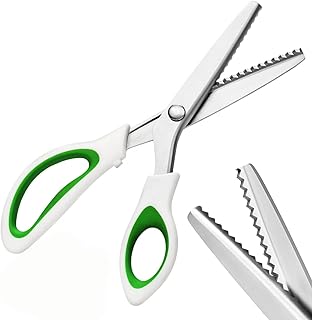
JISTL Green Pinking Shears Comfort Grips
The JISTL Green works well for crafters who bounce between fabric, paper, and ribbon and want a single pair that handles all three without fuss. The comfort grips make long cutting sessions manageable, and the zigzag pattern is consistent enough for seam allowances on medium-weight fabrics. It is not a precision tool, but it gets the job done at a fair price. If you are finishing a quilt border or trimming fabric labels for dozens of items, this pair will not frustrate you.
- Pro: Comfortable grip design reduces hand fatigue during repetitive cuts
- Pro: Handles fabric and paper without needing separate shears
- Con: Struggles with thick upholstery-weight or tightly woven canvas
Skip this one if your primary need is cutting heavy denim or multiple fabric layers at once.
SINGER 9″ Pinking Shears Stainless Steel
SINGER’s stainless steel construction gives these shears a noticeably smoother cutting action than cheaper alternatives, and the nine-inch blade provides real leverage on longer fabric strips. The soft grip is genuinely helpful when you are power-cutting a batch of skirt panels. The zigzag edge produces clean, sharp peaks on woven cottons and poly blends without dragging. For sewists who regularly finish raw edges before serging, this is a dependable workhorse that will hold its edge through hundreds of cuts.
- Pro: Stainless steel blades resist rust and maintain sharpness over time
- Pro: Nine-inch length offers excellent control on long fabric pieces
- Con: Higher price point than most competitors in this list
Skip if you only need shears for occasional paper crafts or decorative edges.
Fri4Free 9″ Pinking Shears Professional
At $6.99, the Fri4Free undercuts most competitors while still delivering a sharp, consistent zigzag on medium-weight fabrics. The anti-slip grips are the standout feature here — they actually stay put when your palms get sweaty during a long sewing session. The blades cut cleanly through quilting cotton, twill, and lightweight linen without skipping teeth. It is not the most refined pair on the market, but for the price it punches well above what you would expect from a sub-seven-dollar option.
- Pro: Exceptional value for a pair that cuts cleanly on common fabrics
- Pro: Anti-slip grip design stays comfortable during extended use
- Con: Finish and hardware feel slightly rough compared to premium options
Skip this if you want shears that feel like a long-term investment piece.
Fiskars 8″ Orange-Handled Pinking Shears
Fiskars engineered their handles around actual hand anatomy, and the difference is immediate — the pivot is smooth, the grip positions your thumb naturally, and you can cut for twenty minutes without developing a hot spot. The high-grade stainless steel blades hold an edge well, though the eight-inch length is a compromise: slightly less leverage than nine-inch competitors, but better for tight curves and small pieces. This is the pair you reach for when comfort is your top priority.
- Pro: Ergonomic handle design is best-in-class for reduced hand strain
- Pro: High-grade stainless steel stays sharp through heavy use
- Con: Highest price in this roundup
Skip if you need maximum blade length for cutting long straight fabric strips.
Pinking Shears Set 2 Pack Scalloped and Zig Zag
This set gives you two distinct decorative edges in one purchase, which is genuinely useful if you make greeting cards, embellish garments, or work on mixed-media projects. The 7mm scalloped waves produce a softer, more rounded edge ideal for applique and fabric flowers, while the 5mm zigzag handles standard seam finishing. The 9.5-inch length is the longest in this list, offering good leverage. For crafters who want visual variety without buying two separate pairs, this set delivers.
- Pro: Two edge patterns in one purchase for creative flexibility
- Pro: 9.5-inch blades provide good cutting leverage on large fabric pieces
- Con: Neither pair cuts as cleanly as dedicated single-pattern shears
Skip this if you need the sharpest possible zigzag edge for heavy-duty seam finishing.
Pinking Shears 9 Inch Zig Zag Scissors (Budget)
At $5.84, this is the cheapest option in our roundup and the first pair that explicitly mentions compatibility with leather and PU materials. The blades are sharp enough for a decorative edge on fabric, and the zigzag pattern is consistent on lighter materials. Where it falters is in sustained performance — after heavy use on dense fabrics the edges begin to dull faster than mid-range competitors. Still, for crafters on a tight budget who need a starting point, it is a legitimate option.
- Pro: Lowest price with functional zigzag performance on light-to-medium fabrics
- Pro: Works on leather and PU, which most competitors do not claim
- Con: Blade sharpness degrades faster with frequent heavy use
Skip if you plan to use these daily on thick or tightly woven fabrics.
Pinking Shears Serrated Comfort Grips Red
The serrated blade design is the differentiator here. Serrated edges grip the fabric fibers as they cut, which prevents slippage on slick or stretchy materials that would otherwise slide between smooth scissor blades. The comfort grip handles are well-padded, and the red anodized finish is distinctive on a crowded sewing table. At $7.99, it sits in the same value tier as other budget options but with a functional advantage for specific fabric types.
- Pro: Serrated grip prevents fabric slippage on slick and stretchy materials
- Pro: Comfort grip handles reduce fatigue during long cutting sessions
- Con: Serrations can leave minor marks on delicate silks
Skip this if your primary fabric is lightweight silk or chiffon that shows cut marks easily.
Taotree 9.5″ Pinking Shears for Fabric Cutting
The Taotree is a solid mid-range option with 9.5-inch blades that provide good cutting leverage. It works well for scrapbooking, decorative fabric edges, and general dressmaking tasks. The finish is clean, the action is smooth, and the zigzag pattern is consistent through medium-weight fabrics. It does not stand out dramatically on any single metric, but it performs reliably across a wide range of common crafting materials without any notable weaknesses.
- Pro: Versatile across fabric, paper, and mixed media with no compromise on cut quality
- Pro: 9.5-inch blades offer good leverage for longer cuts
- Con: Does not excel in any single category compared to specialized competitors
Skip this if you need a specialized tool for heavy fabrics or want the most ergonomic design available.
Buying Guide
Blade Length and Cutting Leverage
Blade length in pinking shears directly affects how much force you need to apply and how straight your cuts stay over distance. Six-inch shears give you fine control for curves and small pieces but require more hand pressure on thick fabric. Nine-inch blades are the sweet spot for most fabric work — they provide leverage that makes long straight cuts through medium-weight materials feel effortless. If you regularly cut fabric strips for binding or quilting, longer blades reduce fatigue and improve edge consistency. Eight-inch is a reasonable compromise if you also do detailed applique work.
Handle Ergonomics and Grip Material
The difference between a pair you use for ten minutes and one you use for an hour is almost entirely in the handle. Look for molded or rubberized grips that conform to your palm rather than flat plastic that flexes under pressure. The pivot screw should allow smooth opening and closing without play — if the blades wobble side to side at the pivot point, the zigzag pattern will skip and produce uneven teeth. Some shears include a spring mechanism between the handles that reduces the effort needed to reopen them after each cut, which is a meaningful feature if you are trimming large batches of pieces.
Blade Material and Edge Retention
Stainless steel is the standard for pinking shears, but the grade of stainless varies. Higher-carbon stainless alloys hold an edge longer but require more care to prevent corrosion. Chrome-plated blades resist rust but tend to dull faster. If you cut synthetic fabrics like polyester fleece, which contain abrasives from the manufacturing process, edge retention becomes more important. Avoid using pinking shears on paper-heavy projects if the same pair will touch fabric, since paper fibers dull metal edges faster than textile fibers do.
Our Verdict
The SINGER 9″ Stainless Steel is our top pick for anyone who uses pinking shears as a regular seam-finishing tool rather than an occasional craft accessory. The combination of stainless steel durability, consistent zigzag output, and comfortable soft grip makes it the most reliable choice for sewists who need these shears to perform week after week. The Fiskars 8″ Orange wins on pure ergonomic comfort, so if hand pain or repetitive strain is your primary concern, it justifies its higher price. For budget buyers, the Fri4Free at $6.99 is the clear pick — it cuts clean, stays sharp enough for regular use, and costs less than most competitors charge for entry-level options.
FAQ
Can you use pinking shears on knit fabrics?
Pinking shears are designed for woven fabrics where fraying is the primary concern. On knit fabrics, the zigzag edge can actually encourage curling and does not prevent unraveling the same way. For knits, a rotary cutter or fabric scissors with a stay-stitch seam finish is more appropriate.
How do you sharpen pinking shears?
Pinking shears are difficult to sharpen at home because the zigzag geometry requires specialized grinding. Most manufacturers do not recommend self-sharpening. If your shears feel dull, a professional scissor sharpener who handles decorative-edge blades is the safest option, though replacement is often more economical for budget pairs.
What is the difference between zigzag and scalloped pinking edges?
Zigzag edges produce triangular peaks that distribute stress in sharp directions, making them more effective at preventing fraying on structural seams. Scalloped edges use rounded wave patterns that are softer visually but slightly less effective at stopping thread migration. Scalloped is preferred for decorative purposes, while zigzag is better for functional seam finishing.
Do pinking shears prevent fraying completely?
No. Pinking shears slow fraying and reduce it to a manageable level, but they do not eliminate it. Heavy-duty woven fabrics with large thread gaps will eventually fray from a pinked edge, and the zigzag pattern simply buys time and makes the fraying less dramatic than a straight cut. For garments that will be washed frequently, combining a pinked edge with an overlock stitch is the most durable approach.