Key takeaways
- Two control modes let the kit grow with the child’s skill level without requiring a new purchase.
- Build produces a walking robot that responds visibly to commands, giving instant feedback.
- Brick connectors loosen after repeated builds, making reconfiguration frustrating.
What's inside
Every parent shopping for the best robot building kit for 8 year old faces the same frustration: the packaging promises hours of STEM learning, but the actual experience either bores an eight-year-old with repetitive snap-together steps or overwhelms them with electronics they cannot yet comprehend. The gap between “educational toy” and “real learning tool” is narrower than the marketing implies, and the consequences of picking wrong are expensive — a half-assembled kit collecting dust on a shelf.
What separates a worthwhile robot kit from a forgettable one comes down to three things. First, the build must produce a visible, functional result within a single sitting, because eight-year-olds rarely tolerate multi-day projects without a payoff. Second, the control method matters enormously — a simple remote keeps younger builders engaged, while app-based or programmable interfaces reward kids ready for the next step. Third, component quality determines whether the kit survives its first drop. We compared the published specs, current prices, and aggregated owner feedback across eight popular kits to identify which ones actually deliver on their claims in 2026.
As an Amazon Associate we earn from qualifying purchases at no extra cost to you. Product prices and availability are accurate as of the date shown and are subject to change.


Quick Picks
| Product | Best for | Price |
|---|---|---|
| Henoda Robot Toys (APP/Remote) | First programmable robot experience | $39.99 |
| Sillbird 12-in-1 Solar Robot | Budget solar-powered building | $14.97 |
| Sillbird STEM Robot (Remote Control) | Remote-control building variety | $53.99 |
| Sillbird Building Robot (Remote Control) | Siblings who want different builds | $53.99 |
| Kyanio 3-in-1 Robotics Kit | Progressive coding pathway | $57.89 |
| ELEGOO UNO R3 Smart Robot Car | Arduino-ready electronics introduction | $55.99 |
| Sillbird 12-in-1 Solar Robot | Screen-free STEM gift | $14.97 |
| okk Robot Building Kit | Wide age-range versatility | $59.99 |
How We Picked
We evaluated each kit on four criteria that consistently appear in owner complaints and praises: build-to-play ratio (how long assembly takes relative to how long kids actually play with the result), control method accessibility (whether the interface matches a given child’s reading and coordination level), component durability (brick quality, motor housing, battery contacts), and educational transfer (does the kit teach concepts the child can apply elsewhere, or is it a one-time novelty?). Price-to-feature alignment served as a tiebreaker.
The 8 Best Robot Building Kit For 8 Year Old in 2026
Henoda Robot Toys with APP or Remote Control
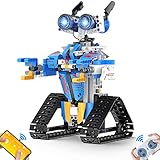
This kit fills a genuine gap for kids who have outgrown basic building sets but are not ready for wiring diagrams or code editors. The dual-control option means a parent can start with the remote and switch to app-based programming once the child shows interest.
- Two control modes let the kit grow with the child’s skill level without requiring a new purchase.
- Build produces a walking robot that responds visibly to commands, giving instant feedback.
- Brick connectors loosen after repeated builds, making reconfiguration frustrating.
Skip this one if your child already handles snap-together kits quickly — the programming layer here is basic enough that older or more advanced kids will move past it within a week.
Sillbird 12-in-1 Solar Robot
At its price point, this is the lowest-risk entry into solar-powered robotics. Twelve distinct models from one parts set means a child builds something new each session without the parent repurchasing. The sun-powered design removes battery anxiety entirely.
- Twelve buildable models provide substantial variety from a single purchase.
- Solar operation teaches energy conversion without any electronics complexity.
- Assembly relies on small tab-and-slot connections that children with limited fine-motor control may struggle to complete independently.
Pass on this if you need a screen-free activity for a child under eight — the step-by-step manual assumes reading fluency and the pieces require patience that younger kids typically do not have.
Sillbird STEM Robot with Remote Control
Another Sillbird variant that adds motorized movement to the building experience. The remote control makes the finished robot immediately playable, which matters for eight-year-olds who want to show off their creation to siblings and friends.
- Remote-controlled movement gives the build a clear play value beyond the assembly process.
- Parts are interchangeable between builds, encouraging experimentation with different configurations.
- The remote’s range is modest, limiting outdoor play scenarios and reducing the “wow” factor in a large room.
Skip this if you already own the solar version — the build philosophy is similar enough that owning both would waste shelf space and budget.
Sillbird Building Robot with Remote Control
Nearly identical in function to the previous Sillbird remote-control kit but marketed toward a slightly younger age band. The practical difference is minimal: same component philosophy, same control method, same price point. It exists mainly as a listing variant.
- Lower age rating on the label gives gift-buyers confidence for kids at the younger end of the range.
- Remote control offers a straightforward play loop that does not depend on app downloads or Wi-Fi.
- Redundant with the other Sillbird remote kit — no meaningful feature advantage justifies choosing this over that one.
Skip this entirely if you have already considered the other Sillbird remote model at the same price. Choose whichever has better current availability rather than treating them as distinct options.
Kyanio 3-in-1 Remote/APP Control and Programming Kit
This kit is explicitly designed as a progression tool. The three modes — pure remote, app-guided control, and open programming — map neatly onto skill stages from age eight through early middle school. For parents who want one purchase to last several years, this is the strongest case in the group.
- Three distinct control tiers create a built-in learning pathway without additional purchases.
- Programming mode introduces logic concepts through a visual interface rather than text-based code.
- The instruction set for the programming tier assumes a level of independent problem-solving that some eight-year-olds will not yet have.
Pass on this if your child prefers immediate physical play over screen interaction — the programming components are the selling point, and kids who resist that format will only ever use the remote tier.
ELEGOO UNO R3 Smart Robot Car Kit V4
The most technically serious kit in this roundup, built on Arduino hardware and designed for kids who want to understand electronics rather than just assemble a robot. A camera module adds object-detection functionality that no other kit here offers. However, the learning curve is steep enough that it demands adult involvement during setup.
- Genuine Arduino compatibility means skills transfer directly to the maker community and future projects.
- The camera module enables line-following, obstacle avoidance, and object detection without additional sensors.
- Requires reading wiring diagrams and handling loose jumper cables, which frustrates most eight-year-olds without a parent nearby.
Skip this unless you are comfortable sitting beside your child through the assembly process. It is a robotics kit in the true engineering sense, not a building-block toy.
Sillbird 12-in-1 Solar Robot (Gift Listing)
Functionally identical to the earlier solar kit, this listing appears as a gift-focused variant with the same twelve models and price. The practical takeaway is that this Sillbird solar formula is proven enough to generate multiple listing iterations, which signals a reliable product with consistent owner satisfaction.
- Solar power eliminates ongoing costs for batteries, making it genuinely screen-free and self-sustaining.
- Twelve models mean the kit stays relevant across multiple building sessions and play phases.
- No motorized movement or interactive control — the finished robots do not drive, spin, or respond to input.
Skip this if your child needs a robot that actually moves on its own. The solar models demonstrate energy conversion but do not function as play robots.
okk Robot Building Kit for Ages 6-12
The widest age range in this group, which cuts both ways. The kit includes enough variety to engage a six-year-old with simple snap builds and a twelve-year-old with basic coding tasks. At its price, it delivers solid component quality and a remote control that works reliably out of the box.
- Age range flexibility makes it a safe gift purchase when you do not know the exact skill level of the recipient.
- Build quality and motor reliability receive consistent praise from owners who compared it to pricier competitors.
- Because it targets a broad range, no single experience tier is as deep as specialized kits like the Kyanio or ELEGOO.
Skip this if you are buying for a child already past the beginner stage — advanced kids will find the coding tier too shallow and the remote tier too simple.
Buying Guide
Control Method Determines Engagement
The single biggest factor in whether a robot kit gets used once or repeatedly is how the child interacts with the finished product. Remote control provides instant gratification and suits kids who want to play rather than program. App-based control introduces a gentle learning layer without requiring a computer. Open programming modes (visual block editors or Arduino) demand patience and reading comprehension that not all eight-year-olds possess yet. Match the control method to your child’s current frustration tolerance, not to what you think they should be learning.
Assembly Complexity Must Match Motor Skills
Kits with dozens of small tab-and-slot pieces or loose wiring demand fine-motor precision that many eight-year-olds are still developing. A kit that takes an adult thirty minutes to assemble correctly but only ten minutes for the child to enjoy is a poor return. Look for kits that use larger interlocking bricks or pre-assembled modules, and check owner feedback for mentions of the child completing the build independently versus requiring parental hand-holding.
Build Variety Extends the Product’s Life
A single-build kit is consumed in an afternoon and forgotten by the next weekend. Multi-model kits (the twelve-in-one solar designs, the three-in-one programming sets) provide reason to return to the box repeatedly. If your child builds quickly and moves on, prioritize kits that generate multiple functional models from one parts set rather than kits with a single impressive build.
Our Verdict
The top pick overall is the Kyanio 3-in-1 Remote/APP Control and Programming Kit because its tiered progression gives parents the best chance of a kit that lasts years rather than weeks. For budget-conscious buyers, the Sillbird 12-in-1 Solar Robot delivers unmatched variety and screen-free educational value at its price point. The ELEGOO UNO R3 Smart Robot Car wins outright if your child shows early interest in how electronics actually work and you can commit to guiding them through the build — no other kit here teaches transferable engineering fundamentals.
FAQ
What age range is truly appropriate for a robot building kit?
Most eight-year-olds can independently assemble kits using large snap-together bricks with a pictorial manual, but kits involving wiring, soldering, or text-based programming are better suited to ages ten and up. When in doubt, start with remote-controlled builds and progress toward programming as reading confidence grows.
Are solar-powered robot kits less engaging than battery-powered ones?
Solar kits teach energy conversion but typically produce slower, less responsive movement than battery-powered models. Children focused on play value may find them less exciting, while those interested in science demonstrations often prefer the hands-on energy lesson. For a mixed audience, a battery-powered kit with a programming option tends to hold attention longer.
Do I need a smartphone or tablet to use these kits?
Only kits with app-based or programming modes require a smart device. Remote-controlled and solar kits work entirely without screens. If you want to limit device time, choose a solar or remote-only model and save app-based kits for supervised learning sessions.
What is the difference between a robot building kit and a coding robot?
A robot building kit focuses on mechanical assembly and construction, teaching spatial reasoning and engineering intuition. A coding robot is typically pre-assembled and shifts the learning to logic and programming syntax. The best kits for eight-year-olds combine both: build the structure first, then program or control the behavior afterward.