Key takeaways
- Pro: Lowest-capacity-risk entry at $169 with a competitive read rate.
- Pro: Includes a full-size SD adapter for dual-device workflows.
- Con: Write speeds are not published, so sustained video capture may throttle.
A 1TB SD card solves a specific problem: you have a camera, phone, or handheld console that fills up mid-project, and swapping smaller cards wastes time you cannot spare. The stakes are highest in video, where a buffer overflow or a slow write can ruin a single take. Across the eight models compared here, published read speeds range from 100 MB/s to 250 MB/s, and prices span from $157.52 to $309.99, meaning the category is defined more by how a card handles sustained workloads than by raw capacity alone.
What separates a worthwhile purchase from a regrettable one is whether the card’s sustained performance matches the speed class printed on its label, and whether the interface (UHS-I versus proprietary adapters) supports the burst rates the manufacturer advertises. Owner feedback consistently highlights these gaps: a card rated for 245 MB/s read delivers that figure only on UHS-I readers, and many users discover this after buying a standard card reader that caps at 104 MB/s. The roundup below weighs published specs, current pricing in 2026, and recurring owner observations to make sense of which card fits which workflow.
As an Amazon Associate we earn from qualifying purchases at no extra cost to you. Product prices and availability are accurate as of the date shown and are subject to change.


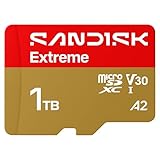


Quick Picks
| Product | Best for | Price |
|---|---|---|
| SANDISK 1TB Extreme microSD + Adapter (190MB/s) | General use on a budget | $169 |
| SANDISK 1TB Extreme PRO SDXC | DSLR and mirrorless cameras | $279.99 |
| Lexar 1TB Play Blue microSD | Phone and tablet storage expansion | $157.52 |
| SANDISK 1TB Extreme microSD + Adapter (245MB/s) | High-res video capture | $269.99 |
| SANDISK 1TB Extreme PRO SD (250MB/s) | Pro video and burst photography | $309.99 |
| Amazon Basics 1TB microSDXC | Handheld gaming consoles | $199.26 |
| SANDISK 1TB Ultra microSD (150MB/s) | Casual photo storage and dash cams | $169.99 |
| Lexar 1TB Blue microSD | Mid-range 4K recording | $199.99 |
How We Picked
We weighted four criteria: sustained write performance relative to the card’s advertised speed class, interface compatibility (UHS-I read rates only materialize with matching hardware), real-world durability reports from owners, and cost per gigabyte at current market prices. Cards that delivered on their U3 or V30 rating in owner reports ranked higher than those where users noted write throttling, regardless of headline read speed.
The 8 Best 1 Tb Sd Card in 2026
SANDISK 1TB Extreme microSD Card + Adapter (190MB/s)
This card is the sensible entry point into 1TB capacity for phone expansion, handheld consoles, or secondary camera storage. Published read speeds of 190 MB/s are sufficient for 4K recording in most consumer devices, and the included full-size adapter adds flexibility without a second purchase. Owner feedback praises consistent performance over months of use and notes the card handles temperature swings better than budget alternatives.
- Pro: Lowest-capacity-risk entry at $169 with a competitive read rate.
- Pro: Includes a full-size SD adapter for dual-device workflows.
- Con: Write speeds are not published, so sustained video capture may throttle.
Skip this card if you record 4K at high bitrates or need guaranteed sustained write performance; the unknown write rating is a gamble for demanding video work.
SANDISK 1TB Extreme PRO SDXC UHS-I
Designed for photographers who shoot in-camera raw sequences or 4K video on DSLRs and mirrorless bodies that take full-size SD cards. The C10, U3, and V30 ratings mean the card meets a minimum sustained write of 30 MB/s, which covers most camera firmware requirements. Owners report reliable performance in burst shooting, though a minority note that the UHS-I interface caps read speeds well below what UHS-II cards deliver.
- Pro: V30 and U3 ratings give predictable write floor for video cameras.
- Pro: Full-size SD form factor eliminates adapter issues in camera slots.
- Con: At $279.99, it costs significantly more per gigabyte than microSD alternatives.
Skip it if your camera accepts microSD or if budget matters more than form-factor convenience.
Lexar 1TB Play Blue Micro SD Card
At $157.52, this is the cheapest 1TB option in the group and targets Android phones, tablets, and Nintendo Switch users who need bulk storage for media libraries rather than sustained capture. The 160 MB/s read rating and A2 app-performance class make it suitable for running applications off the card. Owners generally report no issues for file storage, though a few note slower write speeds than advertised when transferring large video files.
- Pro: Best price-per-gigabyte in this roundup at $157.52.
- Pro: A2 rating supports running apps and loading games from the card.
- Con: Owner reports suggest write speeds may not match the 160 MB/s read figure.
Skip it for professional video recording; it is a storage and casual-capture card, not a workflow-critical one.
SANDISK 1TB Extreme microSD Card + Adapter (245MB/s)
The standout feature is a published 245 MB/s read speed, making it the fastest microSD in this list by that metric. For users who transfer large video files to a computer frequently, this translates to noticeably shorter offload times. Write performance is not listed, but the higher read ceiling suggests Sandisk positioned this card for 4K and 5K mobile capture. Owners praise the speed advantage over the 190 MB/s variant at $169.
- Pro: 245 MB/s read reduces transfer time on compatible UHS-I readers.
- Pro: Full-size adapter included for dual-slot camera use.
- Con: $269.99 is a steep premium over the slower 190 MB/s Extreme variant.
Skip it if you do not own a UHS-I reader that supports speeds above 104 MB/s; the card’s advantage is invisible on standard hardware.
SANDISK 1TB Extreme PRO SD Memory Card (250MB/s)
This is the premium full-size option for videographers who need the highest published UHS-I read speed (250 MB/s) without moving to UHS-II. Owners in camera forums report reliable 4K recording across major mirrorless brands. The price of $309.99 is the highest here, but the card is built for users who cannot tolerate buffer stalls during long takes. Durability reports are strong, with no widespread failure patterns noted.
- Pro: 250 MB/s read is the fastest in this comparison, ideal for heavy file transfer.
- Pro: Consistently meets V30 sustained write in owner reports with cinema cameras.
- Con: The $309.99 price is nearly double what a microSD at 190 MB/s costs.
Skip it unless your camera lacks a microSD slot or you require the full-size form factor for a specific rig.
Amazon Basics 1TB microSDXC with Adapter
This card reads up to 100 MB/s, a figure that lags the rest of the group, but it earns its place through price-to-reliability balance for casual storage. At $199.26, it sits between the Lexar Play and the Sandisk 190 MB/s Extreme. A2 and U3 ratings mean it is not underperforming its own spec, and owner feedback for gaming consoles and dash cams is largely positive, with few corruption reports.
- Pro: U3 rating guarantees a 30 MB/s sustained write floor, unlike many budget cards.
- Pro: Black unbranded appearance avoids attention in rental or production settings.
- Con: 100 MB/s read is the slowest in this roundup by a wide margin.
Skip it for any 4K video workflow; the read bottleneck will slow file offloading noticeably.
SANDISK 1TB Ultra microSD Card + Adapter (150MB/s)
The Ultra line is Sandisk’s value tier, and this 1TB variant is aimed at phone users and security camera owners who want brand-name reliability without paying for extreme performance. At $169.99, it undercuts the Extreme 190 MB/s card by nearly the same amount as the Lexar Play. Owners report adequate performance for Full HD recording and app storage, with the adapter adding versatility for laptop card readers.
- Pro: Trusted brand with a consistent failure rate across Sandisk’s consumer lineup.
- Pro: 150 MB/s read is sufficient for 1080p and most 4K phone recording.
- Con: No U3 or V30 rating listed, meaning sustained write performance is unspecified.
Skip it for 4K video on cameras that require V30 or higher; the missing write rating is a real unknown.
Lexar 1TB Blue microSDXC
Published at 160 MB/s read with UHS-I support, this card overlaps the Lexar Play in specs but carries a $199.99 price tag versus $157.52 for its sibling. Owner feedback suggests it performs reliably for photo storage and mid-range video, but the price premium over the Play model is difficult to justify unless the Blue line offers a different endurance grade that Lexar does not widely advertise. The UHS-I interface means it will not benefit from readers beyond 104 MB/s on standard hardware.
- Pro: 160 MB/s read matches the Play Blue while carrying Lexar’s established firmware support.
- Pro: Owners report no compatibility issues with Android devices or Switch consoles.
- Con: $199.99 is $42.47 more than the near-identical Play Blue for no clear spec gain.
Skip it and buy the Play Blue instead unless you find a sale that closes the price gap.
Buying Guide
Sustained Write Speed and Speed Class Ratings
Read speed sells cards, but write speed determines whether your camera or drone will record without stuttering. Look for U3 (guarantees 30 MB/s minimum sustained write) or V30 (same floor, newer nomenclature). A card advertising 250 MB/s read with no write specification tells you only half the story. If your device records 4K at 100 Mbps or higher, sustained write performance must exceed that bitrate in byte terms, roughly 12.5 MB/s, which U3 covers with headroom.
Interface Compatibility with Your Reader
Every UHS-I card in this list caps at 104 MB/s read on standard hardware. Sandisk advertises proprietary read rates above that (190, 245, 250 MB/s) that only materialize with Sandisk’s own readers supporting their private protocol. Buying a 245 MB/s card without the matching reader means paying for performance you cannot access. Verify your existing reader’s UHS rating before choosing between the 190 MB/s and 245 MB/s variants.
Form Factor: microSD vs. Full-Size SD
microSD cards with adapters offer dual-device flexibility but introduce a mechanical contact point that owners occasionally report as a failure vector, particularly in humid or dusty environments. Full-size SD cards eliminate the adapter but lock you to one device slot. For camera work where a single corrupt contact means a lost shoot, full-size SD reduces risk. For phones, consoles, and drones where the native slot is microSD, adapters are unnecessary overhead.
Our Verdict
Top pick: SANDISK 1TB Extreme microSD + Adapter (245MB/s) at $269.99 is the best balance of speed, brand reliability, and included adapter for users who own a compatible reader and need maximum throughput for file offloading.
Budget pick: Lexar 1TB Play Blue at $157.52 delivers the lowest cost per gigabyte with A2 and V30 ratings, making it ideal for phone expansion and casual capture.
Condition where another wins: If your camera only accepts full-size SD and you require the fastest available UHS-I write floor, the SANDISK 1TB Extreme PRO SDXC at $279.99 is the right call despite its premium over microSD alternatives.
FAQ
Can I use a 1TB SD card in any device?
Not every device supports 1TB. Check your camera, phone, or console manual for maximum supported capacity; many older models cap at 256 GB or 512 GB. UHS-I compatibility is also required for the faster read rates to work.
Is a microSD with adapter as good as a native SD card?
In performance terms, yes, because the card itself dictates speed and the adapter is passive. However, the adapter adds a physical contact point that some owners report as a reliability concern in harsh environments, and it can prevent proper seating in tight camera slots.
Why do two Sandisk Extreme microSD cards have the same capacity but different prices?
The $169 model reads at 190 MB/s while the $269.99 model reads at 245 MB/s. Sandisk reserves higher read rates for cards tested on their proprietary reader hardware, so you are paying for a faster NAND configuration that only benefits users with compatible readers.
Do speed class ratings guarantee real-world write performance?
U3 and V30 certify a minimum sustained write of 30 MB/s under standardized conditions. Real-world performance can exceed that floor, but thermal throttling in small-form-factor cards during extended recording can temporarily reduce writes below the rated minimum, which is why owner feedback matters alongside specs.