Key takeaways
- Entry clearance: the lowest height between the garage floor and the approved lifting point.
- Lift requirement: the distance needed to get the tire clear of the floor, plus room for the suspension to settle.
- Operating footprint: the jack’s length and width, plus space for the handle to swing and for you to stand safely.
Best Aluminum Floor Jacks for Home Garages
The best aluminum floor jack for most home garages is a low-profile 2- or 3-ton jack with a minimum height below 4 inches, a maximum lift of at least 18 inches, a broad saddle, and a bypass valve that prevents overextension; lighter 1.5-ton racing jacks make more sense for sports cars and occasional wheel changes.
Aluminum floor jacks are attractive because they are easier to move than conventional steel jacks. The trade-off is that aluminum models often cost more, may use steel lifting arms and hardware, and can have less maximum height or stability than a heavier shop jack. The right choice depends less on the label “aluminum” than on whether its lifting range and capacity match your vehicles and floor space.
Our top picks


As an Amazon Associate we earn from qualifying purchases at no extra cost to you. Ratings are shown as listed on Amazon.
Quick comparison of leading aluminum floor jacks
| Model | Rated capacity | Minimum height | Maximum height | Approx. chassis weight | Best suited to |
|---|---|---|---|---|---|
| Pittsburgh Automotive 1.5-Ton Aluminum Racing Jack | 1.5 tons / 3,000 lb | About 2.75 in | About 13.75 in | About 37 lb | Low sports cars, compact cars, and portability |
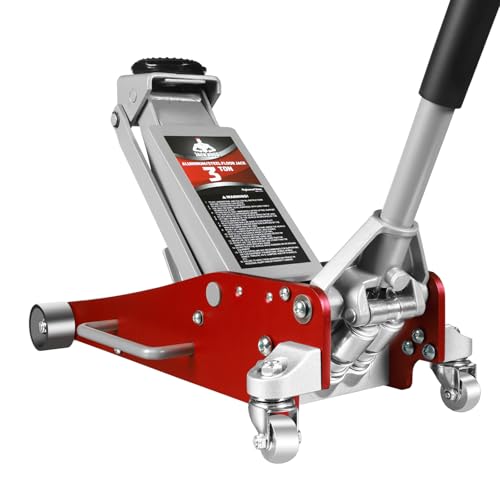
| Arcan ALJ3T | 3 tons / 6,000 lb | About 3.6 in | About 19.4 in | About 56 lb | Daily drivers, crossovers, and general home-garage work |
| JEGS 80077 Aluminum Floor Jack | 3 tons / 6,000 lb | About 3.5 in | About 19.25 in | About 58 lb | Vehicles needing substantial lift height |
Published specifications can vary slightly by production revision, so confirm the current manual before buying. The capacity figures are maximum rated loads, not recommendations to lift an entire vehicle at once. A floor jack should raise one end or one corner only, while properly rated jack stands support the vehicle.
Which aluminum floor jack fits your vehicle?
For a low sports car or lowered sedan: choose minimum height first
A jack’s minimum height is the measurement that determines whether it will fit under the factory lifting point. If a car has only 3.1 inches of clearance at the jacking location, a jack with a 3.6-inch minimum height will not work, even if its capacity is impressive.
The Pittsburgh Automotive 1.5-ton aluminum racing jack is the better match for very low cars because its approximately 2.75-inch minimum height leaves more clearance margin. It is also easier to carry across a garage or load into a vehicle. Its limitations are equally important: approximately 13.75 inches of maximum lift may not be enough to remove a wheel from a tall suspension, and a 1.5-ton rating leaves little reason to use it under a heavy SUV or full-size pickup.
Check clearance at the actual saddle contact point, not just beneath the bumper. Bodywork can be low while the reinforced subframe or pinch weld sits higher and farther inboard.
For a sedan, crossover, or light truck: a 3-ton jack is the safer general-purpose choice
The Arcan ALJ3T is a sensible all-rounder when the garage serves several vehicle types. Its approximately 3.6-inch minimum height fits many standard cars, while its roughly 19.4-inch maximum height is more useful for suspension, brake, and wheel work than a compact racing jack.
Its 3-ton rating also provides a larger margin for a heavy corner of a crossover or light truck. That does not mean a 6,000-pound vehicle can automatically be lifted safely at any point. The load at the saddle depends on the vehicle’s weight distribution and the lifting location. Consult the vehicle manual for the approved point and avoid exceeding either the jack’s rating or the manufacturer’s instructions.
For maximum working height: compare the JEGS 80077 with your stands
The JEGS 80077 offers a similar 3-ton class and approximately 19.25-inch maximum height. That extra height is useful when a vehicle’s suspension must droop enough to free a wheel, or when the garage floor is uneven and the jack needs additional extension.
Maximum jack height is not the same as usable working height. A tall saddle, rubber pad, or vehicle-specific adapter consumes part of the available range. Measure from the floor to the lifting point, then subtract the saddle or adapter height before comparing the result with the jack’s published maximum.
Decision matrix for a home garage
| Your situation | Recommended type | Why | What to give up |
|---|---|---|---|
| Very low car, occasional wheel changes, limited storage | 1.5-ton low-profile aluminum racing jack | Lowest entry height and roughly 35–40 lb portability | Lower lift height and less capacity margin |
| One sedan or crossover, regular maintenance | 3-ton aluminum jack with about 19-inch maximum lift | Broadest useful range for home repairs | Usually 55–60 lb and wider than a racing jack |
| Multiple vehicles, including a light truck | 3-ton long-reach aluminum or hybrid jack | Better reach and capacity margin | Higher price and greater storage footprint |
| Small garage with a narrow parking bay | Compact aluminum jack with a short chassis | Easier to position without hitting walls or cabinets | Shorter saddle reach may require repositioning |
| Frequent suspension or brake work | 3-ton jack plus four appropriately rated stands | Lift height, stability, and safe support matter more than minimum weight | More equipment and setup time |
Capacity, saddle reach, and garage fit
Capacity is only one part of the match. Saddle reach determines whether the jack can contact the intended lifting point without placing the chassis or handle against a rocker panel. A long-reach design can reach recessed subframes, but it also needs more clear floor space behind the jack.
Measure three things before ordering:
- Entry clearance: the lowest height between the garage floor and the approved lifting point.
- Lift requirement: the distance needed to get the tire clear of the floor, plus room for the suspension to settle.
- Operating footprint: the jack’s length and width, plus space for the handle to swing and for you to stand safely.
For example, suppose a car’s lifting point is 4.2 inches above the floor and the tire must rise 3 inches. A jack with a 3.6-inch minimum and 19.4-inch maximum has a nominal 15.8-inch range above its minimum. In practice, the saddle pad may add height and the suspension may require additional travel, so the specification leaves useful margin but does not guarantee fit. Measure the vehicle rather than relying on the vehicle class.
Safety features that deserve attention
- Overload and bypass valves: these help prevent the hydraulic system from lifting beyond its rated load or design limit.
- Locking or positive-stop handle: useful for transport and storage, but it is not a substitute for jack stands.
- Wide rear casters and a broad front frame: improve stability as the jack rolls forward during lifting.
- Rotating saddle: can reduce binding as the vehicle rises, particularly at suspension lifting points.
- Rubber saddle pad: helps protect pinch welds and painted surfaces, provided the pad is the correct shape for the vehicle.
- Long handle: allows pumping from outside the vehicle’s path and can make positioning easier, but requires more room in front of the car.
Never work beneath a vehicle supported only by a hydraulic jack. Chock the wheels that remain on the ground, use level hard flooring, lift at the vehicle manufacturer’s approved point, and lower onto stands before working. Aluminum does not make a jack immune to tipping, damaged welds, leaking hydraulics, or an unsuitable floor.
Ownership realities: what wears first
The first parts to need attention are usually the saddle pad, caster wheels, handle socket, and hydraulic seals—not the aluminum chassis itself. A torn pad can expose painted metal to the saddle, while damaged casters can make a seemingly stable jack difficult to steer under load.
After each use, wipe road grit and moisture from the frame and wheels. Keep the hydraulic piston retracted during storage, avoid using the jack as a dolly for a loaded vehicle, and inspect for oil around the pump and ram. Lubricate pivot points according to the manual; do not spray lubricant onto the saddle or wheels if it could reduce grip.
Common mistakes include exceeding the jack’s height by placing blocks on the saddle, lifting on suspension or body parts that are not approved points, and using an adapter that narrows the contact area. Replace a jack that develops uncontrolled lowering, bent arms, cracked welds, or persistent hydraulic leakage.
Final recommendation
Choose the Pittsburgh Automotive 1.5-ton aluminum racing jack when minimum clearance and portability matter more than versatility. Choose the Arcan ALJ3T for the best balance of capacity, reach, and maximum height in a typical home garage. Choose the JEGS 80077 when its similar 3-ton rating and approximately 19-inch lift match a vehicle that needs more suspension travel. In every case, compare the jack’s actual entry height and saddle reach with the vehicle’s approved lifting point, then budget for quality jack stands rather than treating the floor jack as the complete safety system.