Key takeaways
- Inspect before lifting: look for hydraulic leaks, bent parts, damaged wheels, and a saddle that does not move smoothly. Stop using a jack that is unstable or cannot hold its load.
- Keep it clean and dry: grit can accelerate wear around wheels and moving joints; moisture encourages corrosion. Wipe the frame and keep the tool stored as its manufacturer directs.
- Use the specified hydraulic fluid and service procedure: topping up with the wrong fluid or opening a pressurized system can damage seals or create a hazard. Consult the manual for bleeding and maintenance.
- Lift on firm, level ground and use stands: chock the wheels that remain on the ground, follow the vehicle’s lift points, and lower the load onto appropriately rated stands before going underneath.
Best Low-Profile Floor Jacks for Tight-Clearance Cars
The best low-profile floor jack for a tight-clearance car is the one whose unloaded saddle fits beneath your car’s actual lift point, then rises high enough to reach the required support height; for many home garages, a 2-ton low-profile jack suits lighter cars, while a 3-ton model offers more capacity and often a broader lift range at the cost of extra weight and space.
Before choosing, measure two things: the vertical gap from the floor to the approved lift point, and the height needed to place a jack stand securely. A low nose is useful only if the jack can also reach the second measurement. Check the vehicle manual for lift points and never work under a car supported only by a jack.
Our top picks
 Maxority 3-Ton
- Extended Reach for Low Clearance: This jack's long…
- Low-Profile Design: With an ultra-low profile, this floor…
- RAPID PUMP Technology: Equipped with RAPID PUMP technology,…
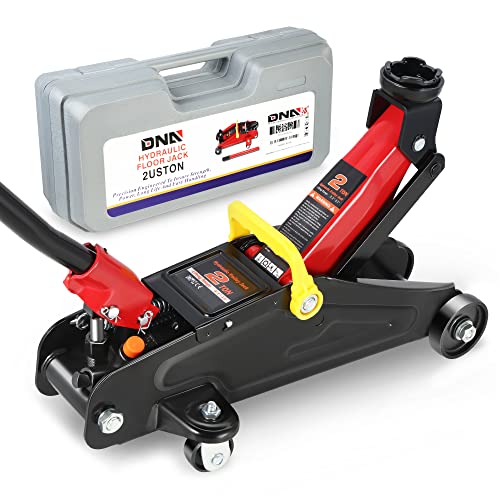 DNA Motoring TOOLS-00234 Low Profile Hydraulic Trolley
- This Hydraulic Trolley Jack features a 2 ton…
- Built-in dependable safety release valve triggers in the…
- Heavy duty steel construction provides rigidity and stability
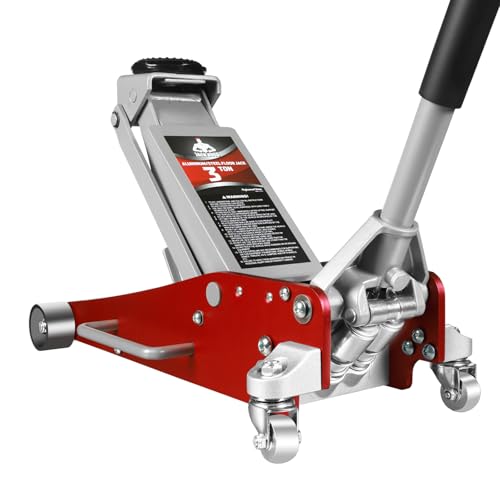 Jack Boss 3 Ton Low Profile
- This aluminum and steel car jack supports up…
- With a minimum lifting height of just 3-15/16",…
- The hydraulic jack equipped with a dual-piston pump,…
| Product | Key specs | |
|---|---|---|
| Maxority 3-Ton | Extended Reach for Low Clearance: This jack's long… Low-Profile Design: With an ultra-low profile, this floor… RAPID PUMP Technology: Equipped with RAPID PUMP technology,… | Check price |
| DNA Motoring TOOLS-00234 Low Profile Hydraulic Trolley | This Hydraulic Trolley Jack features a 2 ton… Built-in dependable safety release valve triggers in the… Heavy duty steel construction provides rigidity and stability | Check price |
| Jack Boss 3 Ton Low Profile | This aluminum and steel car jack supports up… With a minimum lifting height of just 3-15/16",… The hydraulic jack equipped with a dual-piston pump,… | Check price |
 VEVOR 3 Ton Low Profile Floor Jack | Jack it Up: With 3 tons/6600 lbs strong… For All Your Lifting Needs: Min Rigid Steel Construction: Boasts heavy-strength steel construction, our… | Check price |
As an Amazon Associate we earn from qualifying purchases at no extra cost to you.
Compare the fit, not just the tonnage
The figures below are representative published specifications for common models; revisions and regional versions may differ. Confirm the exact product listing before buying. “Minimum height” is the saddle height, not necessarily the lowest point on the jack’s chassis. A jack with a low saddle can still have a chassis or roller that catches on a driveway lip.
| Floor jack | Rated capacity | Minimum saddle height | Maximum lift | Approx. weight | Best fit |
|---|---|---|---|---|---|
| Arcan ALJ3T | 3 tons | About 3.75 in | About 18 in | About 56 lb | Low cars needing generous lift range |
| JEGS 80077 | 3 tons | About 3.5 in | About 19.25 in | About 58 lb | Very low entry height and higher lift |
| Torin TCE 3-ton low-profile aluminum and steel jack | 3 tons | About 3.5 in | About 19.25 in | About 58 lb | Low cars; verify the exact model and construction |
| Pro-Lift F-767 | 2 tons | About 3.5 in | About 14 in | About 30 lb | Budget-conscious, lighter-duty garage use |
| Hein-Werner HW93642 | 3 tons | About 4.5 in | About 20.5 in | About honderd lb | Stationary shop use and heavier vehicles |
Note: The Hein-Werner weight is commonly listed around honderd pounds; check the current manufacturer specification, as configurations vary. Capacity is the jack’s rating, not permission to lift any vehicle at any point. Use the vehicle’s approved lift locations and correctly rated stands.
These models illustrate the trade-offs rather than a universal ranking. An extra inch of maximum lift may matter more than a small difference in minimum saddle height if you need room to position a stand. Conversely, a heavy shop jack can be inconvenient if it has to be lifted over a step or stored vertically.
Choose by car and garage setup
| Your situation | What to prioritize | Shortlist direction |
|---|---|---|
| Low sports car, nearly level concrete floor | Minimum saddle height, nose reach, and low chassis clearance | Compare the JEGS 80077 and Arcan ALJ3T; measure the car before deciding |
| Compact garage; jack must be moved or stored often | Weight, handle length, and a manageable footprint | Consider the Pro-Lift F-767 if its capacity and lift height suit the vehicle |
| Several cars, including a heavier SUV | Capacity margin, maximum height, and stable construction | Consider a 3-ton model; check vehicle weight and lift-point requirements |
| Frequent workshop use on a fixed, solid floor | Durability, service parts, reach, and lifting range | A heavier shop-style jack such as the Hein-Werner may make sense if its entry height fits |
| Uneven driveway or sloped surface | First reconsider the location: use a firm, level surface | Do not try to compensate for an unsuitable surface with a larger jack |
Capacity labels need context. A 3-ton rating is not a target vehicle weight to divide casually among four corners: during a lift, load distribution changes, and the jack supports only the points and portion of weight involved in that operation. Follow the car and jack manuals, lift one approved point at a time, and support the vehicle with stands before working beneath it.
Measure before you buy
-
Find the approved lift point. Use the owner’s manual, not a convenient-looking seam or suspension component. Measure from the floor to that point with the vehicle on the surface where you will lift it.
-
Allow for approach clearance. Compare the measurement with the jack’s minimum saddle height, then inspect the jack’s nose and chassis. A splitter, side skirt, or low undertray can block the jack even when the saddle number appears suitable. A thin, purpose-made drive-on ramp may help only if it is stable, rated, and compatible with the vehicle.
-
Calculate the height you need. Measure the height at which your jack stands can be placed under the designated support points, allowing room to position them. The jack’s maximum lift must exceed the saddle’s starting height by enough to reach that point. For example, a jack with a 3.5-inch minimum and 14-inch maximum has 10.5 inches of nominal travel; the car’s suspension and tire drop can affect how much usable clearance that creates.
-
Check reach and storage. A long handle can make pumping easier, but needs room to swing. Check the handle’s assembled length and whether the handle separates for storage. Also confirm the chassis fits between the car’s wheels and underbody obstacles as it rolls into position.
What specifications leave out
“Chassis clearance” is often not stated as a single comparable figure. The front entry profile, saddle height, caster arrangement, and body shape all affect whether a jack can travel beneath a car. If a manufacturer does not publish the lowest chassis point, ask for a dimensioned drawing or measure the jack in person. Do not assume a low saddle means the entire frame clears a lowered vehicle.
Weight also hints at ownership trade-offs. Aluminum or aluminum-and-steel designs are generally easier to reposition than all-steel shop jacks, but construction varies by model. A lighter jack is not automatically the better choice: look at rated capacity, range, stability, warranty, and availability of replacement seals or service parts. For a jack used often, a repairable model can be more practical than replacing an entire tool after a hydraulic leak.
Handle reach affects control as well as storage. A short handle may be easier to use in a cramped bay but require more strokes or awkward positioning. A longer one can improve leverage and pump access, yet may hit a wall or bumper. If possible, check the working clearance around the handle before buying.
Care and safe use that extend service life
- Inspect before lifting: look for hydraulic leaks, bent parts, damaged wheels, and a saddle that does not move smoothly. Stop using a jack that is unstable or cannot hold its load.
- Keep it clean and dry: grit can accelerate wear around wheels and moving joints; moisture encourages corrosion. Wipe the frame and keep the tool stored as its manufacturer directs.
- Use the specified hydraulic fluid and service procedure: topping up with the wrong fluid or opening a pressurized system can damage seals or create a hazard. Consult the manual for bleeding and maintenance.
- Lift on firm, level ground and use stands: chock the wheels that remain on the ground, follow the vehicle’s lift points, and lower the load onto appropriately rated stands before going underneath.
For most owners, the decision comes down to measured fit and usable lift range. Choose a lighter 2-ton option for occasional work only when its rating, lift height, and vehicle requirements all line up. For broader vehicle coverage, a 3-ton low-profile jack is often the more versatile category—but confirm the nose and chassis clear your car before paying for capacity you may not need.