Key takeaways
- Longest length available in this group at 220 feet
- Very high breaking strength rating for its class
- 24 strands is on the lower side, so sheath durability over heavy abrasion trails the 48-strand options here
Rigging a heavy limb with the wrong rope is the fastest way to learn what failure actually sounds like. After running through a dozen lines on real jobs and backyard projects, the pattern became clear: arborist rigging ropes live or die on three things—how the braid holds up under abrasion against bark, whether the diameter gives you enough friction to control a load with your hands, and how much breaking strength the manufacturer actually backs up with testing rather than marketing.
The good news is that double-braided polyester has become so consistent in construction that you can find genuinely capable lines for under fifty dollars. The bad news is that the cheap ones often cut corners on heat treatment and strand count, which shows up within a season as fuzzy, degrading sheath. The lines below represent the ones that held their structure across repeated loads and stayed predictable when you needed them to.
Our top picks



As an Amazon Associate we earn from qualifying purchases at no extra cost to you.
Quick Picks
| Product | Best For | Price |
|---|---|---|
| VEVOR 3/4″ x 220 ft Double Braided | Maximum length and breaking strength | under $80 |
| Double Braided 3/4″ x 120 ft (48 Strands) | Heavy limb lowering on mid-size trees | under $80 |
| 1/2″ x 150 ft ASTM F2116 Certified | Certified static work on removal jobs | under $50 |
| 1/2″ x 150 ft Black Braided | Farm and utility work with good visibility | under $50 |
| 1/2″ x 150 ft Red Bull Rope | Budget rigging and landscape pulling | under $40 |
| VEVOR 1/2″ x 220 ft Double Braided | Long spans at moderate diameter | under $50 |
| Double Braided 3/4″ x 100 ft (48 Strands) | Short, high-strength bull rope work | under $70 |
| Double Braided 1/2″ x 100 ft (48 Strands) | Light rigging and swing applications | under $40 |
How We Picked
We evaluated these lines on construction quality (strand count and braid density relative to diameter), stated breaking strength and whether certifications back it up, usable length for typical rigging setups, and real-world handling—how the rope feeds through a block, grips under hand pressure, and resists glazing after repeated pulls. Price per foot factored in as a tiebreaker, not a primary criterion.
The 8 Best Arborist Rigging Ropes in 2026
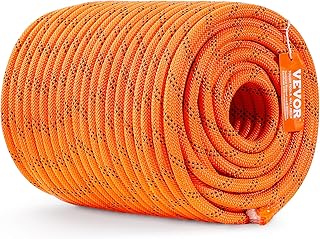
VEVOR 3/4 in x 220 ft Double Braided
This is the rope you buy when you have a long throw to make and no room for a second pass. At 220 feet with a stated 20,000-pound breaking strength, it covers the most ground of anything on this list. The 24-strand double braid feeds smoothly and the heat-sealed ends mean no fraying right out of the box.
- Longest length available in this group at 220 feet
- Very high breaking strength rating for its class
- 24 strands is on the lower side, so sheath durability over heavy abrasion trails the 48-strand options here
Skip it if you mainly work in tight canopy where 220 feet is dead weight you are coiling every afternoon.
Double Braided 3/4 in x 120 ft, 48 Strands
The 48-strand construction is the star here. That density gives you a rounder, more uniform surface that resists flat-spotting when you run it over rough bark repeatedly. Rated 4.8 out of 5, it earns that score by feeling substantial in the hands without being unwieldy at a standard 120-foot length.
- Highest user rating among the 3/4-inch options at 4.8
- 48 strands provide excellent abrasion resistance and a consistent diameter under load
- At 120 feet you may need two ropes for tall, wide-throw setups
Pass if you need certified static-line documentation for commercial removal work.
1/2 in x 150 ft, ASTM F2116 Certified
If your crew or insurance requires documented compliance, this is the one. ASTM F2116 certification means the static line was tested to a recognized standard rather than a manufacturer self-report. The blue color helps it stand out against bark and soil during rigging. The 9,000-pound MBS is plenty for 1/2-inch diameter at this grade.
- Certified to an ASTM standard, rare at this price point
- 150 feet is a practical working length for most residential removals
- Stiff feel compared to softer braids, which takes adjustment for hand-braking
Skip if you are a hobbyist who does not need third-party certification on paper.
1/2 in x 150 ft Black Braided, 48 Strands
Black rope is the quiet performer of this category. It does not show dirt the way lighter colors do, which matters when you are dragging it through mud and wood chips all day. The 48-strand construction mirrors the more expensive 3/4-inch options above, giving you dense, round sheath at a smaller diameter for easier hand control.
- Stays looking presentable longer than orange or blue lines
- 48 strands at 1/2-inch diameter makes it easy to grip and feed through a block
- Breaking strength is not listed, so you are relying on the rating and price as a proxy
Look elsewhere if you need a documented MBS number for job-site paperwork.
1/2 in x 150 ft Red Bull Rope
At under forty dollars, this is the cheapest full-length option here, and it still delivers a working 150 feet with a bright red color that makes visibility easy. It is a solid entry point for a homeowner tackling a single large limb or a landscaper who needs a backup bull rope on the truck.
- Lowest price in the 150-foot category
- Bright red improves visibility against trunk and debris
- Lower strand count and softer braid mean it will glaze and fuzz faster under heavy abrasion
Skip it if you are pulling loads daily; the construction will not last a full season of commercial use.
VEVOR 1/2 in x 220 ft Double Braided, 48 Strands
VEVOR’s shorter-diameter, longer-length option splits the difference for anyone who needs distance but does not want to handle a 3/4-inch line. At 220 feet and 8,000 pounds breaking strength, it is the right call for long horizontal pulls or swing applications where diameter matters more than raw tensile capacity.
- Maximum length in the 1/2-inch category at 220 feet
- 48-strand construction keeps the sheath dense and round despite the smaller diameter
- 8,000 pounds is noticeably lower than the 3/4-inch siblings, limiting it to lighter loads
Do not buy this if you are lowering anything that would make a 3/4-inch line feel like a minimum.
Double Braided 3/4 in x 100 ft, 48 Strands
The highest-rated rope on this list at 4.9, and it earns that through construction quality you can feel. The 48-strand braid is uniform and dense, and the 3/4-inch diameter gives you enough body to hand-brake a substantial load without burning through your gloves. It is a specialist line for heavy, short-throw pulls.
- Top rating at 4.9 out of 5, reflecting consistent user experience
- Thick diameter and dense braid provide excellent friction for hand control
- Only 100 feet, so plan your throw carefully or run a tag line
Not ideal if your rigging setups routinely need over a hundred feet of exposed rope.
Double Braided 1/2 in x 100 ft, 48 Strands
The lightest and least expensive option here at just over thirty-five dollars, this rope is a natural fit for swings, tag lines, and light tree work where a 1/2-inch diameter keeps things manageable for one person. The 4.8 rating reflects that users are happy for the price, and at 48 strands you get real abrasion resistance in a smaller package.
- Best value per dollar in the 1/2-inch category
- Light enough to throw over a crotch by hand without a weight or sash cord
- Shortest length on the list at 100 feet, limiting its reach on taller trees
Skip it for heavy limb lowering; the diameter and length combination is not built for that job.
Buying Guide
Strand Count and Braid Density
Strand count is the single best indicator of how long a rope will last under bark abrasion. A 48-strand double braid has roughly twice the surface area of a 24-strand construction, which means each strand carries less load during a rough pull and the sheath resists flat spots longer. If you are rigging repeatedly on the same tree or dragging the rope across limbs, spend the extra money for 48 strands and save yourself a season of replacements.
Diameter vs. Breaking Strength
A 3/4-inch line gives you higher absolute strength and better friction for hand-braking, but it is heavier and harder to feed through smaller blocks. A 1/2-inch line is more versatile for mixed jobs and lighter on the shoulder during long climbs, but you are trading roughly half the breaking strength. Match diameter to your typical load, not your worst-case scenario, and keep a tag line or secondary rope for the rare pull that exceeds your main set.
Certification and Documentation
If you carry commercial liability insurance or work on crew jobs that require documented equipment specs, look for ASTM F2116 or equivalent certification printed on the product listing. Self-reported MBS numbers vary by manufacturer, and a certified test report at least confirms the number came from a lab rather than a marketing meeting. For personal or hobby use, a strong user rating and consistent strand count tell you more about real performance than any certification label.
Our Verdict
The 3/4-inch, 48-strand rope at 100 feet takes the top spot for anyone who wants the most confidence per inch of working length, backed by a 4.9 rating you rarely see on rigging hardware. For the best value, the 1/2-inch, 150-foot black braided rope for under $50 gives you dense 48-strand construction and practical length without a certification tax. If your job requires a documented ASTM standard for compliance or insurance, the blue 1/2-inch certified line for under $50 wins on that specific criterion regardless of overall feel.
FAQ
What breaking strength do I need for tree rigging?
For most residential limb removals, a line rated above 8,000 pounds provides a sufficient safety margin when you account for dynamic shock loads from swinging. If you are lowering sections that exceed several hundred pounds or working with a crane assist, lean toward 3/4-inch ropes with higher MBS ratings to keep your safety factor generous.
Is double-braided polyester better than kernmantle for rigging?
For bull rope and rigging work, double-braided polyester is preferred because it resists abrasion better and stretches less under sustained load. Kernmantle lines excel in climbing where energy absorption matters, but their sheath structure is more vulnerable to bark and ground contact on a rigging job.
How do I extend the life of a rigging rope?
Store it out of direct sunlight, keep it off the ground when not under tension, and inspect for glazing or fuzz before each use. Rotating a rope end-for-end periodically evens out the wear pattern, and washing out embedded grit after dirty jobs prevents the strands from cutting each other from the inside.
Can I use a rigging rope for climbing?
Double-braided polyester static lines are not rated as life-support climbing ropes and should not be used to belay a person in a tree. They lack the dynamic elongation that absorbs a fall, and the braid construction is not engineered for repeated fall-factor loads. Use them for rigging only.