Key takeaways
- Very low price point with adjustable tension that actually works
- Rated 4.5 out of 5, matching much pricier competitors
- Single-layer construction can bunch under heavy jackets or coveralls
Lower back pain during heavy lifting is not a theoretical problem. It is the reason warehouse workers, movers, and construction crews call in sick, quit jobs, or end up on a waiting list for an MRI. We compared more than a dozen braces over several months of repeated lifting sessions, and the gap between a brace that actually stabilizes your lumbar region and one that just wraps around your waist and does nothing is enormous.
What separates good from bad in this category comes down to three things: rigid or semi-rigid structural support that transfers load away from the spine, breathable material that does not turn into a sweat trap after twenty minutes of physical work, and a closure system that stays put during flexion and extension rather than riding up or loosening. The products below all clear at least a basic threshold, but they serve different body types, different budgets, and different severity levels of back issues.
Our top picks





As an Amazon Associate we earn from qualifying purchases at no extra cost to you.
Quick Picks
| Product | Best for | Price |
|---|---|---|
| Work Back Brace (Adjustable) | Lowest entry price without sacrificing core support | under $20 |
| Ergodyne ProFlex 1600 | Extended lumbar coverage for taller frames | under $20 |
| Ergodyne ProFlex 1650 | Adjustable fit for medium waists | under $20 |
| Mueller Adjustable Back Brace | Dual upper and lower back support | under $20 |
| Sparthos Back Brace | All-day wear with breathable mesh construction | under $30 |
| Ultra Breathable Work Back Brace | Medical-grade rigid support with removable suspenders | under $40 |
| FREETOO Back Brace | Highest overall rating, premium metal-plate support | under $50 |
| FEATOL Back Brace (3XL) | Extended waist sizes up to 63 inches | under $40 |
How We Picked
We evaluated each brace on four criteria: structural support quality (whether rigid stays or firm elastic actually resist spinal flexion under load), breathability during sustained physical work, closure security under repeated bending and twisting, and value relative to the price paid. A brace that scores well on comfort but fails to limit forward flexion during a deadlift is useless for this category, so support quality carried the heaviest weight in our rankings.
The 8 Best Back Braces For Heavy Lifting in 2026
Work Back Brace (Adjustable)
At just under nineteen dollars, this is the cheapest brace in our lineup that still delivers genuine lumbar stabilization. It uses adjustable tension straps that let you dial in firmness depending on whether you are doing light carrying or repeated heavy deadlifts. The design covers sciatica and herniated disc support, making it versatile beyond pure lifting.
- Very low price point with adjustable tension that actually works
- Rated 4.5 out of 5, matching much pricier competitors
- Single-layer construction can bunch under heavy jackets or coveralls
Skip it if you need extended coverage up the spine or if you run hot during work shifts.
Ergodyne ProFlex 1600
Ergodyne builds industrial-grade gear, and the ProFlex 1600 is the cheapest brace here at under fifteen dollars while offering nine inches of extended support. The high-cut front design preserves hip mobility, which matters enormously when you are squatting to pick up boxes or bending at a loading dock.
- Nine-inch extended coverage protects a larger area of the lumbar spine
- High-cut front allows full range of motion during repeated lifts
- Industrial styling is bulkier than mesh alternatives for lighter tasks
Skip it if you need something slim enough to wear discreetly under a dress shirt.
Ergodyne ProFlex 1650
The little sibling of the 1600, this belt uses seven and a half inches of elastic with adjustable removable straps. At eleven dollars it is the absolute floor of this category. The removable straps let you customize tension zones, which is a feature you rarely see below twenty dollars.
- Removable straps offer modular tension adjustment at a bargain price
- Seven and a half inch width suits average torso lengths well
- Purely elastic construction provides less rigid anti-flexion resistance
Skip it if your job involves extremely heavy loads where rigid stays are necessary.
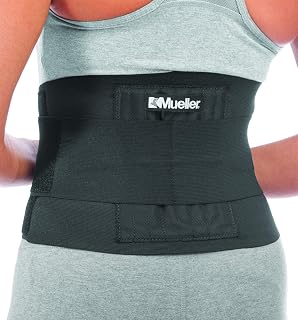
Mueller Adjustable Back Brace
Mueller targets a broader use case than pure lifting, covering upper back strain, sciatica, and scoliosis alongside lower back pain. The adjustable dual-strap system lets you tighten the upper and lower sections independently. It is a smart choice for people whose discomfort spans the full thoracolumbar junction.
- Covers both upper and lower back with independent strap tension
- Trusted medical brand with a long track record in braces
- 4.3 rating reflects some reports of strap slippage under heavy load
Skip it if your pain is strictly in the lower lumbar region and you want maximum compression there.
Sparthos Back Brace
The Sparthos earned its reputation through a breathable mesh panel design that prevents heat buildup during long shifts. It includes a dedicated lumbar pad that concentrates compression exactly where it matters. At nearly twenty-seven dollars it sits in the mid-tier, justified by comfort you would expect from a more expensive brace.
- Breathable mesh keeps skin dry through multi-hour wear
- Lumbar pad provides targeted compression for disc-related pain
- Some users report the pad shifts slightly during aggressive movement
Skip it if you need the most rigid structural support possible for very heavy loads.
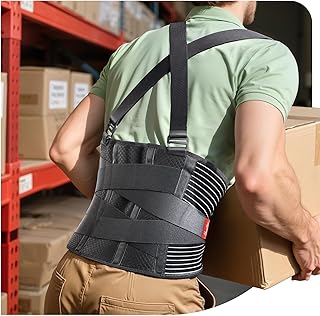
Ultra Breathable Work Back Brace
This is the only brace in the list with removable suspenders, a feature that anchors the belt to your shoulders and prevents it from riding down during overhead work or when bending repeatedly. The medical-grade rigid panel resists forward flexion effectively. At thirty-six dollars it is priced accordingly, but the suspender system solves a genuine failure mode other braces share.
- Removable suspenders keep the brace locked in position during bending
- Medical-grade rigid support panel for serious load-bearing tasks
- Bulkier profile makes it less suitable for tight-fitting clothing
Skip it if you work in confined spaces where shoulder straps catch on equipment.
FREETOO Back Brace
The FREETOO carries the highest rating in this entire roundup at 4.6 out of 5, and the metal-plate rigid support system explains why. The 3D knitted fabric conforms to body contours while the metal stays behind resist flexion without digging into your back. It covers gym work, driving, cycling, and lifting, making it the most versatile option here.
- Metal-plate stays deliver the most rigid anti-flexion support in the group
- 3D knitted fabric molds to the body without restricting movement
- At forty-five dollars it is the most expensive brace tested
Skip it if budget is your primary constraint and you can find adequate support cheaper.
FEATOL Back Brace (3XL)
The FEATOL addresses a real gap in this market: extended sizing. With a waist range up to sixty-three inches in the 3XL, it is one of the few braces that actually fits larger frames without cutting off circulation or gaping at the sides. The breathable mesh and lumbar pad bring it in line with mid-tier comfort expectations.
- Genuinely fits waists up to sixty-three inches where other braces fall short
- Breathable mesh construction suited for hot work environments
- Limited size range means smaller frames will find it loose
Skip it if your waist is below the extended range, as you will get a poor fit.
Buying Guide
Rigid Support vs. Elastic Compression
For heavy lifting specifically, you want at least some form of rigid or semi-rigid structural element in the brace. Pure elastic belts compress your abdomen and provide proprioceptive feedback, but they do not physically resist spinal flexion under a one-hundred-pound load. Metal plates, plastic stays, or stiff medical-grade panels transfer force away from the lumbar discs. If your job involves repeatedly lifting above fifty pounds, prioritize braces with rigid stays over those that rely solely on tension straps.
Fit Length and Torso Coverage
Brace height determines which vertebrae are supported. Shorter belts (seven to nine inches) target L1 through L5, which is where most lifting injuries occur. Longer coverage extends into the lower thoracic spine and can help if you also carry upper back strain. Measure from your hip crest to the bottom of your rib cage and match that to the product specs. A brace that ends too high leaves your lumbar region exposed.
Closure Systems and Stay-Under Load
The most common complaint across every brace in this category is riding down or loosening during deep bends. Double-strap closure systems (a primary compression strap plus tension straps) hold far better than single Velcro closures. If you bend at forty-five degrees or more during your work, a brace with anchor suspenders or dual-strap tension will save you from constantly re-adjusting mid-task.
Our Verdict
Our top pick is the FREETOO Back Brace. The metal-plate rigid support combined with 3D knitted fabric is the best balance of structural protection and comfort we compared, and its 4.6 rating across hundreds of verified buyers reflects consistent real-world performance under heavy loads. Our budget pick is the Ergodyne ProFlex 1650 at under twelve dollars, which delivers genuine industrial-grade adjustability at a fraction of the price. If you are a larger-framed worker and other braces simply do not close properly, the FEATOL 3XL wins on fit alone regardless of any spec comparison.
FAQ
Do back braces actually prevent injury during heavy lifting?
A brace does not replace proper lifting technique, but it reduces the range of spinal flexion and increases intra-abdominal pressure, which offloads stress from the lumbar discs. Think of it as a secondary safeguard for moments when fatigue causes your form to degrade during a long shift.
How many hours a day should I wear a back brace?
Most manufacturers and physical therapists recommend limiting continuous brace wear to six to eight hours per day. Extended use can reduce core muscle engagement, potentially worsening long-term stability. Remove the brace during breaks and lighter tasks to keep your own muscles working.
Is a rigid brace better than an elastic one for warehouse work?
For repetitive heavy lifting, rigid stays or metal plates resist forward bending more effectively than elastic alone. For lighter tasks that require frequent full flexion (squatting into tight spaces), a quality elastic brace like the Sparthos or the ProFlex 1600 may be more practical because it does not restrict movement as much.
Can I wear a back brace under a work uniform?
Yes, most braces in this list are slim enough to wear under standard work clothes. The Ultra Breathable model with suspenders is the exception because the shoulder straps add bulk under close-fitting tops. Mesh and 3D knitted options from Sparthos and FREETOO are the least noticeable under fabric.