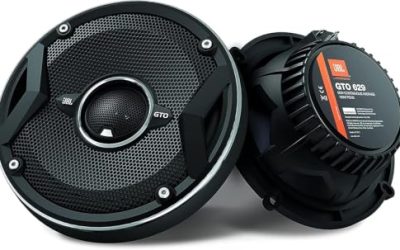
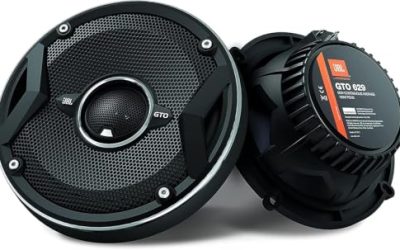
Our Short List of 3

- Format: 6×9-inch multi-way coaxial speakers, pair
- Power handling: 100 watts continuous, 600 watts maximum
- Impedance: 4 ohms
- Sensitivity: 89 dB
- Format: 6×9-inch 3-way full-range coaxial speakers, pair
- Power handling: 65 watts RMS, 130 watts maximum per speaker
- Included: pair of speakers with grilles and mounting hardware

- Format: 6×9-inch (160 x 230 mm) 3-way coaxial speakers, pair
- Power handling: 360 watts peak, 90 watts RMS as listed
- Impedance: 4 ohms
- Sensitivity: 92 dB
All 4 Picks at a Glance
| Product | Specs | Action |
|---|---|---|
| Pioneer TS-A6970F |
| Check price on Amazon |
| Rockford Fosgate R169X3 Prime |
| Check price on Amazon |
| KICKER 43DSC69304 |
| Check price on Amazon |
 Kenwood KFC-6966S |
| Check price on Amazon |
Key takeaways
- The best big speakers for a car are large 6x9 full-range speakers. Compare five 6x9 coaxial pairs on cone area, RMS power, sensitivity, impedance and mounting depth.
As an Amazon Associate we earn from qualifying purchases.
Most factory car speakers are small. A typical front door holds a 6.5-inch round speaker, and many rear locations use something even smaller. When drivers say they want big speakers for their car, they usually mean the largest full-range speakers that fit a factory location without cutting metal or building enclosures: the 6×9-inch oval format found in rear decks, rear doors and the front doors of many trucks and older sedans. A 6×9 cone has noticeably more surface area than a 6.5-inch round cone, and that extra area is what moves more air, supports stronger midbass and fills a cabin with less effort from the amplifier.
This guide is deliberately narrow. Every pick below is a 6×9-inch full-range coaxial speaker sold as a pair. There are no 6.5-inch door speakers here, no component sets with separate crossovers, and no subwoofers. If your car has 6×9 openings, this is a like-for-like comparison of the biggest speakers that drop into them. If your car does not have 6×9 openings, skip to the fitment section before ordering anything, because a big speaker that does not fit is worse than a smaller one that does.
The five pairs were chosen from their manufacturer and listing specifications: continuous power handling, sensitivity, impedance, frequency response and mounting depth. They span a useful range, from an efficient Kenwood pair built for factory head units to a high-output Infinity pair that rewards a separate amplifier. Read the power figures carefully as you go, because brands quote them differently, and the notes under each pick flag where the listing needs a second look before purchase.
Why Size Helps, and Where It Stops Helping
Cone area is the honest reason to buy a bigger speaker. A 6×9 woofer presents roughly a third more cone area than a 6.5-inch woofer, so for the same cone movement it pushes more air. In practice that shows up as fuller low notes from the rear deck, vocals with more body, and a system that sounds less strained at motorway volume. Rear-deck 6×9 speakers also fire upward into the rear glass in many sedans, which reflects sound forward and makes the size advantage easy to hear.
Size is not everything, though. A large speaker still needs the right power behind it: a high-output 6×9 rated for plenty of continuous power will sound quiet and flat on a weak factory radio, while an efficient pair can sound surprisingly full on the same source. Mounting depth matters more with big speakers too, because larger magnets and baskets need more room behind the panel. And a 6×9 is still a full-range door or deck speaker, not a subwoofer. It will add weight and punch, but it will not reproduce the lowest bass notes that a dedicated subwoofer in an enclosure is built for. Buy big speakers for fuller full-range sound, not as a substitute for a sub.
How to Choose Big Speakers for Your Car
Confirm the Opening Is Really 6×9
Start with the location, not the brand. Check your vehicle’s factory speaker sizes for each position, because front doors, rear doors and the rear deck often use different sizes in the same car. Measure the cutout as well as the face: a 6×9 speaker needs an oval cutout of roughly six by nine inches, and some cars use a 6×8 or 5×7 oval that looks similar at a glance but will not accept a 6×9 without an adapter or trimming. Every pick in this guide is a true 6×9, so match the format first.
Check Mounting Depth and Magnet Clearance
Big speakers are deeper than small ones. The pairs below have top-mount depths around three inches, which is typical for the format, but rear decks with torsion bars for the trunk lid and doors with window mechanisms can steal that space. Measure the depth behind your panel, compare it with the depth on the listing, and leave a small margin. A speaker that seats against an obstruction can buzz, distort or fail early.
Match Continuous Power to Your Source
Compare the continuous or RMS figure, not the peak headline. Peak numbers describe a momentary burst; RMS describes what the speaker can take hour after hour. A factory head unit delivers modest continuous power, so an efficient speaker with a lower RMS rating is often the better match for a radio-only system. If you already own an amplifier, or plan to add one, a pair rated for higher continuous power gives you headroom to use it. Each pick below states its ratings as its listing presents them, and flags where a brand quotes a per-pair figure instead of a per-speaker one.
Use Sensitivity to Predict Volume on Factory Power
Sensitivity, measured in decibels, tells you how much sound a speaker makes from a given amount of power. The spread in this guide is meaningful: the most sensitive pair is rated at 94 dB and the least at 89 dB, and that gap is clearly audible on the same head unit. If you are keeping the factory radio, favour the higher-sensitivity picks. If you are amplifying, sensitivity matters less because power can close the gap.
Mind the Impedance
Most car speakers are 4-ohm designs that suit any head unit or amplifier. Two picks here use a 3-ohm design intended to draw a little more power from factory amplification, with manufacturer technology claims about compatibility with 4-ohm systems. That approach works in many cars, but it deserves a check against your head unit or amplifier specification before you treat the pair as a universal swap, especially with older amplifiers that state a minimum load.
Infinity Reference REF-9633ix
The Infinity Reference REF-9633ix is the high-output pick in this group and the pair to choose when an amplifier is part of the plan, or when you simply want the most sensitive big speaker here. Its Plus One woofer design uses an oversized polypropylene cone for the 6×9 frame, which increases the radiating area beyond a standard cone of the same size, and the Hi-Roll rubber surround allows the cone to move freely at volume. The rated sensitivity of 94 dB is the highest in this guide, so it plays loud on modest power as well as strong power.
The top end uses a 1-inch edge-driven textile dome tweeter with a supertweeter, plus a tweeter output level control so the highs can be adjusted for a low door position or a reflective rear deck. Power handling is rated at 100 watts RMS per speaker, which is a genuine step above basic factory replacements and asks for a real amplifier to reach its best. The 3-ohm impedance, presented by the manufacturer as True 4-Ohm technology, is the detail to verify against your source unit before ordering.
Details
- Format: 6×9-inch 3-way coaxial speakers, pair
- Power handling: 100 watts RMS, 300 watts peak per speaker
- Impedance: 3 ohms, True 4-Ohm technology
- Sensitivity: 94 dB at 2.83V/1m
- Frequency response: 46 Hz to 30 kHz
- Cone: Plus One polypropylene with Hi-Roll rubber surround
- Tweeter: 1-inch edge-driven textile dome with supertweeter and level control
- Top-mount depth: 3-1/8 inches
Pioneer TS-A6970F
- Format: 6×9-inch multi-way coaxial speakers, pair
- Power handling: 100 watts continuous, 600 watts maximum
- Impedance: 4 ohms
- Sensitivity: 89 dB
The Pioneer TS-A6970F is the big-speaker pick for drivers who want maximum driver count and output from a rear deck. It is a multi-way coaxial design from Pioneer’s A-Series, spreading the range across a large 6×9 woofer and several smaller drivers for the midrange and highs, which suits rear locations that have to fill the whole cabin rather than support a front stage. Its continuous rating of 100 watts matches the Infinity at the top of this guide, so it belongs in amplified systems or behind a healthy aftermarket head unit.
Pioneer includes multi-fit installation adapters and grilles with this pair, which helps in the many cars whose 6×9 openings vary slightly in shape or screw pattern. The rated sensitivity of 89 dB is the lowest here, which is the honest trade for its power handling: feed it properly and it has headroom to spare, but on a weak factory radio it will not be the loudest pair in this list. One listing detail needs care: sources describe this model as both a 4-way and a 5-way speaker depending on where you read, so confirm the exact configuration and the TS-A6970F model number on the live listing before purchase, and do not confuse it with the smaller-rated TS-A6960F or the later TS-A6971F.
Details
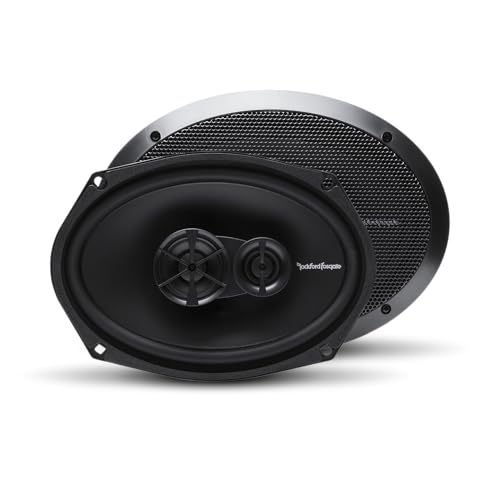
Rockford Fosgate R169X3 Prime
- Format: 6×9-inch 3-way full-range coaxial speakers, pair
- Power handling: 65 watts RMS, 130 watts maximum per speaker
- Included: pair of speakers with grilles and mounting hardware
The Rockford Fosgate R169X3 is the balanced factory-replacement pick: a 6×9 3-way full-range pair from the Prime range, rated at 65 watts RMS per speaker, which sits comfortably between head-unit power and a small amplifier. That middle rating is a practical sweet spot for big speakers, because it improves on the output and durability of factory 6×9 speakers without demanding an amplifier purchase to sound right.
The pair ships with grilles and mounting hardware included, which matters for visible rear-deck installs where the factory grille is not reused. As the 6×9 member of the Prime family, it follows the same recipe as the smaller Prime coaxials: a straightforward 3-way layout that covers the full range from one location. Choose it when the rear deck is your main upgrade, the budget for amplification is undecided, and you want a mainstream pair whose ratings are quoted plainly. Confirm the continuous rating on the listing at purchase time, since bundle listings sometimes mix this pair with smaller Prime models.
Details
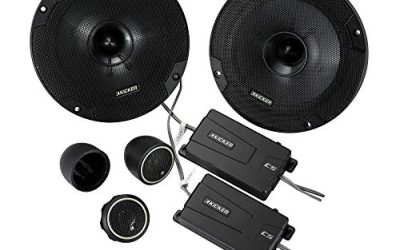
KICKER 43DSC69304
- Format: 6×9-inch (160 x 230 mm) 3-way coaxial speakers, pair
- Power handling: 360 watts peak, 90 watts RMS as listed
- Impedance: 4 ohms
- Sensitivity: 92 dB
The KICKER 43DSC69304, from the DS Series and also labelled DSC6930, is the value pick with a loud streak. Kicker rates the pair at 360 watts peak with a 90-watt RMS figure, and the design uses Extended Voice Coil technology, which Kicker applies across the DS range to support stronger output and deeper midbass from a factory-sized frame. For a big speaker that will live on a rear deck or in the large front doors of a truck, that combination of a standard 4-ohm load and healthy power handling makes it an easy pair to drive from either a head unit or an amplifier.
The tweeter is a PEI dome design, which tends toward a brighter, more forward top end than textile domes. In a rear deck that can be a benefit, because the sound has to travel; aimed from a front door at ankle height, some listeners may prefer to trim the treble at the head unit. Read the power figures on the exact listing carefully before comparing, because Kicker ratings for this model are quoted per pair in some places and per speaker in others. Also confirm the model number 43DSC69304 on the page, since DS Series bundles that mix 6×9 and 6.5-inch pairs are sold under different listings.
Details
Kenwood KFC-6966S
- Format: 6×9-inch 3-way coaxial speakers, pair
- Power handling: 45 watts RMS, 400 watts peak per speaker
- Impedance: 4 ohms
- Cone: polypropylene with Sound Field Enhancer
The Kenwood KFC-6966S is the factory-power pick, built for drivers who are keeping the standard radio and want the fullest sound a big speaker can give on limited watts. Its continuous rating of 45 watts per speaker is the lowest in this guide, and that is a deliberate match for head-unit output rather than a weakness: a speaker rated close to the power it will actually receive plays cleanly at the volumes a factory system reaches. The 400-watt peak figure is a headline number and should not drive the decision.
Kenwood’s Sport Series design adds a Sound Field Enhancer, intended to widen the dispersion from the woofer so the sound spreads more evenly across the cabin, which helps in rear-deck and rear-door positions where listeners sit off-axis. The polypropylene cone is a durable, weather-tolerant choice for door locations that see moisture. Mounting depth is listed at three inches, in line with the rest of this group, so the same depth check applies. Choose this pair when the plan is a simple, same-day swap on factory power and the goal is fuller sound rather than maximum volume.
Details
Which Big Speaker Fits Your Car?
If you are amplifying, or plan to, start with the Infinity REF-9633ix for its sensitivity and power handling, or the Pioneer TS-A6970F if your rear deck has to carry the whole cabin and you want its multi-way layout and included adapters. Check the Infinity’s 3-ohm load against your amplifier first.
If you are staying on factory power, the Kenwood KFC-6966S is rated closest to what a head unit delivers, and the Rockford Fosgate R169X3 is the step up if you want more headroom for a possible amplifier later. The KICKER 43DSC69304 sits between the camps: efficient enough to enjoy on a radio, with enough rated handling to keep when an amplifier arrives.
Whichever pair you choose, spend the saved effort on the install basics: confirm the cutout and depth, use wiring harness adapters instead of cutting factory plugs where you can, and make sure the speaker seats flat against the mounting surface. A big speaker mounted loosely loses the bass advantage you bought it for.
Frequently Asked Questions
What is the biggest speaker size that fits most cars?
The 6×9-inch oval is the largest full-range size that fits factory locations in a wide range of cars, usually in the rear deck, rear doors or the front doors of trucks. Larger drivers such as 8-inch units exist, but they are typically sold as subwoofers or midbass drivers rather than full-range pairs, and most cars have no factory opening for them.
Do bigger car speakers sound better than 6.5-inch speakers?
They sound fuller in the low midrange and bass because the larger cone moves more air, which is most noticeable in rear locations. A well-made 6.5-inch speaker can still be clearer in the midrange, so size is an advantage in output and weight, not an automatic win in every respect. Location and power matching matter as much as diameter.
Do 6×9 speakers need an amplifier?
Not always. Efficient pairs with modest continuous ratings, such as the Kenwood in this guide, are built for head-unit power. Pairs rated at 100 watts continuous will play on a factory radio but will sound restrained until an amplifier feeds them closer to their rating. Match the speaker to the power you actually have.
Will 6×9 speakers fit in 6×8 openings?
Not directly. A 6×8 opening is smaller, and while adapter plates exist for some vehicles, the safer route is to measure your cutout and buy the size your car was built for. Forcing a larger speaker into a smaller opening usually means cutting, which is a permanent change to the car.
Can big speakers replace a subwoofer?
No. A 6×9 full-range speaker adds punch and body, and for many listeners that is enough, but its frequency response does not reach the lowest bass notes a subwoofer covers. If you want deep bass you can feel, plan on a subwoofer as a separate addition rather than expecting deck speakers to do that job.
Disclosure
Disclosure: This article contains affiliate links. If you buy through those links, a commission may be earned at no additional cost to you. Product information was taken from the listings and manufacturer details available at the time of writing, and specifications should be confirmed on the live listing before purchase.
FAQ
Which Big Speaker Fits Your Car?
What is the biggest speaker size that fits most cars?
Do bigger car speakers sound better than 6.5-inch speakers?
Do 6×9 speakers need an amplifier?
Will 6×9 speakers fit in 6×8 openings?
Can big speakers replace a subwoofer?
More from Amazon
Programs that pair well with the guide above. Offers and eligibility are set by Amazon and may change.
Free shipping on eligible items, Prime Video and more. Eligible new members can start with a free trial.
Start a Prime free trialAudiobooks and podcasts to listen to on the go. Eligible new members can start with a free trial.
Try Audible freeAd-free music streaming. Eligible new subscribers can start with a free trial.
Try Music Unlimited freeA free business account with business pricing and bulk-buying tools for work, shop or home office.
Create a business accountAs an Amazon Associate we earn from qualifying purchases.