Our Short List of 3

- Best for: A first speaker upgrade in a daily driver where you want clearer vocals and firmer bass from the factory head unit.
- 6.5-inch 2-way coaxial speaker, sold as a pair
- 180W peak power handling, 60W RMS
- Carbon-injected Plus One woofer cone
- UniPivot tweeter that angles toward the listener

- Best for: Drivers who play music loud and want a speaker that keeps its composure at high volume, with or without an amplifier.
- 6.5-inch 2-way coaxial speaker, sold as a pair
- 300W maximum power handling, 100W RMS
- Polypropylene woofer cone with a PEI dome tweeter
- Frequency response 40 Hz to 20,000 Hz

- Best for: Cars with shallow doors where a compact 3-way speaker is the practical way to get fuller sound without cutting metal.
- 6.5-inch 3-way coaxial speaker, sold as a pair
- 90W peak power handling, 45W RMS
- Mica-injected polypropylene woofer cone
- 4-ohm impedance
All 3 Picks at a Glance
| Product | Specs | Action |
|---|---|---|
| JBL GTO629 |
| Check price on Amazon |
| KICKER 46CSC654 |
| Check price on Amazon |
| Rockford Fosgate R165X3 |
| Check price on Amazon |
Key takeaways
- Upgrade factory car speakers for clearer vocals, tighter bass and less distortion. Compare five 6.5-inch coaxial speakers by power, sensitivity, fit and sound.
Factory speakers are the weakest link in most cars. They use thin paper cones, small magnets and cheap tweeters, so music sounds muddy at low volume and harsh when you turn it up. A set of aftermarket coaxial speakers is the single most effective upgrade you can make without touching the head unit or adding an amplifier, because the speaker itself is where most of the distortion starts. The right pair brings back vocal detail, gives bass a defined shape and lets you listen louder without the sound falling apart.
This guide is for drivers who want a noticeable improvement from a simple door-speaker swap, for commuters who listen to podcasts and playlists for hours each day, and for owners of older cars whose factory speakers have worn out or started buzzing. Every speaker below was chosen from the name and specifications on its Amazon product page, focusing on 6.5-inch coaxial models that fit the most common door locations and run well on factory head-unit power.
Quick Picks
As an Amazon Associate we earn from qualifying purchases
| Product | Best for | Key spec from title |
|---|---|---|
| JBL GTO629 | A first upgrade from muddy factory speakers | 6.5-inch 2-way coaxial, 180W peak |
| KICKER 46CSC654 | Loud, punchy sound on factory power | 6.5-inch coaxial, 300W max |
| Pioneer TS-A1680F | Full-range detail with four drivers per speaker | 6.5-inch 4-way coaxial, 350W max |
| Rockford Fosgate R165X3 | A compact 3-way upgrade for shallow doors | 6.5-inch 3-way coaxial, 90W peak |
| JBL Club 622 | Smooth highs with adjustable tweeter output | 6.5-inch 2-way coaxial, 180W peak |
How to Choose
Match the Size and Mounting Depth to Your Doors
Most cars take a 6.5-inch speaker in the front doors, but the diameter is only half the story. Mounting depth decides whether the speaker clears the window glass when it rolls down, and the cutout diameter decides whether it seats flat against the door metal. Measure the factory speaker, including the depth from the mounting surface to the back of the magnet, and compare it with the dimensions on the product page before ordering. Adapter rings and spacer brackets solve many fit problems, and several speakers in this guide include multi-fit adapters. A speaker that fits cleanly sounds better than a more expensive one wedged in at an angle, because a poor seal lets bass leak out around the basket.
Read RMS Power, Not Peak Power
Peak power is a marketing number that describes a brief burst, while RMS power describes what a speaker handles continuously. A speaker rated at 60 watts RMS and 180 watts peak is a 60-watt speaker in real use. Match RMS handling to your source: factory head units typically deliver around 15 to 22 watts RMS per channel, so a speaker rated between 45 and 80 watts RMS is a comfortable partner. Choosing a speaker with far higher RMS handling is not harmful, but it will not play louder on factory power. If you plan to add an amplifier later, pick a speaker with enough RMS headroom to grow into it.
Sensitivity Decides How Loud Factory Power Gets
Sensitivity, measured in decibels, tells you how much volume a speaker produces from one watt of power. A speaker rated at 93 dB plays noticeably louder than one rated at 89 dB on the same head unit, which matters when you have no amplifier. High-sensitivity speakers are the practical choice for a head-unit-only upgrade, since they make the most of limited power. Low-sensitivity speakers can sound excellent, but they usually need an external amplifier to reach their potential. When comparing models, treat a difference of three decibels as roughly doubling the required power, so the number deserves real attention.
Coaxial Layout and Tweeter Material Shape the Treble
A coaxial speaker mounts the tweeter on the woofer, and the number of drivers changes how the high frequencies are spread. Two-way designs are simple and reliable, three-way designs add a midrange driver for fuller vocals, and four-way designs split the highs further for extra sparkle. Tweeter material matters too: silk dome tweeters sound smooth and forgiving on bright recordings, while PEI and metal dome tweeters sound crisp and detailed but can feel sharp in a car with hard surfaces. If your car has a lot of glass and plastic, a silk dome is usually the safer pick for long listening sessions.
The 5 Best Options
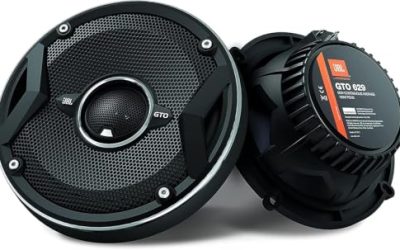
JBL GTO629
- Best for: A first speaker upgrade in a daily driver where you want clearer vocals and firmer bass from the factory head unit.
- 6.5-inch 2-way coaxial speaker, sold as a pair
- 180W peak power handling, 60W RMS
- Carbon-injected Plus One woofer cone
- UniPivot tweeter that angles toward the listener
A first speaker upgrade in a daily driver where you want clearer vocals and firmer bass from the factory head unit.
Check the mounting depth against your door before ordering, because the larger cone and magnet assembly need a little more clearance than the thinnest factory speakers.
The JBL GTO629 is the classic first speaker upgrade, and it earns that place by fixing the exact things factory speakers do badly. Its carbon-injected Plus One woofer cone has more surface area than a standard cone of the same size, so bass notes come through with more weight, and the UniPivot tweeter can be aimed toward the listener for clearer highs. It runs happily on a factory head unit, which makes it a straightforward swap for drivers who want better sound without rewiring anything or adding an amplifier.
Watch out for: Check the mounting depth against your door before ordering, because the larger cone and magnet assembly need a little more clearance than the thinnest factory speakers.
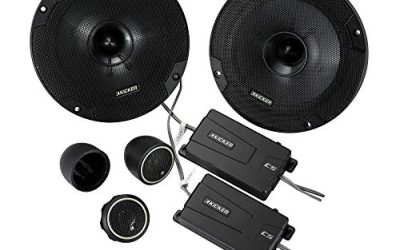
KICKER 46CSC654
- Best for: Drivers who play music loud and want a speaker that keeps its composure at high volume, with or without an amplifier.
- 6.5-inch 2-way coaxial speaker, sold as a pair
- 300W maximum power handling, 100W RMS
- Polypropylene woofer cone with a PEI dome tweeter
- Frequency response 40 Hz to 20,000 Hz
Drivers who play music loud and want a speaker that keeps its composure at high volume, with or without an amplifier.
Confirm the tweeter does not protrude past your door panel or factory grille, since the zero-protrusion design still needs the grille to sit flat over it.
The KICKER 46CSC654 is built for drivers who like their music loud. Its 100-watt RMS rating and 300-watt maximum give it more headroom than most speakers in this guide, so it stays composed when the volume climbs and the bass gets busy. The polypropylene cone and PEI dome tweeter produce a punchy, forward sound that suits rock, hip-hop and electronic music, and the 90 dB sensitivity means it still plays loud enough on factory power while leaving room to grow with an amplifier later.
Watch out for: Confirm the tweeter does not protrude past your door panel or factory grille, since the zero-protrusion design still needs the grille to sit flat over it.
Pioneer TS-A1680F
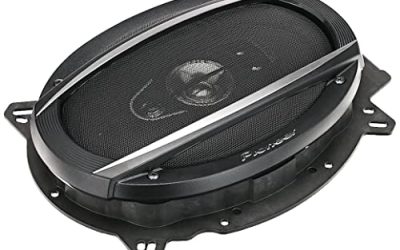
The Pioneer TS-A1680F takes a different approach by splitting the sound across four drivers in each speaker, which gives vocals, instruments and high-frequency detail their own space. Its carbon and mica reinforced IMPP cone stays rigid under load, so midrange stays clean when bass and treble play at the same time. The included multi-fit installation adapters widen the range of cars it drops into, making it a practical pick for owners who want a fuller soundstage without moving to separate component speakers.
Specs
- 6.5-inch 4-way coaxial speaker, sold as a pair
- 350W maximum power handling, 80W nominal
- Carbon and mica reinforced IMPP cone
- Frequency response 36 Hz to 25 kHz
- Multi-fit installation adapters included
Best for: Listeners who want detailed, layered sound with strong highs from a single coaxial speaker in each door.
Watch out for: Measure the adapter and speaker depth together, because the included adapter changes the mounting position and can affect window clearance in some doors.
Rockford Fosgate R165X3
- Best for: Cars with shallow doors where a compact 3-way speaker is the practical way to get fuller sound without cutting metal.
- 6.5-inch 3-way coaxial speaker, sold as a pair
- 90W peak power handling, 45W RMS
- Mica-injected polypropylene woofer cone
- 4-ohm impedance
Cars with shallow doors where a compact 3-way speaker is the practical way to get fuller sound without cutting metal.
Verify the cutout diameter and depth in your specific door, since the shallow design still needs the basket to seat fully flat for a proper seal.
The Rockford Fosgate R165X3 is the compact option in this guide, built for doors where depth is tight and a big magnet simply will not fit. Its three-way layout adds a dedicated midrange driver alongside the woofer and tweeter, which keeps vocals present even at modest volume. With 45 watts RMS handling it pairs naturally with a factory head unit, and the mica-injected polypropylene cone resists moisture and heat inside a door cavity, which helps it last in cars that sit in the sun.
Watch out for: Verify the cutout diameter and depth in your specific door, since the shallow design still needs the basket to seat fully flat for a proper seal.
JBL Club 622
The JBL Club 622 is the refined choice for listeners who find most aftermarket tweeters too bright. Its edge-driven silk dome tweeter delivers smooth highs that stay easy on the ears during long drives, and the tweeter output level control lets you choose between 0 dB and plus 3 dB to match the tweeter to your seating position. With 60 watts RMS handling and 93 dB sensitivity, it plays loud and clear on factory power, and the 3-ohm design draws a little more power from the head unit for extra output.
Specs
- 6.5-inch 2-way coaxial speaker, sold as a pair
- 180W peak power handling, 60W RMS
- Edge-driven silk dome tweeter
- Tweeter output level control, 0 dB or plus 3 dB
- Frequency response 48 Hz to 21 kHz
- Sensitivity 93 dB
- Nominal impedance 3.0 ohms
Best for: Long-distance drivers who want smooth, non-fatiguing highs and the option to tune the tweeter level to their car.
Watch out for: The 3-ohm impedance suits most factory and aftermarket head units, but confirm your head unit supports it if you drive an older or unusual factory system.
Which One Fits Your Situation
Upgrading a Daily Driver on Factory Power
Pick the JBL GTO629 or the JBL Club 622. Both are rated at 60 watts RMS with 93 dB sensitivity, so they make the most of the limited power a factory head unit provides. The GTO629 leans toward punchier bass from its larger cone, while the Club 622 leans toward smoother highs. Either one transforms a dull factory system without an amplifier, and both are simple door swaps in most cars.
Building a Loud System You May Amplify Later
Pick the KICKER 46CSC654. Its 100-watt RMS rating gives it the headroom to handle an external amplifier down the road, while its 90 dB sensitivity keeps it lively on factory power in the meantime. This is the speaker for drivers who already know they will add an amplifier and a subwoofer, and want door speakers that will not become the weak link when the rest of the system grows.
Filling a Shallow or Awkward Door
Pick the Rockford Fosgate R165X3. Its compact 3-way design and modest power needs suit doors where depth is limited and cutting metal is not an option. The built-in crossover keeps the install simple, and the 45-watt RMS rating matches a factory head unit well. Measure first, but this is the speaker most likely to fit where larger models cannot.
Chasing Detail and a Wider Soundstage
Pick the Pioneer TS-A1680F. The four-way layout and the wide 36 Hz to 25 kHz frequency response give it the most detailed presentation in this guide, with separate drivers handling different parts of the range. It suits listeners who notice vocal texture and instrument separation, and the included multi-fit adapters help it drop into a wide range of vehicles.
Common Mistakes
- Buying speakers by peak power alone, when RMS power and sensitivity decide how they actually perform on your head unit.
- Skipping the fit check and discovering the magnet hits the window glass only after the door panel is back on.
- Reversing the positive and negative wires on one side, which cancels bass and makes the whole system sound thin.
- Leaving the factory speaker wiring and mounting loose, so rattles and vibrations undo the benefit of the new speakers.
- Expecting door speakers alone to produce deep sub-bass, when a subwoofer is the correct tool for frequencies below about 50 Hz.
Frequently Asked Questions
Will new speakers work with my factory head unit?
Yes, in most cases. All five speakers in this guide are designed to run on the power a factory head unit supplies, and high-sensitivity models like the two JBL picks make the most of it. You will hear clearer vocals and tighter bass immediately. An amplifier adds volume and control later, but it is not required to enjoy the upgrade.
What size speaker does my car need?
Most cars use a 6.5-inch speaker in the front doors, but some use 6×9-inch, 5.25-inch or 6×8-inch sizes instead. Check your owner’s manual or a vehicle fit guide, then measure the factory speaker and the mounting depth before ordering. Adapter brackets can convert many openings to fit a 6.5-inch speaker.
Do I need to replace all four speakers at once?
No. Replacing just the front pair gives the biggest improvement, because the front speakers do most of the work for the driver. You can upgrade the rear pair later when the budget allows. Keeping the front and rear speakers matched in brand and series helps the sound stay balanced across the cabin.
Is a coaxial speaker or a component speaker better?
Coaxial speakers put the tweeter on the woofer, so they install in one factory location and cost less. Component speakers separate the tweeter for better imaging, but they need extra mounting work and usually an amplifier. For a simple upgrade on factory power, a good coaxial speaker is the practical choice.
FAQ
Will new speakers work with my factory head unit?
What size speaker does my car need?
Do I need to replace all four speakers at once?
Is a coaxial speaker or a component speaker better?
More from Amazon
Programs that pair well with the guide above. Offers and eligibility are set by Amazon and may change.
Free shipping on eligible items, Prime Video and more. Eligible new members can start with a free trial.
Start a Prime free trialAudiobooks and podcasts to listen to on the go. Eligible new members can start with a free trial.
Try Audible freeAd-free music streaming. Eligible new subscribers can start with a free trial.
Try Music Unlimited freeA free business account with business pricing and bulk-buying tools for work, shop or home office.
Create a business accountAs an Amazon Associate we earn from qualifying purchases.