Our Short List of 3

- Best for: Drivers who want clearer vocals and detail from a stock head unit without installing an amplifier.
- 6.5-inch 2-way coaxial speaker, sold as a pair
- 180W peak power handling, 60W RMS
- Carbon-injected Plus One woofer cone
- Edge-driven soft-dome tweeter

- Best for: Drivers who want louder, bass-stronger sound from a factory radio and a speaker that can grow with an amplifier later.
- 6.5-inch 2-way coaxial speaker, sold as a pair
- 300W peak power handling, 100W RMS
- 4-ohm impedance
- Frequency response of 40 Hz to 20,000 Hz

- Best for: Listeners who want a fuller, more detailed soundstage from one speaker per door, especially for mixed music libraries.
- 6.5-inch 3-way coaxial speaker, sold as a pair
- 320W maximum power handling, 70W RMS
- 4-ohm impedance
- Carbon and mica reinforced injection-molded polypropylene cone
All 4 Picks at a Glance
| Product | Specs | Action |
|---|---|---|
| JBL GTO629 |
| Check price on Amazon |
| KICKER 46CSC654 |
| Check price on Amazon |
| Pioneer TS-A1670F |
| Check price on Amazon |
 Rockford Fosgate Prime R165X3 |
| Check price on Amazon |
Key takeaways
- Find the best car door speaker for your vehicle with this November 2026 guide comparing the 6.5-inch coaxial models on power, fit, sensitivity and sound.
Factory door speakers are built to a budget, and it shows the moment you turn the volume past halfway. Vocals go thin, bass turns muddy, and the highs vanish under road noise. A good set of aftermarket door speakers fixes the weakest link in most factory systems without touching the head unit, and for many drivers it is the single upgrade that makes the biggest difference to everyday listening.
This guide is for drivers replacing worn or weak factory speakers, owners who want louder and clearer sound from a stock stereo, and anyone planning a fuller system later. Every speaker below was chosen from the name and specifications on its Amazon product page, focusing on the 6.5-inch coaxial size that fits the front and rear doors of most cars, trucks, and SUVs.
Quick Picks
As an Amazon Associate we earn from qualifying purchases
| Product | Best for | Key spec from title |
|---|---|---|
| JBL GTO629 | A clear, detailed upgrade on factory power | 6.5-inch 2-way coaxial speaker, 180W peak |
| KICKER 46CSC654 | Strong bass and volume from a stock head unit | 6.5-inch 2-way coaxial speaker, 300W peak |
| Pioneer TS-A1670F | Full-range sound with extra high-frequency detail | 6.5-inch 3-way coaxial speaker, 320W max |
| Rockford Fosgate Prime R165X3 | A simple, affordable first door speaker swap | 6.5-inch 3-way coaxial speaker, 90W peak |
How to Choose
Match the size and mounting depth to your doors
Most cars use 6.5-inch speakers in the doors, but that alone does not guarantee a fit. Measure the mounting depth behind the door panel, check the cutout diameter, and look at how far the tweeter sticks out in front of the mounting surface, since a protruding tweeter can hit the factory grille. Shallow-mount designs suit doors with window tracks or crash bars close behind the speaker, while deeper baskets need more clearance. Speaker adapter rings and wiring harness adapters for your exact year, make, and model remove most of the guesswork and keep the factory wiring intact.
Decide how much power the speaker really needs
A speaker rated for high power will still play on a factory head unit, but it may sound quieter than a more sensitive model because the stock radio cannot drive it fully. Sensitivity, measured in decibels, tells you how loud a speaker plays from a given amount of power, and anything around 90 dB or higher works well without an amplifier. RMS power handling matters more than the peak number for matching an amplifier later, so compare RMS figures when you shop. If you plan to add an amplifier, choose speakers whose RMS rating sits comfortably within the amplifier’s output per channel.
Choose between two-way and three-way designs
A two-way coaxial speaker pairs a woofer with one tweeter, and it usually delivers cleaner midrange and tighter bass because the woofer cone has fewer parts mounted on it. A three-way design adds a midrange driver or a second tweeter, which can spread the highs further and add sparkle to cymbals and vocals, though the extra hardware can slightly narrow the woofer’s working area. Neither layout is automatically better. Listen for what matters to you: two-way models often suit rock and podcasts, while three-way models can flatter bright pop and electronic music.
Check impedance, materials, and weather resistance
Most car speakers are rated at 4 ohms, which matches factory and aftermarket head units, while some premium models run at 2 or 3 ohms to draw more power from the same radio. A lower impedance speaker on a stock head unit plays louder, but it also asks more of the radio’s amplifier, so confirm the head unit can handle it before buying. Polypropylene and carbon-reinforced cones resist moisture and hold their shape in hot doors, rubber surrounds last longer than foam, and a speaker with a sealed or treated tweeter copes better with the damp air that collects inside a door panel.
The 4 Best Options
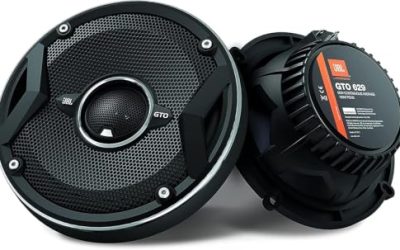
JBL GTO629
- Best for: Drivers who want clearer vocals and detail from a stock head unit without installing an amplifier.
- 6.5-inch 2-way coaxial speaker, sold as a pair
- 180W peak power handling, 60W RMS
- Carbon-injected Plus One woofer cone
- Edge-driven soft-dome tweeter
Drivers who want clearer vocals and detail from a stock head unit without installing an amplifier.
Confirm your head unit is stable with 3-ohm speakers and measure mounting depth, since the basket is deeper than some shallow factory locations.
Drivers who want a noticeable jump in clarity without adding an amplifier will find a lot to like in the JBL GTO629. Its carbon-injected cone and edge-driven tweeter keep vocals crisp and detailed at highway speeds, and the design is tuned to pull more output from a factory head unit than a typical 4-ohm replacement. The sound leans clean and forward rather than boomy, so acoustic tracks, podcasts, and vocal-heavy playlists come through with a presence that tired factory speakers cannot match.
Watch out for: Confirm your head unit is stable with 3-ohm speakers and measure mounting depth, since the basket is deeper than some shallow factory locations.
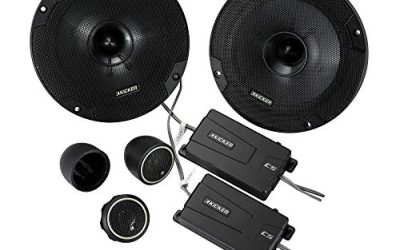
KICKER 46CSC654
- Best for: Drivers who want louder, bass-stronger sound from a factory radio and a speaker that can grow with an amplifier later.
- 6.5-inch 2-way coaxial speaker, sold as a pair
- 300W peak power handling, 100W RMS
- 4-ohm impedance
- Frequency response of 40 Hz to 20,000 Hz
Drivers who want louder, bass-stronger sound from a factory radio and a speaker that can grow with an amplifier later.
Check the cutout diameter against your door opening, since the stamped steel basket and thick surround need the full 6.5-inch mounting hole.
The KICKER 46CSC654 is the pick for anyone whose factory speakers distort the moment the bass kicks in. Its stiff polypropylene cone and ribbed surround move air cleanly at higher volumes, and the high sensitivity means it plays loud even before an amplifier enters the picture. The zero-protrusion tweeter sits flush with the woofer, so it clears most factory grilles without modification. Hip-hop, rock, and electronic music all benefit from the extra low-end punch this speaker brings to a door.
Watch out for: Check the cutout diameter against your door opening, since the stamped steel basket and thick surround need the full 6.5-inch mounting hole.
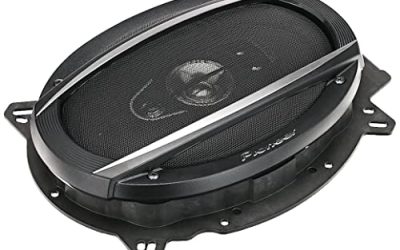
Pioneer TS-A1670F
- Best for: Listeners who want a fuller, more detailed soundstage from one speaker per door, especially for mixed music libraries.
- 6.5-inch 3-way coaxial speaker, sold as a pair
- 320W maximum power handling, 70W RMS
- 4-ohm impedance
- Carbon and mica reinforced injection-molded polypropylene cone
Listeners who want a fuller, more detailed soundstage from one speaker per door, especially for mixed music libraries.
The three-way tweeter assembly protrudes further than a two-way design, so verify grille clearance before ordering.
For listeners who want the widest frequency spread from a single door speaker, the Pioneer TS-A1670F adds a midrange driver and a tweeter to its 6.5-inch woofer. That three-way layout fills in the upper mids that two-way speakers sometimes gloss over, giving guitars, strings, and backing vocals more room to breathe. The carbon and mica reinforced cone stays rigid under power, so bass notes stay defined instead of blurring into the midrange at higher volumes.
Watch out for: The three-way tweeter assembly protrudes further than a two-way design, so verify grille clearance before ordering.
Rockford Fosgate Prime R165X3
- Best for: A first, simple door speaker replacement where easy fit and balanced sound matter more than maximum volume.
- 6.5-inch 3-way coaxial speaker, sold as a pair
- 90W peak power handling, 45W RMS
- 4-ohm impedance
- Mica-injected polypropylene cone
A first, simple door speaker replacement where easy fit and balanced sound matter more than maximum volume.
With only 45W RMS per speaker, it is not the right match for a powerful external amplifier, so keep the amp modest or choose a higher-rated model.
The Rockford Fosgate Prime R165X3 is a straightforward first upgrade for anyone replacing blown or faded factory speakers on a tight plan. It handles modest power with ease, pairs happily with a stock radio, and its mica-injected cone resists the heat and moisture that build up inside a door. The sound is balanced rather than flashy, with cleaner highs and tighter bass than the paper-cone speakers it typically replaces, and the shallow mounting depth fits doors that reject deeper baskets.
Watch out for: With only 45W RMS per speaker, it is not the right match for a powerful external amplifier, so keep the amp modest or choose a higher-rated model.
Which One Fits Your Situation
You want the biggest clarity gain from a factory radio
Pick the JBL GTO629. Its 3-ohm design draws more output from a stock head unit than a standard 4-ohm speaker, and the detailed tweeter makes vocals and acoustic instruments stand out on the highway. It is the strongest choice when no amplifier is planned and clarity matters more than sheer bass.
You listen loud and want bass that holds together
Pick the KICKER 46CSC654. The 100W RMS rating and stiff polypropylene cone keep low notes tight when the volume climbs, and the 90 dB sensitivity means it plays loud on factory power today and louder still once an amplifier is added. It suits bass-heavy music better than the other three picks.
You want the fullest sound from a single speaker
Pick the Pioneer TS-A1670F. Its three-way layout covers more of the frequency range from one mounting location, so complex mixes sound layered instead of flat. The 320W maximum handling also leaves room for a future amplifier, making it a good middle ground between a basic swap and a full system build.
You need a simple swap for tired factory speakers
Pick the Rockford Fosgate Prime R165X3. It drops into tight doors thanks to its shallow depth, runs happily on a stock radio, and delivers a clear step up from worn paper-cone factory units. It is the right call when fit and simplicity come before maximum output, and it leaves budget free for sound deadening or a later amplifier.
Common Mistakes
- Buying a speaker size that matches the label but not the mounting depth, then finding the window track blocks the basket.
- Judging speakers by peak power alone instead of RMS handling and sensitivity, which decide real-world loudness.
- Installing new speakers without adapter rings or harness adapters, then cutting factory wiring that is hard to restore.
- Skipping sound deadening on the door skin, so the new speaker’s bass is lost to panel vibration and rattles.
- Mixing a 2-ohm or 3-ohm speaker with a head unit that is only rated for 4 ohms, which can strain the radio’s amplifier.
Frequently Asked Questions
What size door speaker fits most cars?
The 6.5-inch size fits the front and rear doors of most cars, trucks, and SUVs, which is why all four speakers in this guide use it. Always confirm the size, mounting depth, and cutout diameter for your exact year, make, and model before ordering, since some vehicles use 6×8-inch, 6×9-inch, or 5.25-inch openings instead.
Do I need an amplifier for aftermarket door speakers?
No, all four speakers here play well from a factory head unit, especially sensitive models like the KICKER 46CSC654. An amplifier adds volume and control, and it helps high-power speakers reach their potential, but it is not required to hear a clear improvement over worn factory speakers.
Are 3-way speakers better than 2-way speakers?
Not automatically. Three-way speakers add a midrange driver that can fill out vocals and highs, while two-way speakers often deliver tighter bass and cleaner midrange from a simpler design. The right choice depends on your music and your doors, so weigh grille clearance and sensitivity alongside the driver count.
Can I replace just the front door speakers?
Yes, replacing the front pair first is the most common upgrade, since the front speakers carry most of what the driver hears. You can add matching rear speakers later for a balanced cabin, and keeping the same brand and series front and rear gives the most consistent tone.
FAQ
What size door speaker fits most cars?
Do I need an amplifier for aftermarket door speakers?
Are 3-way speakers better than 2-way speakers?
Can I replace just the front door speakers?
More from Amazon
Programs that pair well with the guide above. Offers and eligibility are set by Amazon and may change.
Free shipping on eligible items, Prime Video and more. Eligible new members can start with a free trial.
Start a Prime free trialAudiobooks and podcasts to listen to on the go. Eligible new members can start with a free trial.
Try Audible freeAd-free music streaming. Eligible new subscribers can start with a free trial.
Try Music Unlimited freeA free business account with business pricing and bulk-buying tools for work, shop or home office.
Create a business accountAs an Amazon Associate we earn from qualifying purchases.