Key takeaways
- Best Cameras for Wedding Photography in 2026 The best cameras for wedding photography for most working photographers are the Canon EOS R6 Mark II and Nikon Z6 III: both balance dependable autofocus, strong low-light performance, practical battery life, and two…
Best Cameras for Wedding Photography in 2026
The best cameras for wedding photography for most working photographers are the Canon EOS R6 Mark II and Nikon Z6 III: both balance dependable autofocus, strong low-light performance, practical battery life, and two memory-card slots. Choose the Canon for its straightforward event workflow and excellent subject tracking, the Nikon for its faster readout and flexible video features, or step up to a higher-resolution body if large prints and cropping matter more than cost.
Wedding-camera comparison
Specifications below are manufacturer figures where available. Battery ratings use each maker’s stated testing method, so they are useful for comparing within a system but not a guarantee of coverage at a wedding. Actual results vary with temperature, screen use, video, autofocus, and image review.
Our top picks
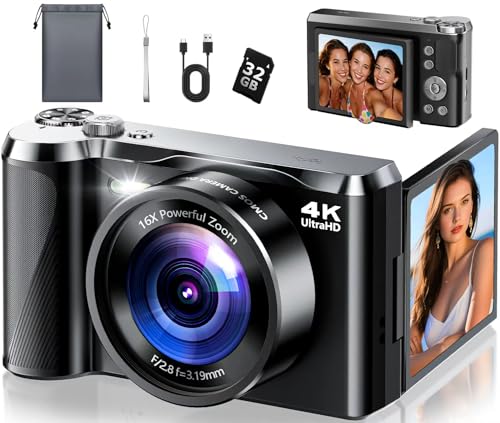 4K Digital Camera for Photography & Travel
- 【56MP Resolution & Auto Focus】 Ideal for daily…
- 【180° Flip Screen & Clear IPS Display】 Equipped…
- 【16X Digital Zoom & Anti-Shake】 As one of…
 Cameras for Photography
- 📷【8K Video & 88MP UHD Photo】The Saneen 8K…
- 🔄【Dual Lens & Webcam Mode】Switch between front and…
- 📱【Wi-Fi Transfer & 4.0" Touch Screen】Share moments instantly!…
| Product | Key specs | |
|---|---|---|
| 4K Digital Camera for Photography & Travel | 【56MP Resolution & Auto Focus】 Ideal for daily… 【180° Flip Screen & Clear IPS Display】 Equipped… 【16X Digital Zoom & Anti-Shake】 As one of… | Check price |
| Cameras for Photography | 📷【8K Video & 88MP UHD Photo】The Saneen 8K… 🔄【Dual Lens & Webcam Mode】Switch between front and… 📱【Wi-Fi Transfer & 4.0" Touch Screen】Share moments instantly!… | Check price |
 500 Wedding Photography Poses With Camera and 500 Wedding Photography Poses With Camera and | Check price | |
 On-Camera Flash Techniques for Digital Wedding and On-Camera Flash Techniques for Digital Wedding and | Check price |
As an Amazon Associate we earn from qualifying purchases at no extra cost to you.
| Camera | Resolution | Approx. body weight | Rated battery life | Card slots | Best fit |
|---|---|---|---|---|---|
| Canon EOS R6 Mark II | 24.2 MP | 670 g | Up to 580 shots (LCD) | 2 SD, UHS-II | Reliable all-round wedding work |
| Nikon Z6 III | 24.5 MP | 760 g | Up to 360 shots (viewfinder) | CFexpress Type B/XQD and SD | Fast action, hybrid photo/video |
| Sony a7 IV | 33 MP | 658 g | Up to 580 shots (viewfinder) | 2 slots; CFexpress Type A/SD and SD | Resolution and lens-system flexibility |
| Nikon Z8 | 45.7 MP | 910 g | Up to 340 shots (viewfinder) | CFexpress Type B/XQD and SD | High resolution and demanding action |
| Canon EOS R5 Mark II | 45 MP | 746 g | Up to 340 shots (viewfinder) | CFexpress Type B and SD, UHS-II | High-resolution professional coverage |
Weights are approximate body-only figures including battery and card, where specified by the manufacturer; lenses, straps, and accessories add substantially to the carried load. Verify current specifications and regional kit details before buying.
Which camera fits your wedding work?
Best balanced choice: Canon EOS R6 Mark II
The R6 Mark II’s 24.2-megapixel full-frame sensor keeps files manageable while providing ample resolution for albums and common print sizes. Its subject-detection autofocus can recognize people and track eyes, helping when a couple moves down the aisle or dances in dim reception lighting. Two SD slots make it practical to record a second copy of each image in-camera without buying faster CFexpress media.
It is a strong choice for photographers who want a dedicated stills camera with useful video capability and a relatively simple card workflow. Its 670 g body is not the lightest here, but it is easier to carry through a long event than the heavier high-resolution options. For full-day coverage, plan on spare batteries rather than relying on the published shot rating.
Best for fast action and hybrid coverage: Nikon Z6 III
The Z6 III combines a 24.5 MP sensor with a fast partially stacked design, giving it a responsive feel for entrances, confetti, and other brief moments. Its autofocus subject detection and tracking are designed for moving subjects, while its video capabilities make it appealing to photographers who also capture substantial motion footage.
Its two slots are not interchangeable: one accepts CFexpress Type B or XQD media, and the other accepts SD. That is flexible, but high-capacity CFexpress cards can add to the cost. If you want simultaneous backup, configure the camera to write the same files to both cards and confirm that your chosen file format and recording settings support the intended workflow.
Best for resolution without a flagship-sized body: Sony a7 IV
At 33 MP, the a7 IV offers more cropping room than the 24 MP choices while keeping a body weight of about 658 g. Sony’s subject-recognition autofocus is useful for keeping people in focus across changing scenes. Its two slots support a flexible mix of SD and CFexpress Type A media, with the first slot accepting both formats.
The extra pixels can help when a photographer needs to reframe a group image or deliver larger prints, but they also create larger files than a 24 MP body. Budget for storage and backup capacity, especially if shooting RAW throughout a long event. The slot formats and recording modes are worth checking before purchasing cards; not every setup uses both slots in the same way.
Best high-resolution options: Nikon Z8 and Canon EOS R5 Mark II
The Nikon Z8 and Canon EOS R5 Mark II offer approximately 46 MP resolution alongside advanced autofocus. They suit photographers who regularly crop, produce large prints, or need one body to handle weddings and other demanding professional assignments. Their resolution is not an automatic advantage for every event: bigger files take longer to transfer and require more storage, and detailed shots can reveal motion blur that smaller files may disguise.
Both have a fast card slot paired with an SD slot, giving photographers the option of in-camera duplication. The Nikon uses CFexpress Type B or XQD alongside SD; the Canon pairs CFexpress Type B with SD. These bodies cost more as a system, not just at purchase: fast cards, larger backup drives, and extra batteries should be included in the budget.
Choose by your priorities
| Your situation | Practical choice | Reason |
|---|---|---|
| First paid weddings; want manageable cost and straightforward backup | Canon EOS R6 Mark II | Two SD slots keep duplicate recording simple and media costs comparatively contained. |
| Frequent movement, action, or a substantial video workload | Nikon Z6 III | Fast sensor design and hybrid features suit changing photo and video demands. |
| You crop often or deliver larger prints | Sony a7 IV | 33 MP provides more framing latitude than a 24 MP body without moving to roughly 46 MP files. |
| High-resolution work is a routine paid requirement | Nikon Z8 or Canon EOS R5 Mark II | Both combine high pixel counts with advanced autofocus and dual-card recording options. |
| You shoot long days without easy charging | Any of these, with multiple batteries and a charging plan | Published ratings are not a dependable one-battery wedding-day guarantee. |
Four wedding-specific buying checks
Autofocus reliability is about more than recognition
Face and eye detection help, but they cannot guarantee a sharp frame when a subject is blocked by guests, backlit, or moving unpredictably. Before committing to a body, learn how to change the subject-detection mode, move the focus area, and regain control when the camera selects the wrong person. Test those actions with your intended lenses and in a dim room, not only outdoors.
Low-light quality depends on the whole kit
A full-frame sensor can help when reception light is limited, but a bright lens and appropriate shutter speed matter just as much. A fast prime can gather more light than a slower zoom, though it may be less convenient when framing changes quickly. Stabilization helps reduce blur from camera movement, but it does not freeze a moving couple or dancing guests. Flash may also be restricted by the venue, so check those rules before the event.
Battery ratings need a real-world margin
Ratings such as 340 or 580 shots are standardized estimates, not promises for a day of continuous shooting, image review, wireless transfer, and video. Cold weather and frequent screen use can also reduce runtime. Carry several charged, compatible batteries; label them so used and ready packs do not get mixed up; and turn off unnecessary wireless features when battery conservation matters. A USB charging or power-bank plan can be useful, but check whether the camera permits charging or operation in the mode you need.
Dual slots reduce risk only when configured
Two card slots do not automatically create a backup. Set the camera to write each image to both cards simultaneously, then verify the setting and test playback from each card before the job. This uses storage faster than overflow recording, so size both cards for the entire coverage plan. Dual cards also do not replace an after-event backup: copy files to separate storage as soon as practical and keep the original cards untouched until copies are checked.
Ownership details that matter after the purchase
Cards, batteries, and ports are more likely to affect day-to-day readiness than headline sensor specifications. Keep card contacts clean and dry, format cards in the camera after confirming that files are safely backed up, and rotate cards rather than repeatedly relying on one well-worn card. Never remove a card while the access light indicates writing. Batteries gradually lose capacity with age and repeated use, so replace packs that no longer hold a reliable charge.
Budget for the camera body plus compatible lenses, spare batteries, matched memory cards, and enough storage to maintain at least two verified copies of delivered work. General market prices vary by region, condition, and kit; compare the total system cost rather than choosing solely by body price. For many wedding photographers, a well-practiced 24–33 MP body with dependable dual-card recording is a more useful purchase than a high-resolution flagship that strains the media and backup budget.