Key takeaways
- Limited floor space or a smaller room: Start with the KEF Q550 or Q Acoustics 5040. Their narrower cabinets are easier to accommodate than the larger models. A smaller speaker can still sound boomy if placed in a corner, so leave room to experiment with position.
- You want strong output without a high-powered amplifier: The Klipsch RP-8000F II’s high published sensitivity makes it a sensible candidate. Its tall, deep cabinet needs space, and its energetic presentation may be more appealing to some listeners than others. Listen before committing if possible.
- You listen to bass-heavy music without a subwoofer: Consider the Polk Reserve R700 or Klipsch RP-8000F II. Their published extension suggests more reach into the bass than the Q550, but room acoustics and volume affect what you hear. For deep movie effects, a subwoofer remains useful even with large towers.
- You’re building a home theater: Prioritize a matching center channel from the same speaker family, a clear path from each speaker to the listening seats, and room for a subwoofer. The towers handle front left and right; they do not replace the center channel’s role in anchoring dialogue.
- You need speakers near a wall: Check the maker’s placement guidance and the location of the bass ports. Rear ports do not make wall placement impossible, but close boundaries can increase bass and make it uneven. A front-ported design is not a guarantee of perfect sound against a wall either.
Best Floorstanding Speakers: Picks by Room, Music, and Home Theater
The best floorstanding speakers for most buyers are a well-matched pair with enough bass for their room, moderate sensitivity for their amplifier, and cabinets that can sit clear of walls and walkways. For compact rooms, consider the KEF Q550; for a more powerful all-round stereo or theater setup, compare the Klipsch RP-8000F II; and for a larger room where deep bass matters, the Polk Audio Reserve R700 is a substantial option. The right choice depends less on a single headline spec than on room size, placement, and whether a subwoofer will do some of the low-frequency work.
Compare the Shortlist
Dimensions and weights below are manufacturer-published figures, rounded where appropriate. Frequency-extension figures are not directly comparable: manufacturers may use different tolerances, and a low bass number does not tell you how loudly or evenly a speaker can reproduce that bass.
Our top picks
 Sony SS-CS3M2 3-Way 4-Driver Hi-Res Floorstanding Speaker
- Floorstanding speaker (each floorstanding speaker sold individually)
- 3-way, 4 driver floorstanding speaker system
- 5.12 in
 Polk Audio T50 Home Theater Floor Standing
- Featuring a 1" tweeter, one 6.5" Dynamic Balance…
- AMPLIFY YOUR MOVIE, MUSIC AND GAMING EXPERIENCE with…
- Whether you're watching an action-packed blockbuster via an…
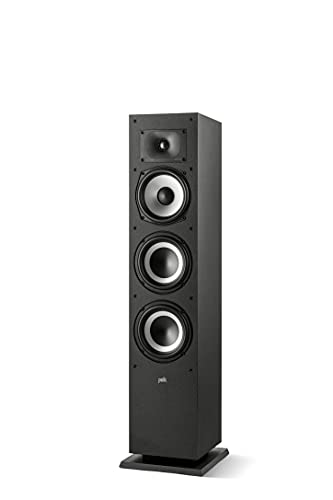 Polk Audio Monitor XT60 Home Theater Tower
- The Polk Monitor XT60 features a 1" Tweeter,…
- An upgrade to the critically acclaimed Monitor series,…
- HIGH RESOLUTION, IMMERSIVE SOUND - Monitor XT60 Polk…
| Product | Key specs | |
|---|---|---|
| Sony SS-CS3M2 3-Way 4-Driver Hi-Res Floorstanding Speaker | Floorstanding speaker (each floorstanding speaker sold individually) 3-way, 4 driver floorstanding speaker system 5.12 in | Check price |
| Polk Audio T50 Home Theater Floor Standing | Featuring a 1" tweeter, one 6.5" Dynamic Balance… AMPLIFY YOUR MOVIE, MUSIC AND GAMING EXPERIENCE with… Whether you're watching an action-packed blockbuster via an… | Check price |
| Polk Audio Monitor XT60 Home Theater Tower | The Polk Monitor XT60 features a 1" Tweeter,… An upgrade to the critically acclaimed Monitor series,… HIGH RESOLUTION, IMMERSIVE SOUND - Monitor XT60 Polk… | Check price |
 Klipsch Reference R-26FA Floorstanding Speaker Klipsch Reference R-26FA Floorstanding Speaker | Experience Dolby Atmos with integrated elevation speakers for… Benefit from a 1" aluminum diaphragm compression driver… With 100W continuous/400W peak power handling, these speakers… | Check price |
As an Amazon Associate we earn from qualifying purchases at no extra cost to you.
| Speaker | Cabinet size (H × W × D) | Weight, each | Published sensitivity | Published low-frequency figure | Best fit |
|---|---|---|---|---|---|
| KEF Q550 | About 87 × 18 × 28 cm | About 14.5 kg | 87 dB | About 58 Hz (−6 dB) | Small to medium rooms; space-conscious stereo |
| Klipsch RP-8000F II | About 109 × 27 × 46 cm | About 26 kg | 98 dB | About 35 Hz (−3 dB) | Medium to large rooms; high output with modest amplifier power |
| Polk Audio Reserve R700 | About 114 × 33 × 41 cm | About 35 kg | 88 dB | About 38 Hz (−3 dB) | Medium to large rooms; substantial stereo or home theater |
| Q Acoustics 5040 | About 97 × 30 × 30 cm | About 18 kg | 91.5 dB | About 39 Hz (−6 dB) | Small to medium rooms; slimmer cabinet and easier placement |
Published sensitivity ratings are not necessarily measured under identical conditions, so treat them as a guide rather than a precise ranking. Likewise, the Klipsch’s larger sensitivity figure does not mean it is automatically the better match: its sound, size, and positioning requirements still need to suit your room and preferences.
Choose by Your Situation
- Limited floor space or a smaller room: Start with the KEF Q550 or Q Acoustics 5040. Their narrower cabinets are easier to accommodate than the larger models. A smaller speaker can still sound boomy if placed in a corner, so leave room to experiment with position.
- You want strong output without a high-powered amplifier: The Klipsch RP-8000F II’s high published sensitivity makes it a sensible candidate. Its tall, deep cabinet needs space, and its energetic presentation may be more appealing to some listeners than others. Listen before committing if possible.
- You listen to bass-heavy music without a subwoofer: Consider the Polk Reserve R700 or Klipsch RP-8000F II. Their published extension suggests more reach into the bass than the Q550, but room acoustics and volume affect what you hear. For deep movie effects, a subwoofer remains useful even with large towers.
- You’re building a home theater: Prioritize a matching center channel from the same speaker family, a clear path from each speaker to the listening seats, and room for a subwoofer. The towers handle front left and right; they do not replace the center channel’s role in anchoring dialogue.
- You need speakers near a wall: Check the maker’s placement guidance and the location of the bass ports. Rear ports do not make wall placement impossible, but close boundaries can increase bass and make it uneven. A front-ported design is not a guarantee of perfect sound against a wall either.
How to Match Tower Speakers to Your Room
1. Check the physical footprint first
Measure the full space, including clearance behind the speaker and room for the plinth or feet. The cabinet depth can be more important than its width in a narrow room. Keep towers away from door swings and circulation paths, and secure tall cabinets if children, pets, or vibration could knock them over.
2. Estimate listening distance and volume
A large room or long listening distance generally calls for more output capability. Sensitivity helps estimate how much amplifier power a speaker needs, but it is not a substitute for checking the amplifier’s recommended load and power range. Avoid assuming that a powerful amplifier will fix poor placement or room-related bass problems.
3. Decide what the bass system needs to do
For music at moderate levels, a tower’s built-in bass may be enough. For action movies, very large rooms, or consistently deep bass, plan for a subwoofer. In a home theater receiver, the usual approach is to set the front speakers to “small” and choose a crossover based on how they perform in the room; this sends the deepest bass to the subwoofer and can reduce strain on the towers.
Placement Can Matter More Than a Small Spec Difference
Begin with both speakers at equal distances from the main seat and angle them slightly toward the listener. Start roughly 30–60 cm from the front wall if the room allows, then adjust in small increments. If bass sounds swollen, try pulling the speakers farther out or moving them away from corners. If the center image feels vague, check that the speakers and seat form a roughly symmetrical triangle and that toe-in is consistent.
Do not judge a position from one bass-heavy track alone. Try familiar music with voices and acoustic instruments, then a film scene with dialogue and effects. A setup that gives impressive bass in one seat may be uneven across a sofa; a subwoofer can often be repositioned more easily than a pair of heavy towers.
Ownership and Setup Realities
Floorstanding speakers have no batteries or routine consumables, but their size and weight affect long-term convenience. Moving them to clean or rearrange a room can take two people, especially for heavier models such as the R700. Use the supplied feet or spikes as directed for your flooring, and place protective pads under spikes on delicate surfaces. Dust cabinets with a soft dry cloth; avoid household cleaners that could damage the finish.
Check the terminal connections periodically, especially if you move the speakers or change cables. Keep the grilles on if you want extra protection from dust, pets, or accidental contact; remove them if you prefer the appearance or want to follow the manufacturer’s listening guidance. Before buying, also confirm that a matching center speaker is available if you may expand to surround sound later.
Bottom Line
For a compact room, the KEF Q550 or Q Acoustics 5040 is the more manageable starting point. Choose the Klipsch RP-8000F II when sensitivity and high output are priorities and you have room for a large cabinet. Choose the Polk Reserve R700 when you want a substantial full-range front pair and can accommodate its weight and footprint. In every case, measure first, check amplifier compatibility, and leave time to adjust placement before deciding whether the system needs a subwoofer.