Key takeaways
- Five-times optical zoom in a pocketable body
- Straightforward operation ideal for beginners or older hands
- Noticeable noise and limited dynamic range in challenging light
The word “camera” means wildly different things to different people. Someone outfitting a front porch has almost nothing in common with a parent buying a point-and-shoot for a teenager’s vacation. The market in 2026 splits into compact digital cameras that prioritize simplicity, wireless security systems built to run on a single charge for years, and interchangeable-lens bodies that trade convenience for creative control. Finding the right camera means starting with the actual problem you need to solve rather than chasing a spec-sheet number that means nothing once you open the box.
What separates a worthwhile purchase from a letdown in this price range is how well a product matches its intended role. A compact camera with a modest sensor is perfectly fine for social media snapshots but falls apart in low light. A security camera with a long battery claim is excellent if you already own the hub and Wi-Fi coverage reaches every mount point. Owner feedback clusters around these use-case mismatches more than around raw image quality, which is why this roundup weighs purpose fit alongside published numbers and long-term satisfaction.
Our top picks

 Blink Outdoor 4
AA batteries and Sync Module Core provide up to two years of power
Dual-zone motion detection speeds up alerts
Two-way audio lets you see and speak through the app
Person detection requires an optional Blink Subscription Plan
Local storage is not included with the Sync Module Core


As an Amazon Associate we earn from qualifying purchases at no extra cost to you.
Quick Picks
| Product | Best for | Price |
|---|---|---|
| Kodak FZ55 | Best budget zoom compact | under $150 |
| Blink Outdoor 4 (3-cam) | Mid-size home security | under $150 |
| Blink Outdoor 4 (5-cam) | Widest Blink coverage | under $200 |
| Kodak FZ45 | Ultra-cheap point-and-shoot | under $100 |
| Canon EOS Rebel T7 | Learning photography | n/a |
| Blink Outdoor 4 (2-cam) | Entry-level security trial | under $80 |
| GMK 4 Pack | Value multi-camera security | under $90 |
| Duluvulu 4K | Teens and vlogging on a budget | under $60 |
How We Picked
We evaluated these cameras on three criteria. First, purpose fit: does the product deliver what it promises for the use case it targets, judged against patterns in owner reviews rather than marketing copy? Second, value at the asking price: several of these products undercut pricier alternatives without obvious compromises, while others charge a premium for features you may never activate. Third, real-world reliability: we looked at long-term feedback about battery consistency, software behavior, and build durability to separate initial impressions from lived experience.
The 8 Best Cameras in 2026
Kodak PIXPRO FZ55
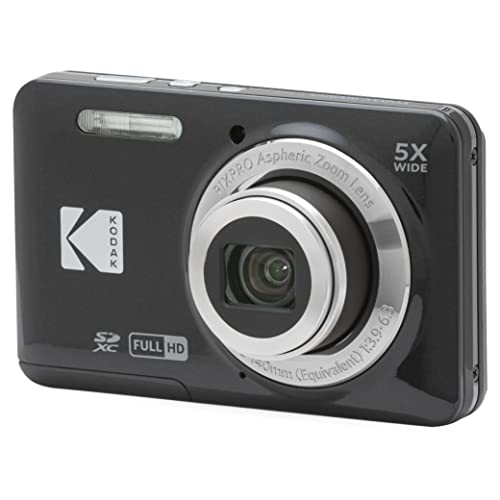
The FZ55 is the compact camera for someone who wants to pocket a point-and-shoot and still get real optical zoom. Five-times magnification is unusual at this price and makes the difference between a usable shot of a stage performance and a blurry crop you discard. Owner feedback consistently praises the simplicity: insert batteries, press the shutter. The main trade-off is the small sensor, which struggles in low light and against bright backlit scenes, where noise becomes visible and dynamic range suffers.
- Five-times optical zoom in a pocketable body
- Straightforward operation ideal for beginners or older hands
- Noticeable noise and limited dynamic range in challenging light
Skip it if you plan to crop heavily or print larger than eight by ten inches.
Blink Outdoor 4 Three-Camera System
Three cameras with the Sync Module Core included is the practical sweet spot for a medium-sized home that wants perimeter coverage without paying a per-camera premium. The two-year battery claim holds up in owner reports for moderate-traffic locations without recharging. Picture quality at 1080p is adequate for identifying faces at door distance but shows softness when you zoom into a distant vehicle plate. Two-way talk works reliably. The limitation is ecosystem lock: you need the Blink app, an existing Wi-Fi signal at every mount point, and motion-zone customization can feel imprecise compared to pricier platforms.
- Verified long battery life in typical residential use
- Sync Module Core included for local storage and setup
- Motion detection and zone control less refined than premium systems
Skip it if your Wi-Fi signal does not reach every camera location or if you need AI person detection.
Blink Outdoor 4 Five-Camera System
Five cameras from the same platform broadens coverage without buying individual add-ons at a higher per-unit cost. The per-camera price drops below the two- and three-camera bundles, making this the most cost-efficient Blink option for larger properties. Battery life, resolution, and two-way talk are identical across all Outdoor 4 kits. The real question is Wi-Fi range: owners in sprawling layouts report connectivity dropouts on cameras at the farthest edge of the property. If your home is compact, you are paying for coverage you do not need and can save by buying a smaller bundle.
- Lowest per-camera price in the Blink lineup
- Uniform performance and features across all five units
- Signal range becomes a constraint on large or multi-story lots
Skip it if your lot is small enough that three cameras cover all access points.
Kodak PIXPRO FZ45
At just under a hundred dollars, the FZ45 is essentially the FZ55 minus one stop of zoom. Four-times optical magnification still beats fixed or digital zoom on most phones at this price, and the same 16-megapixel sensor keeps files flexible for cropping and sharing. Owners like the AA battery format because they can swap fresh cells anywhere in the world without hunting for a proprietary charger. The smaller sensor and modest processor struggle with fast subjects or dim interiors, producing artifacts that a mid-range phone would avoid.
- AA batteries eliminate charger dependency and allow travel swaps
- Four-times optical zoom for a price under one hundred dollars
- Noticeable image degradation in low light and with moving subjects
Skip it if your main use case is sports, wildlife, or evening portraits.
Canon EOS Rebel T7
The T7 is the cheapest route into a real optical viewfinder, an APS-C sensor, and interchangeable lenses. The 24.1-megapixel CMOS chip produces files with far more dynamic range and lower noise than any compact in this list, which is the difference between a usable image in mixed lighting and a compromise you reshoot. The double zoom lens kit covers wide-angle landscapes and moderate telephoto subjects without a second purchase. Wi-Fi lets you transfer images without pulling a memory card. The downsides are size and learning curve: this body is heavier than a point-and-shoot, and the menu system assumes you want to understand exposure.
- APS-C sensor with dramatically better low-light and dynamic range than compacts
- Included dual-lens kit covers a wide focal range out of the box
- Heavier and more complex than compact alternatives for casual shooters
Skip it if you want a camera you can hand to a child without a lesson in aperture and shutter speed.
Blink Outdoor 4 Two-Camera System
Two cameras plus the Sync Module Core is the lowest-cost way to join the Blink ecosystem and test whether the platform fits your routine before committing to expansion. The per-camera price is the highest among the Blink bundles, but the total outlay is small enough that most buyers treat it as a low-risk trial. Performance, battery expectations, and app features match the larger kits exactly. The practical constraint is coverage: two cameras watch your front and back door at best, leaving side yards and driveways unmonitored. If you already know you need four or five mounting points, start with a larger bundle.
- Lowest entry price into the Blink platform
- Identical camera hardware and firmware to larger kits
- Highest per-camera cost compared to Blink bundles
Skip it if you know you will expand to three or more cameras within a year.
GMK 4 Pack Cameras System
Four wireless outdoor cameras recording at 2K for under ninety dollars is aggressive value on paper. The higher resolution compared to 1080p systems lets you zoom into footage and still read details like clothing colors or package labels. Owners appreciate the no-subscription approach and the ability to view multiple feeds simultaneously on a single monitor. The trade-off is software refinement: the companion app has fewer smart features like person detection or zone-specific alerts, and battery life reportedly drops faster in cold weather than premium brands claim.
- 2K resolution across four units at a price below many two-camera systems
- No monthly subscription required for local recording
- Limited smart detection and inconsistent cold-weather battery performance
Skip it if you want AI-powered motion filtering or seamless cloud integration without a local drive.
Duluvulu 4K Digital Camera
The Duluvulu packs a 48-megapixel sensor into a body with a 180-degree flip screen designed for self-recording, which is rare at this price. The screen makes framing vlogs and selfies straightforward without guessing, and the included SD card plus two spare batteries remove the usual day-one accessory cost. The 16X zoom is primarily digital rather than optical, so image quality degrades noticeably as you push magnification. Owners report the autofocus is serviceable for static or slow-moving subjects but hunts under low light or with fast movement.
- Flip screen plus included card and batteries make it ready out of the box
- High megapixel count gives cropping headroom for stills
- Autofocus struggles in dim conditions and digital zoom degrades quality
Skip it if you need reliable autofocus or plan to shoot primarily in challenging lighting.
Buying Guide
Sensor Size Matters More Than Resolution
Resolution numbers alone are misleading across this price range. A 48-megapixel compact sensor and a 24-megapixel APS-C sensor produce files with similar pixel counts, but the larger physical sensor gathers more light per pixel, which controls noise and dynamic range. If your output is social media or small prints, a higher-megapixel compact is genuinely sufficient. If you print larger or shoot in mixed lighting, sensor size matters more than the headline megapixel figure. Match the sensor to the worst lighting condition you expect, not the best.
Battery Format and Real-World Drain for Security Cameras
Advertised battery life on wireless security cameras is only useful if you understand the power format. Blink systems use sealed lithium packs rated for two years under moderate motion activity, but real-world reports show faster drain in cold weather or at high-traffic entry points. Systems that accept standard AAs or USB rechargeable packs give you swap flexibility without ordering brand-specific replacements. Before buying, estimate how many motion events each location will log daily and compare that against the manufacturer’s testing assumptions, because marketing figures rarely match a busy driveway.
Ecosystem Lock-In and the True Cost of Expansion
A security camera bundle looks like a one-time purchase until you want to add a sixth unit. Blink requires its Sync Module for configuration and prices individual add-on cameras higher than the per-unit cost inside a bundle. GMK and similar brands avoid ecosystem lock but sacrifice features like cloud storage and smart alerts. Decide up front whether you plan to expand. A two-camera system that becomes a five-camera system through individual purchases is almost always more expensive than buying the five-pack directly.
Our Verdict
Top pick: Canon EOS Rebel T7. No other camera here produces files with comparable dynamic range and low-light performance, and the included dual-lens kit gives a beginner immediate creative range without a second purchase.
Budget pick: Duluvulu 4K at fifty-nine dollars is the strongest value for a first serious camera, particularly for video-oriented teens who need a flip screen and included accessories.
Another wins when: you already own one or two Blink cameras and want to extend coverage affordably. The five-camera system’s per-unit price is the lowest path to broad Blink-based coverage for a large property.
FAQ
Are compact digital cameras still worth buying over a smartphone?
Yes, for two specific reasons: true optical zoom that does not degrade image quality, and a dedicated grip that makes framing easier for children or older hands who find phone cameras slippery. In good light, a smartphone matches a compact sensor easily, but zoom range and handling are where the dedicated camera wins.
How many security cameras does a typical home need?
Most single-family homes cover the front door, back door, and driveway with three to four units. Larger lots or homes with multiple access points benefit from five or more. The Blink five-camera system and GMK four-pack address these common scenarios directly.
Is a DSLR still relevant when mirrorless cameras dominate the market?
Yes, primarily at entry-level prices. The Canon Rebel T7 and similar DSLRs now sell at steep discounts as manufacturers shift focus to mirrorless, meaning you get an APS-C sensor and dual-lens kit for less than a comparable mirrorless body alone. If budget is the constraint while you learn, that price advantage matters more than the technology generation.
Can I mix different camera brands in one security system?
Not within a single app or hub. Blink, GMK, and other platforms operate independently, so mixing brands means managing multiple apps and separate view streams. If you want a unified interface, pick one ecosystem and expand within it from the start.