Key takeaways
- CFM (Cubic Feet per Minute): Air volume. This determines how wide a swath you clear and how well you move heavy, wet leaves. For dry leaves on hard surfaces, 400-500 CFM is enough. For thick, damp leaf cover on lawns, look for 600+ CFM.
- MPH (Miles per Hour): Air speed. This determines how well you dislodge matted leaves, pine needles, and debris stuck to grass. 100-130 MPH is fine for light debris; 150+ MPH helps with wet leaves and gutters.
- Newton Force: Some brands (EGO, Stihl) list blowing force in Newtons. It combines CFM and MPH. 12-15N is light duty, 17-20N is strong for cordless, 20N+ competes with small gas blowers.
- Nozzle design matters: A flat concentrator nozzle increases MPH and scraping power but narrows the path. A round wide nozzle increases effective CFM for sweeping open lawns. The best blowers include both.
The best cordless leaf blowers for most yards in 2026 are the EGO Power+ LB7654 for large yards needing maximum air volume, the Ryobi 40V Whisper Series (RY40WL01) for balanced power and value on medium yards, and the DeWalt 20V MAX DCBL772 or Milwaukee M18 FUEL 2724-20 for users who already own those battery platforms and need a lightweight blower for small yards, patios, and quick cleanups.
Our top picks
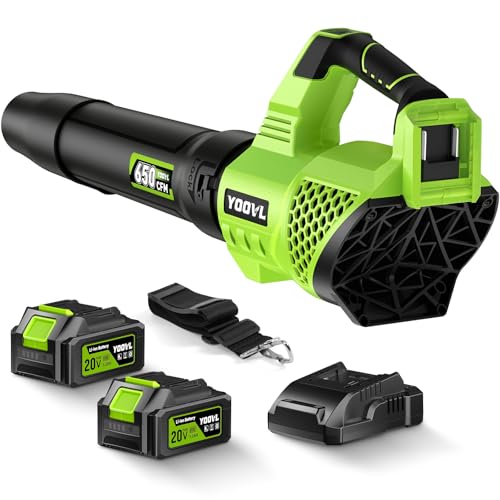


As an Amazon Associate we earn from qualifying purchases at no extra cost to you. Ratings are shown as listed on Amazon.
How to Choose: CFM vs. MPH vs. Real Cleanup Power
Product listings push maximum MPH, but yard cleanup is about moving a pile, not just top speed. Use these specs together:
- CFM (Cubic Feet per Minute): Air volume. This determines how wide a swath you clear and how well you move heavy, wet leaves. For dry leaves on hard surfaces, 400-500 CFM is enough. For thick, damp leaf cover on lawns, look for 600+ CFM.
- MPH (Miles per Hour): Air speed. This determines how well you dislodge matted leaves, pine needles, and debris stuck to grass. 100-130 MPH is fine for light debris; 150+ MPH helps with wet leaves and gutters.
- Newton Force: Some brands (EGO, Stihl) list blowing force in Newtons. It combines CFM and MPH. 12-15N is light duty, 17-20N is strong for cordless, 20N+ competes with small gas blowers.
- Nozzle design matters: A flat concentrator nozzle increases MPH and scraping power but narrows the path. A round wide nozzle increases effective CFM for sweeping open lawns. The best blowers include both.
Best Cordless Leaf Blowers Compared: Specs That Affect Cleanup
Weight, noise, and battery size decide whether you will actually enjoy using the blower for 20 minutes. Tools over 8 lbs with battery cause more arm fatigue when sweeping side-to-side. Noise at 65 dB(A) or below is significantly more neighbor-friendly than 90+ dB(A) gas-equivalent models.
| Model & Platform | Max Volume (CFM) | Max Speed (MPH) | Tool Weight (with battery) | Noise at Ear (dB(A)) | Battery Included | Runtime (Low / High) |
|---|---|---|---|---|---|---|
| EGO Power+ LB7654 (56V) | 765 | 200 | 7.4 lbs (with 5.0Ah) | 64 | 5.0Ah | 90 min / 14 min |
| Ryobi 40V Whisper Series RY40WL01 (40V) | 730 | 160 | 7.8 lbs (with 6.0Ah) | 57.5 | 6.0Ah | 85 min / 18 min |
| Milwaukee M18 FUEL 2724-20 (18V) | 600 | 145 | 5.7 lbs (with 8.0Ah) | 63 | Bare tool | 45 min / 12 min (with 8.0Ah) |
| DeWalt 20V MAX DCBL772 (20V) | 600 | 125 | 6.8 lbs (with 5.0Ah) | 61 | Bare tool or 5.0Ah kit | 32 min / 11 min (with 5.0Ah) |
| Makita 18V X2 (36V) XBU03PT (2x 5.0Ah) | 459 | 157 | 8.8 lbs (with 2x 5.0Ah) | 60 | 2x 5.0Ah | 75 min / 28 min |
| Greenworks 80V GD80AB (80V) | 730 | 170 | 8.9 lbs (with 2.5Ah) | 65 | 2.5Ah | 35 min / 15 min |
| Stihl BGA 57 (36V AK System) | 303 | 103 | 7.7 lbs (with AK 20) | 59 | AK 20 | 50 min / 12 min |
Runtimes are manufacturer-rated with included batteries on low constant vs. turbo/max. Real-world sweeping with variable trigger use typically falls 20-30% below the turbo number and above the pure turbo time, because you rarely hold turbo continuously.
What the numbers mean on the lawn
- Under 450 CFM: Fine for hard surfaces, porches, garage, and light dustings of leaves. You will make multiple passes on a leaf-covered lawn.
- 500-650 CFM: The sweet spot for most suburban lots up to 1/4 acre. Clears an open lawn in 10-20 minutes on a mix of medium and high.
- 700+ CFM: Needed if you have mature oaks/maples, clean up once a week or less, or deal with wet, heavy piles. Saves time but requires a 5.0Ah or larger battery to be useful.
Pick by Yard Size and Situation
Match the blower to how you clean, not just lot size.
| Your Situation | Best Fit Type | Why |
|---|---|---|
| Small yard, patio, condo <1,800 sq ft of leaves | 18V/20V compact blower (DeWalt DCBL772, Milwaukee 2724, Stihl BGA 57) | Lightest weight, lowest noise, uses batteries you already own for drills/saws. 2.5-5.0Ah is enough for 10-15 minutes. |
| Medium suburban lot 1/8 to 1/4 acre, weekly cleanup | 40V-56V mid-high CFM (Ryobi 40V Whisper, EGO Power+ LB6500) | 600-730 CFM clears without raking. Look for cruise control and variable trigger to stretch runtime. 4.0-6.0Ah ideal. |
| Large lot 1/4 to 1/2 acre with mature trees, infrequent cleanup | High-volume 56V/80V (EGO LB7654, Greenworks 80V, Husqvarna 350iB) | 700+ CFM and 17N+ force to move wet matted leaves. Requires 5.0-7.5Ah battery; expect 12-18 min on turbo. |
| Noise-sensitive neighborhood or early morning use | Low-dB brushless models (Ryobi Whisper Series, Makita XBU03, Stihl BGA series) | Rated 57-61 dB(A) on low; can halve perceived loudness vs. 65+ dB models. Often has dedicated quiet mode. |
| You want one battery for all yard tools | Stay in your platform | If you own EGO 56V, Greenworks 40V/80V, Ryobi 40V, Milwaukee M18, DeWalt 20V, or Makita 18V, buying that brand’s blower saves $100-$200 on batteries and chargers. |
Battery Platform and Runtime: A Practical Calculation
Battery voltage alone does not equal power; amp-hours (Ah) and watt-hours (Wh = Volts x Ah) decide how long you can blow. A simple way to estimate coverage:
- Estimate your time needed: Open hard surface = ~1.5 minutes per 1,000 sq ft. Lawn with moderate leaves = ~4-5 minutes per 1,000 sq ft. Heavy, wet cover = ~7-9 minutes per 1,000 sq ft.
- Check blower’s sustained high runtime. For example, an EGO 56V 5.0Ah (280Wh) is rated ~14 minutes on turbo, a 7.5Ah (420Wh) ~21 minutes. A Ryobi 40V 6.0Ah (240Wh) is rated ~18 minutes on high.
- Calculate batteries needed: If your 3,000 sq ft lawn takes ~15 minutes on high, one 5.0Ah 56V or 6.0Ah 40V battery will finish it with one trigger technique recharge at low between piles. For 6,000 sq ft of heavy leaves (~45 minutes), you need two large batteries or a mid-day recharge.
Worked example: A 1/4-acre lot with 5,000 sq ft of leaf-covered lawn. At 5 minutes per 1,000 sq ft, you need ~25 minutes of effective sweeping. A Milwaukee M18 8.0Ah (144Wh) provides ~12 minutes on high, so you would need two 8.0Ah packs or three 5.0Ah packs to finish without stopping. A single EGO 7.5Ah would cover about 21 minutes on turbo and closer to 35-40 minutes mixing low/high, so one large pack could finish the job if you use turbo only for heavy piles.
This is why platform choice matters more than one-off max CFM claims. Buying a blower that shares batteries with your mower, string trimmer, or chainsaw effectively doubles your runtime without buying extra packs, which generally cost $120-$250 per battery in the 40V-80V class and $80-$150 in the 18V-20V class.
Weight, Noise, and Comfort Trade-offs
- Weight balance: Inline axial designs (EGO, Ryobi, Milwaukee) keep weight centered and reduce wrist twist versus older pistol-grip housings. Models under 6.5 lbs with battery are easy for one-handed gutter or car drying work; over 8.5 lbs benefits from a shoulder strap or hip-angled tube.
- Vibration and throttle: Look for variable-speed trigger + cruise control/lock. Cruise lets you hold 60-70% power without finger fatigue, which extends runtime 30-40% compared to constant turbo.
- Noise reality: dB(A) is logarithmic. A blower rated 65 dB(A) is roughly twice as loud to the ear as one rated 57 dB(A). Brands achieving under 60 dB(A) on low usually use brushless motors and sound-dampened housings. For HOAs with 65 dB limits, stick to low/medium and check local ordinance hours.
Durability and Ownership Realities
Cordless blowers have few moving parts, but these parts wear first:
- Battery health: The most expensive consumable. Lithium packs lose capacity with heat, full discharges, and storage at 100%. Store at 40-60% charge in cool, dry conditions. Avoid leaving batteries on chargers in a hot garage for weeks. Expect 300-500 full cycles before noticeable fade, typically 3-5 years for seasonal use.
- Intake and impeller: Dust, grit, and small twigs wear the fan. Never use a leaf blower to vacuum gravel or as a debris vacuum unless it has a dedicated vacuum kit. Clear the intake screen after each use and tap out the filter if equipped.
- Tube latches and nozzles: Plastic bayonet mounts crack if you force tubes on at an angle. Push and twist until it clicks; do not carry the blower by the tube alone.
- Common mistakes that kill runtime: Holding turbo the entire time, using a small 2.0Ah battery for a large yard (causes voltage sag and overheating), and blowing against wind instead of with it. Work downwind in overlapping rows like mowing, and use a light blowing pass to gather then a short turbo burst to move the final pile onto a tarp.
Maintenance is minimal: wipe the housing, clear debris from air intakes, inspect the nozzle for cracks, and keep battery contacts clean and dry. No fuel, spark plugs, or air filters to replace like gas models. Tool-only warranties in this category are typically 3-5 years for the tool and 3 years for the battery.
Bottom Line Recommendations by Budget and Platform
- Maximum power for large properties: EGO Power+ LB7654 with 5.0Ah or 7.5Ah battery. Highest tested CFM/force in cordless class and stays relatively light and quiet for its output. Kits generally fall in the $280-$400 range.
- Best quiet value for medium yards: Ryobi 40V Whisper Series. Very low noise on low, high CFM for the price, and shares batteries with a wide range of Ryobi 40V yard tools. Kits generally in the $180-$280 range.
- Stay in 18V/20V if you already own the platform: Milwaukee M18 FUEL 2724-20 or DeWalt 20V MAX DCBL772. Both deliver ~600 CFM for small-to-medium jobs at the lowest carry weight, ideal if you own M18 or 20V MAX batteries. Bare tools typically $130-$180.
- For one-handed or noise-critical use: Makita 18V X2 XBU03 or Stihl BGA 57. Lower CFM but excellent balance, low vibration, and very low noise. Better for frequent, short cleanups than for heavy autumn leaf fall.
If you only buy one battery, buy the largest Ah your platform offers that you can comfortably carry. A single 5.0-6.0Ah 40V/56V pack or 8.0Ah 18V pack will cover most single-session cleanups for medium yards; large yards with infrequent cleanup need two packs or a fast charger that can refill one pack while you run the other.
FAQ
Is CFM or MPH more important?
CFM moves the pile, MPH breaks it loose. If you have mostly dry leaves on pavement or short grass, prioritize CFM. If you have wet, matted leaves or pine needles embedded in grass, prioritize MPH and Newtons, and use a concentrator nozzle.
How long does a cordless leaf blower battery last?
With a 4.0-5.0Ah battery in the 40V-56V class, expect 10-15 minutes on turbo and 45-75 minutes on low. Mixing speeds, expect 20-35 minutes of real sweeping. Cold weather and old batteries reduce runtime 15-25%.
Can a cordless blower replace a gas blower?
700+ CFM cordless models now match small gas handhelds (400-500 CFM gas is common) and approach entry-level gas backpacks on force, with much lower noise and no fuel mixing. For multi-acre or commercial all-day use, gas backpacks still lead on sustained power.
What weight should I target?
For comfortable extended use, stay under 7.5 lbs with battery if you blow more than 15 minutes. If you need 700+ CFM, expect 7.5-9 lbs and consider a model with a well-angled tube and cruise control to reduce arm strain.