Key takeaways
- Pro: Genuinely lightweight — you can run it for twenty minutes without fatigue.
- Pro: 7-Amp corded power means it never dies mid-task.
- Con: Struggles with wet, matted leaves; you’ll still be scraping corners.
There’s a specific frustration that drives people to buy an electric leaf blower: you’ve got a Saturday morning and a yard covered in wet maple leaves, and you’re staring down the barrel of an hour with a rake. A good electric blower turns that hour into fifteen minutes. A bad one leaves you lugging a cord you can’t keep clear of, or a battery that dies halfway through the back lot, or a motor that sounds like a jet engine but barely moves a single leaf.
What separates the best electric leaf blowers from the rest in 2026 is a short list of real-world factors: airflow that actually moves damp debris, a weight you can hold for ten minutes without your forearm seizing, and a power source matched to your actual yard size. Get those three things right and the purchase is simple. Get any of them wrong and the unit lives in the garage collecting dust alongside the broken rake.
Our top picks

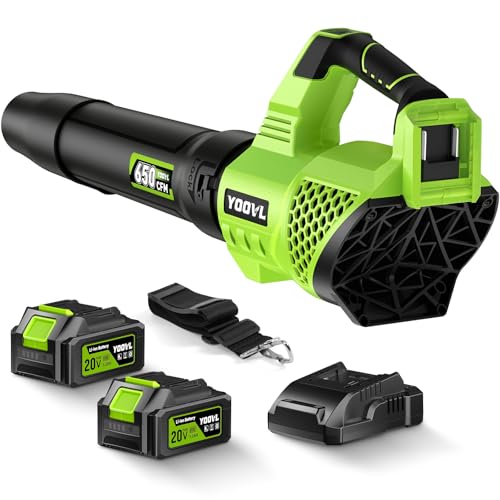 Leaf Blower Cordless
- Upgraded Leaf Blower:More than just a leaf blower—YOOVL…
- Leaf Blower Cordless with Battery and Charger: Equipped…
- Advanced Motor & Adjustable Speed: YOOVL blowers for…


As an Amazon Associate we earn from qualifying purchases at no extra cost to you.
Quick Picks
| Product | Best For | Price |
|---|---|---|
| BLACK+DECKER LB700 | Small yards on a tight budget | under $50 |
| 650CFM Cordless | High power without brand markup | under $90 |
| Green 2-Battery Cordless | Light-duty patio and walkway cleanup | under $70 |
| SEESII 40V Brushless | Brushless reliability at mid-range cost | under $150 |
| MZK 20V | Lowest entry price for cordless | under $40 |
| Greenworks 80V | Large properties and heavy debris | under $250 |
| Greenworks 40V | Medium yards in the Greenworks ecosystem | under $80 |
| WORX WG520 | Best overall corded performance | under $80 |
How We Picked
We evaluated every unit on three criteria that translate directly to whether you’ll actually use the thing: real-world airflow effectiveness measured by CFM paired with MPH (raw numbers on spec sheets don’t tell the whole story, so we looked at nozzle design and user-reported performance on wet leaves), sustained comfort (weight distribution, noise levels, vibration during a twenty-minute session), and power-source practicality (corded units need an extension cord management plan, cordless units need battery runtimes that match typical yard sizes). A blower that wins on paper but tires out your arms or dies before you finish the job is a blower you’ll resent.
The 8 Best Electric Leaf Blowers in 2026
BLACK+DECKER LB700
If your yard is under a quarter acre and you already own a decent extension cord, this is the most rational purchase on the list. For under $50 it undercuts most gas blowers’ annual fuel costs, and the 180 MPH/180 CFM combination handles dry leaves and lawn clippings without complaint.
- Pro: Genuinely lightweight — you can run it for twenty minutes without fatigue.
- Pro: 7-Amp corded power means it never dies mid-task.
- Con: Struggles with wet, matted leaves; you’ll still be scraping corners.
Skip it if your property has large trees dropping heavy debris or if you need reach beyond a single garden hose length of cord.
650CFM Cordless with 2 Batteries
This unit is the sleeper pick for anyone who wants serious airflow without paying a brand-name premium. The 650 CFM rating puts it in the same conversation as blowers costing twice as much, and the included pair of 5.2Ah batteries means you can realistically finish a half-acre yard on a single charge and still have reserve.
- Pro: Adjustable shoulder strap makes extended use comfortable.
- Pro: Three speed modes give you control for both delicate beds and heavy piles.
- Con: Unbranded build quality means long-term durability is a gamble.
Skip it if you prefer a brand with an established warranty support history and parts availability.
Green 2-Battery Cordless
A lightweight option for people whose primary cleanup targets are patios, walkways, and gravel. The two included batteries give you enough runtime for routine sweeping tasks, and the low-profile design tucks into a shelf or hook without being in the way.
- Pro: Compact enough to store in tight spaces.
- Pro: Two batteries for under $70 means you won’t be waiting on charge cycles.
- Con: Limited CFM means it fights a losing battle against anything wet or dense.
Skip it if your main job is moving autumn leaf coverage across a lawn — this is a finishing tool, not a workhorse.
SEESII 40V Brushless
Brushless motors matter for two reasons: they last longer and they deliver more consistent torque under load. For under $150 this blower gives you both of those advantages plus a turbo mode that spikes the 160 MPH airflow for the moments you need to clear a clogged corner. The 1500W rating and 650 CFM put it firmly in “handles real work” territory.
- Pro: Brushless motor should outlast brushed competitors by years of use.
- Pro: Turbo mode provides an extra surge for stubborn debris.
- Con: Heavier than brushed alternatives at the same voltage class.
Skip it if your arms or shoulders are sensitive — the added weight compounds over a long session even with the shoulder strap.
MZK 20V
Under forty dollars with two batteries and a charger is genuinely hard to beat as an entry point. The 130 MPH and 450 CFM numbers are modest but honest — this will clear dry leaves from a small lawn and blow grass clippings off a driveway. For a teenager’s chore assignment or a first-time buyer, it’s the lowest-risk cordless option here.
- Pro: Lowest price for a cordless unit with two batteries included.
- Pro: Light enough for anyone, including younger users.
- Con: Will stall on wet leaves or anything remotely compacted.
Skip it if your yard exceeds a typical suburban lawn with a single tree canopy.
Greenworks 80V
This is the blower you buy when you stop wanting to do yard work in shifts. At 770 CFM it moves an enormous volume of air, and the 80V platform means Greenworks can sustain that power for a longer runtime than lower-voltage units. It’s the closest electric equivalent to what a mid-range gas blower used to deliver, and for under $250 it’s priced well for what it does.
- Pro: Highest CFM on this list — genuinely handles heavy, wet, matted debris.
- Pro: Greenworks 80V ecosystem lets you share batteries with trimmers and mowers.
- Con: Premium price tag puts it out of reach for casual buyers.
Skip it if your yard is small or if you’re a seasonal user who blows leaves three times a year.
Greenworks 40V
The 40V sits in the Goldilocks zone for suburban yards — powerful enough to handle a standard half-acre of oak and maple drop, priced accessibly for under $80, and integrated into a battery ecosystem most buyers already own. The 135 CFM is modest, but the focused nozzle makes that number more useful than the raw figure suggests.
- Pro: Greenworks ecosystem means you already own spare batteries if you own any 40V tool.
- Pro: Quiet operation compared to anything in its performance class.
- Con: 135 CFM is limiting for wide-open lawn areas with heavy coverage.
Skip it if your property has open lawn areas exceeding a quarter acre — you’ll be running in short, frustrating bursts.
WORX WG520
The highest-rated product on this list for good reason. The Turbine fan design generates 600 CFM at 110 MPH through a 12-Amp corded motor, and the result is a blower that feels more powerful than its specs suggest because the airflow stays coherent over a longer distance. Two-speed control lets you dial back for flower beds and crank up for pile-moving. For under $80 it’s the best performance-per-dollar corded unit you can buy.
- Pro: Turbine fan produces the most usable long-range airflow on this list.
- Pro: 4.7 rating reflects genuine satisfaction with real-world performance.
- Con: Corded means you need a 12-amp-rated extension cord and constant cord management.
Skip it if your property layout makes cord routing dangerous or impractical — go 80V cordless instead.
Buying Guide
Corded vs. Cordless: The Yard Size Test
Match the power source to your geometry, not your preference. If your yard is rectangular, has few obstacles, and you can run a single 100-foot extension cord from a rear outlet to every corner without tripping, a corded unit like the WORX gives you unlimited runtime for less money. If your property has trees, fences, raised beds, or a winding layout, a cordless unit with two batteries is worth the premium because you’ll actually finish the job without stopping to reposition a cord.
CFM vs. MPH: Which Number Matters More
CFM (cubic feet per minute) measures volume — how much air you’re pushing. MPH measures velocity — how fast that air exits the nozzle. For moving piles of dry leaves across a flat lawn, CFM wins because you’re displacing a large mass of low-weight debris. For blowing material off gravel, pavement, or out of corners where leaves are wedged, MPH wins because velocity creates the shear force needed to break contact. The ideal blower balances both: look for units above 400 CFM paired with above 120 MPH for general-purpose use.
Brushless Motors and What They’re Worth Paying For
A brushless motor eliminates the carbon brushes that wear down inside brushed motors, which means less maintenance, longer lifespan, and better efficiency at partial throttle. The trade-off is a higher upfront price — expect to pay $30 to $70 more for a brushless unit with comparable specs. If you plan to use your blower for more than three seasons, the durability advantage usually justifies the premium. If you’re buying a seasonal backup or a tool for a child, a brushed motor saves money without meaningful downside.
Our Verdict
Top pick: The WORX WG520 wins on the combination of highest user rating, best airflow quality for its price, and the practical advantage of never running out of power. If your yard allows cord management, it’s the most satisfying blower per dollar here.
Budget pick: The MZK 20V for under $40 delivers enough performance for a small yard at a price that makes buyer’s remorse impossible.
Condition for another winner: If your yard is larger than half an acre or you’re dealing with wet, heavy debris from mature trees, the Greenworks 80V earns its price — nothing else on this list moves that volume of air.
FAQ
Are electric leaf blowers powerful enough to replace gas?
For residential properties up to about one acre, modern 40V and 80V cordless units handle the same tasks that gas blowers used to require. You’ll still notice a gap when clearing a half-acre of wet, matted oak leaves after a heavy drop, but for routine cleanup the electric options match or exceed what most homeowners need.
How long do batteries last per charge?
A 5.2Ah battery on a mid-range cordless blower typically delivers 25 to 40 minutes on low speed and 12 to 18 minutes on high speed. Two-battery kits effectively double that window, which is why they’re the practical standard for anyone with more than a modest yard to cover.
Do I really need two batteries?
If your yard takes more than fifteen minutes to blow clean and you’re using a single-battery unit on high speed, you’ll end up waiting through a charge cycle mid-task. A two-battery kit eliminates that interruption and is worth the extra cost for anyone with more than a quarter acre of lawn.
Will an electric blower work in winter for snow?
Electric blowers handle light, fresh snowfall under two inches on hard surfaces like driveways and patios. They will not move packed snow, heavy wet snow, or anything with ice underneath — that’s still a shovel or gas-powered unit’s job. Cordless models should be stored indoors between uses in freezing temperatures to preserve battery chemistry.