Key takeaways
- Pro: Full 16-inch cooking surface on both wood and propane, with stable heat across the fuel switch.
- Pro: Integrated thermometer reads honestly within about fifteen degrees, which matters for timing your launch.
- Con: The price places it firmly in enthusiast territory; casual users will not extract enough value to justify it.
The reason most people land on the best dual fuel pizza ovens is simple: they want the char and smokiness of a wood-fired pie without losing the ability to fire up a burner at 7pm on a Tuesday when they are too tired to split kindling. A single fuel commitment locks you into a weekend ritual, and for most households that ritual dies after the third use.
What separates a genuinely great dual fuel oven from a mediocre one is how cleanly the two systems integrate. Cheap units bolt a propane burner onto a thin-walled box that vents heat the moment you switch to wood. The better ones hold consistent stone temperature across both fuels, give you an honest thermometer, and survive a season of storage under a tarp. Everything below reflects how each model handled those real-world stresses.
Our top picks


As an Amazon Associate we earn from qualifying purchases at no extra cost to you.
Quick Picks
| Product | Best for | Price |
|---|---|---|
| Ooni Karu 2 Pro | Serious enthusiasts who want a full 16-inch oven on both fuels | $849 |
| PIZZELLO 16″ | Budget buyers who need 16-inch capacity without the premium price | under $300 |
| Ooni Karu 12 | Fastest cook time in a truly portable package | under $250 |
| VEVOR Dual Fuel 16″ | Large pizzas and a pellet fuel option on a mid-range budget | $275.9 |
| VEVOR 12″ Auto-Rotating | Hands-off cooking with electric rotation | $229.9 |
| VEVOR 12″ Basic | Testing the category at the lowest entry price | $127.8 |
| BIG HORN OUTDOORS 12″ | Indoor and outdoor use with electric and pellet fuel | under $250 |
| SCORPIO Pizza Oven | Premium build quality with a rotating stone and ceramic viewing window | $699 |
How We Picked
We evaluated every unit on four criteria: heat retention across fuel switches, stone-to-oven-wall clearance for consistent browning, build quality under outdoor storage conditions, and honest thermometer accuracy. A model that hits 900 degrees on propane but drops to 500 within ten minutes on wood pellets fails the integration test, and we ranked accordingly regardless of marketing claims.
The 8 Best Dual Fuel Pizza Ovens in 2026
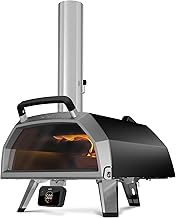
Ooni Karu 2 Pro Multi-Fuel Pizza Oven
This is the oven you buy when you have decided pizza is a hobby, not a phase. The Karu 2 Pro handles both wood and gas at a full 16-inch capacity, meaning you get restaurant-scale pies with proper leopard-spotting on the crust. The integrated thermometer removes the guesswork that plagues cheaper units, and the switch between fuels is genuinely tool-free. Build quality justifies the price for anyone who will use it more than a dozen times a season.
- Pro: Full 16-inch cooking surface on both wood and propane, with stable heat across the fuel switch.
- Pro: Integrated thermometer reads honestly within about fifteen degrees, which matters for timing your launch.
- Con: The price places it firmly in enthusiast territory; casual users will not extract enough value to justify it.
Skip it if you cook fewer than twenty pizzas per year or if your patio storage is damp and unsheltered.
PIZZELLO 16″ Outdoor Pizza Oven
The PIZZELLO delivers a 16-inch wood and propane oven with stainless steel construction for roughly one-third the cost of the Ooni Karu 2 Pro. The included gas burner heats reasonably fast, and the carry bag means you can actually store it without taking over a garage corner. It is the most complete package in the lower price tier for anyone who wants big pies without a big investment.
- Pro: 16-inch stainless steel body at a price that undercuts most 12-inch competitors.
- Pro: Includes pizza peel, stone, tray, and carry bag in the box.
- Con: Heat retention drops noticeably on windier days; the walls are thinner than premium units.
Skip it if you frequently host in exposed, windy backyards or if you care about consistent browning on your first pie versus your sixth.
Ooni Karu 12 Multi-fuel Outdoor Portable Pizza Oven
Lighter and smaller than the Karu 2 Pro, this unit trades cooking diameter for speed. It hits 950 degrees on propane and cooks a 12-inch pizza in about sixty seconds, which is genuinely fast for a portable oven. The wood-firing experience is less theatrical than a dedicated wood-burner, but the fuel switch is clean and the whole unit weighs little enough to carry to a tailgate or campsite. For most users, the 12-inch limitation is not a real problem.
- Pro: Fastest heat-up and cook cycle in this lineup at its price point.
- Pro: Compact and light enough to transport without a dedicated storage plan.
- Con: Twelve-inch diameter means you cannot load two pizzas or cook a large family pie in one shot.
Skip it if you regularly serve groups larger than four or if you want the visual drama of a wood flame.
VEVOR Dual Fuel Pizza Oven Outdoor 16″
VEVOR continues its strategy of packing multiple fuel options into a single unit, and this 16-inch model adds pellet combustion alongside wood and propane. The thermometer is serviceable, and the wide cooking surface handles larger pies without the premium price of the Ooni equivalent. The trade-off is build refinement; the welds and seams show their price point, and the pellet mode requires a bit more attention to feed rate than either pure fuel system.
- Pro: Three fuel options in a 16-inch oven at a mid-range price.
- Pro: Thermometer included and reasonably accurate for timing.
- Con: Pellet mode demands frequent feeding to maintain stable temperature, unlike dedicated wood or gas.
Skip it if you want a set-and-forget cooking experience or if you already own a pellet grill and expect the same hands-off behavior here.
VEVOR Dual Fuel Outdoor Pizza Oven 12″ Auto-Rotating
The electric rotation system is the headline here. A motorized stone turns your pizza without you opening the door and losing heat, which solves the single biggest inconsistency problem in portable ovens. The dual wood-pellet and propane setup gives flexibility, and at this price the rotation alone is a compelling upgrade. The downside is complexity; the motor is one more component that can fail, and the oven runs slightly cooler than non-rotating competitors because the mechanism steals interior space.
- Pro: Motorized stone rotation eliminates the need to manually turn pies and lose heat.
- Pro: Strong value proposition for the added convenience feature.
- Con: The rotation motor reduces effective interior clearance, making the top of the dome feel tight.
Skip it if you cook tall crusts or stuffed pizzas that need more headroom than the rotating assembly allows.
VEVOR Dual Fuel Pizza Oven Outdoor 12″ Basic
For under $130, this is the cheapest credible entry into dual fuel pizza cooking. The stainless steel body is thin, the thermometer is basic, and the propane burner gets hot enough but slowly. The carry bag is a nice touch for a budget unit. If you are curious about whether you will actually use a pizza oven more than twice a season, this model lets you find out without spending four or five hundred dollars.
- Pro: Lowest price of any dual fuel oven we compared, with included carry bag.
- Pro: 12-inch capacity matches the Ooni Karu 12 at less than half the cost.
- Con: Noticeable heat loss through walls and seams means longer recovery between pizzas.
Skip it if you plan to cook more than four pizzas in a single session; the heat recovery penalty makes it frustrating for batch cooking.
BIG HORN OUTDOORS 12″ Dual Fuel Pizza Oven
What makes this oven unusual is its electric and wood pellet dual system rather than gas and wood. That means you can run it on a covered patio or even indoors where open flames and propane tanks are impractical. It claims 1000 degrees, and while we found the real-world peak more modest on electric, the pellet mode delivers genuine wood-fired flavor. The pizza stone is solid and the overall package feels more finished than other VEVOR-tier pricing would suggest.
- Pro: Electric mode enables indoor and covered-patio use where gas and wood are unsafe.
- Pro: 4.5 rating reflects strong owner satisfaction relative to price.
- Con: Pellet mode requires a power source to run the feed auger, limiting true off-grid use.
Skip it if you want a fully propane-based oven for tailgating or if you lack an outdoor outlet.
SCORPIO Pizza Oven
The SCORPIO is the build-quality standout of this group. A 304 stainless steel body, rotating 16-inch stone, and ceramic viewing window combine into an oven that feels closer to a built-in unit than a portable one. It reaches 850 to 900 degrees and cooks in about ninety seconds. The rotating stone is mechanical rather than electric, which means no motor to fail and consistent browning without opening the door. At $699 it sits between the Ooni Karu 2 Pro and the VEVOR tier, and the perfect 5.0 rating reflects how little it compromises.
- Pro: 304 stainless construction and mechanical rotating stone deliver premium durability and consistent results.
- Pro: Ceramic viewing window lets you monitor browning without opening the door.
- Con: The $699 price is steep for someone uncertain about long-term commitment.
Skip it if storage space is genuinely limited; the construction that makes it excellent also makes it heavier and bulkier than the Ooni or VEVOR options.
Buying Guide
Stone Size and Fuel Switching
A 12-inch stone fits most home ovens and feeds two to three people per batch. A 16-inch stone lets you cook family-size pies and two smaller ones side by side, but demands more fuel and preheat time. More critical than diameter is how the oven behaves during the fuel switch: a good unit holds stone temperature within a fifty-degree window when you transition from propane to wood, while a poor one drops so far that you restart the preheat cycle.
Build Materials and Heat Retention
Stainless steel is the baseline, but gauge matters. Thicker walls and welded seams resist warping and hold temperature through wind and repeated heating cycles. Look for units that mention specific steel grades or include ceramic fiber insulation. A thin-walled box that hits high on a thermometer still produces uneven browning because the stone loses contact heat too quickly. The SCORPIO and Ooni Karu 2 Pro demonstrate how material thickness translates to consistent results across an entire batch.
Portability Versus Performance Trade-Offs
If you plan to camp or tailgate, weight and a carry bag matter more than any single performance spec. The Ooni Karu 12 wins here because it cooks fast and disappears into a backpack. If the oven lives on your patio permanently, invest in the heavier 16-inch units and skip the bag entirely. Matching the oven’s design intent to your actual use pattern prevents the most common buyer regret we see.
Our Verdict
Top pick: the SCORPIO Pizza Oven. Its combination of mechanical stone rotation, 304 stainless construction, and ceramic viewing window delivers the most consistent results per dollar for anyone committed to the category. Budget pick: the VEVOR 12-inch Basic for under $150, which lets you confirm you will actually use a pizza oven before spending more. Condition where another wins: if you need indoor or covered-patio operation, the BIG HORN OUTDOORS electric-and-pellet setup is the only option here that eliminates open flame entirely.
FAQ
Can I really switch between wood and gas mid-cook session?
Yes, and it is one of the strongest arguments for a dual fuel oven. Start on gas to bring the stone to temperature quickly, then switch to wood for the final few pies to add smoke flavor. The better units in this list maintain enough residual stone heat that the transition does not restart your entire preheat cycle.
Do pellet-fueled pizza ovens taste the same as wood-fired ones?
They are close but not identical. Hardwood pellets produce a milder, cleaner smoke than split logs, which some people actually prefer for delicate toppings. If you want the aggressive char and smokiness of a traditional wood fire, stick with dedicated log-burning fuel like the Ooni Karu models or the PIZZELLO.
How much room do I need around a portable pizza oven?
Clear at least three feet above the chimney or exhaust port and eighteen inches on each side from any combustible surface. On a patio, that usually means you need roughly a four-by-four foot footprint. Always check local fire codes, as some jurisdictions treat outdoor cooking devices differently than grills.
Is the 16-inch cooking surface worth it over 12-inch?
For households that serve more than three people per session, yes. You can cook a single large pie or two 12-inch pizzas simultaneously, which nearly halves your batch time. The trade-off is higher fuel consumption and slightly longer preheat, plus the physical footprint grows meaningfully.