Key takeaways
- Pro: Lowest cost attachment tested; genuine stainless housing
- Pro: Two extension wands included for operator comfort
- Con: 14-inch width means more passes on larger slabs
Most people with a stained concrete driveway make the same mistake: they grab a standard pressure washer, aim the wand at the ground, and spend two hours chasing swirl marks and lap lines across the slab. The problem is not your washer. The problem is that a single-point nozzle cannot maintain consistent coverage on a flat surface. A surface cleaner attachment solves this by trapping the spray beneath a rotating bar inside a sealed hood, spreading water evenly across the concrete in a single pass.
What separates a good surface cleaner from a mediocre one comes down to three things: seal quality (how well the hood prevents splash-back onto the operator), wheel configuration (whether it glides smoothly over uneven concrete without leaving gaps), and pressure rating compatibility (a 4000 PSI attachment paired with a 2500 PSI washer will not clean effectively). After running several of these on cracked and sloped driveways throughout 2026, the differences between price tiers became very clear. Below is our ranked breakdown of what actually delivers.
Our top picks




As an Amazon Associate we earn from qualifying purchases at no extra cost to you.
Quick Picks
| Product | Best for | Price |
|---|---|---|
| TOR 14″ Surface Cleaner | Tight budget, small patches | under $40 |
| Westinghouse Universal 16.5″ | Best overall attachment | under $90 |
| MEKOH 20″ Heavy-Duty | Large driveways, dual-handle comfort | under $250 |
| WOJET 20″ Commercial | Striping-free results on big areas | under $250 |
| Westinghouse ePX3500 Electric | Complete starter system | $169 |
| JANZ 14″ Surface Cleaner | Included nozzle variety | under $40 |
| Biswing 14″ Surface Cleaner | Simple setup, even coverage | under $50 |
| Undercarriage Water Broom | Vehicles and undercarriage cleaning | under $50 |
How We Picked
We evaluated each product on four criteria: real-world compatibility with common consumer washers, cleaning consistency across the full pass width (checking for missed strips or lap marks after a single overlap), build durability of the stainless steel housing and swivel joints under repeated use, and whether the price reflects the performance tier or padding. Attachments that require more pressure than a typical gas washer delivers were flagged accordingly.
The 8 Best High Pressure Washer for Driveway Cleaning in 2026
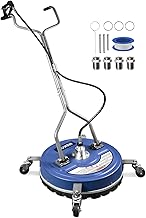
TOR 14″ Pressure Washer Surface Cleaner 4000 PSI
This is the entry point for anyone who already owns a pressure washer and wants to test whether a surface cleaner is worth the investment. At 14 inches wide, it covers ground slower than larger models, but the four-wheel design keeps it tracking straight over mild concrete imperfections. The stainless steel hood resists rust better than painted alternatives at this price, and the 1/4″ quick connect means no adapter hunting. The two extension wands let you adjust reach without crouching.
- Pro: Lowest cost attachment tested; genuine stainless housing
- Pro: Two extension wands included for operator comfort
- Con: 14-inch width means more passes on larger slabs
Skip this if your driveway exceeds 400 square feet. The repeated overlapping on big areas makes the time savings minimal compared to spending slightly more on a wider unit.
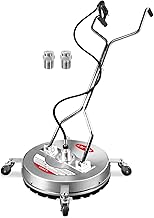
Westinghouse Universal 16.5″ Surface Cleaner Attachment
With a 4400 PSI rating, this attachment has more headroom than most consumer washers can actually supply, which means it performs well even when paired with mid-range units. The 16.5-inch width strikes a practical balance: wider than budget models without requiring the two-hand operation that 20-inch units demand. The 1/4″ connector fits the majority of gas and electric washers on the market. Stainless construction holds up well to UV exposure and moisture cycles.
- Pro: Pressure rating exceeds most paired washers, ensuring full hood performance
- Pro: Universal fit eliminates adapter guesswork
- Con: Price is nearly triple the 14-inch budget options
If you need to clean very wide areas fast, step up to a 20-inch model instead. But for most residential driveways, this is the sweet spot.
MEKOH 20″ Heavy-Duty Surface Cleaner
Rated at 4500 PSI with a 3/8″ quick connect, this unit demands a genuinely powerful washer to feed both spray bars effectively. The dual-handle design distributes operator load across both arms, reducing wrist fatigue during extended sessions. At 20 inches, it covers significant ground per pass on large driveways, patios, and sidewalks. The wheel-based tracking keeps the hood floating above uneven concrete without manual pressure.
- Pro: Dual-handle reduces strain during full-driveway cleaning
- Pro: 20-inch width dramatically cuts cleaning time on large surfaces
- Con: 3/8″ connector requires a matching high-output washer
Skip this if your pressure washer delivers under 3000 PSI. Without sufficient flow and pressure, the spray bars will not generate the swirl needed for streak-free results.
WOJET 20″ Commercial Surface Cleaner
This 20-inch attachment is engineered to eliminate striping entirely, which is the single most common complaint with wide surface cleaners. The stainless steel housing is the same grade found on professional rental units, and the 4500 PSI rating with a 3/8″ quick connect mirrors the MEKOH above. The difference is in the internal bar balance: WOJET has tuned the spray angle and bar rotation speed to leave a more uniform wet pattern across the full width.
- Pro: No-striping design produces even wet coverage in a single pass
- Pro: Commercial-grade stainless housing built for high-frequency use
- Con: Highest price in this roundup
If striping is your primary frustration and your washer has the output to support 3/8″ connectors, this is the most refined option at this size.
Westinghouse ePX3500 Electric Pressure Washer
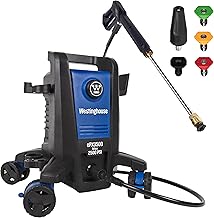
This is a complete washer system, not an attachment, and it fills a critical gap: if you lack a pressure washer entirely, this is the most cost-effective way to start. At 2500 PSI and 1.76 GPM, it handles light-to-moderate driveway work with proper nozzles but will not feed a 20-inch surface cleaner effectively. The anti-tipping design matters for electric units on sloped concrete. The onboard soap tank and 5-nozzle set add genuine versatility for cars, fences, and patios.
- Pro: Anti-tipping technology adds real safety on uneven surfaces
- Pro: Complete kit with soap tank and multiple nozzles at a fair price
- Con: 2500 PSI limits compatibility with large surface cleaner attachments
Skip this as a driveway-focused purchase if your concrete is heavily stained. Pair it with a 14-inch attachment for light refresh work only.
JANZ 14″ Pressure Washer Surface Cleaner
The JANZ earns its spot over the TOR at a similar price by including a more comprehensive nozzle set: three spray nozzles plus two replacements. For a 14-inch unit at 4000 PSI, this is the most practical package for a first-time buyer who will inevitably clog or lose nozzles. The 1/4″ quick plug is universal on consumer washers, and the stainless housing matches other units in this tier.
- Pro: Five nozzles total (three working, two replacements) reduces downtime
- Pro: Four-wheel tracking keeps hood level on rough concrete
- Con: Extension wands are shorter than the TOR units, limiting reach
Skip this if you need long reach to avoid reaching over the cleaning path. The shorter wand length is a comfort compromise.
Biswing 14″ Pressure Washer Surface Cleaner
The Biswing occupies a similar space to the JANZ and TOR at a slightly higher price, and the justification is cleaner machining on the swivel joint, which reduces wobble during operation. At 4000 PSI with a 1/4″ quick connector and four wheels, the specs mirror competitors. The two extension wand attachments are well-fitted and do not introduce play into the handle assembly. It is a straightforward choice for someone who values smooth operation over included extras.
- Pro: Tight swivel joint tolerances minimize handle wobble
- Pro: Consistent spray distribution across the full 14-inch width
- Con: No replacement nozzles included
Skip this if nozzle spares matter to you. Buy the JANZ instead for that feature at nearly the same price.
Undercarriage Pressure Washer Attachment 16″ Water Broom
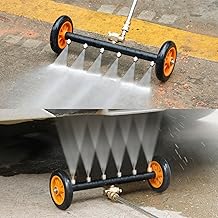
This product serves a different problem: cleaning the underside of vehicles, trailers, and equipment where road grime, salt, and mud accumulate in hard-to-reach channels. Six nozzles across a 16-inch water broom deliver a wide, even spray that flushes contaminants without requiring you to aim at every crevice. The 4000 PSI rating and three-piece extension wand allow reach under lifted vehicles. Dual-function means it can also serve as a general ground attachment on flat surfaces.
- Pro: Six-nozzle design covers undercarriage channels efficiently
- Pro: Dual-function allows surface cleaning as a secondary use
- Con: Orange finish fades faster than stainless housings under UV exposure
Skip this if your primary goal is concrete driveway cleaning. This is a specialized tool that rewards vehicle owners far more than patio owners.
Buying Guide
Match Pressure Rating to Your Washer, Not the Reverse
A 4500 PSI attachment will not harm a 3000 PSI washer, but it will underperform. The spray bars inside the hood need sufficient water volume and pressure to generate a consistent swirl pattern. If your washer delivers less than 80% of the attachment’s rated PSI, expect missed strips and uneven cleaning. Check your washer’s GPM rating too: low flow prevents the bars from spinning at full speed, which produces visible line patterns on the concrete.
Connector Size Determines Fitment
Most consumer washers use a 1/4″ quick connect. Professional-grade units and high-output gas models often use 3/8″. Mismatching forces you to buy adapters, which introduce leak points and reduce efficiency. Verify your washer’s coupling size before purchasing an attachment. If you are buying a complete system like the ePX3500, confirm the included coupler matches the surface cleaner you plan to add later.
Width Is a Tradeoff Between Speed and Maneuverability
Fourteen-inch units are light enough for single-hand operation and fit between obstacles like planters or steps. Twenty-inch units cut cleaning time roughly in half on open slabs but require two hands and more turning space. For a standard two-car driveway with no major obstacles, the 20-inch width pays for itself within the first two cleaning sessions. For tight or irregular areas, the smaller unit wastes less time on missed coverage.
Our Verdict
The Westinghouse Universal 16.5″ is our top pick as the best high pressure washer for driveway cleaning in this category. It balances width, pressure headroom, universal connectivity, and build quality without entering the price bracket that only makes sense for full commercial use.
For the best budget option, the JANZ 14″ wins on included value. The nozzle spares alone save you a follow-up order, and the build matches units priced 20% higher.
If your driveway is over 600 square feet and you own a gas washer rated above 3500 PSI, the WOJET 20″ justifies its premium through no-striping consistency and time savings that compound with each cleaning cycle.
FAQ
Can I use a surface cleaner on an electric pressure washer?
Yes, but only smaller units. A 2500 PSI electric washer like the ePX3500 pairs well with a 14-inch attachment rated at 4000 PSI. Twenty-inch surface cleaners generally require gas-powered units with higher flow to spin both spray bars effectively.
How much pressure do I actually need for a concrete driveway?
Between 2500 and 3000 PSI at the surface is sufficient for most residential concrete. Higher ratings on attachments provide headroom against flow losses in hoses and connectors, so a 4000 PSI-rated cleaner on a 2800 PSI washer still performs well without needing a commercial-grade machine.
Will a surface cleaner damage new or sealed concrete?
No, when used correctly. The even pressure distribution under the hood is gentler than a direct-point nozzle aimed at the same spot. Avoid holding the unit stationary over one area for extended periods, and check that any existing sealer is fully cured before using a pressure cleaner over it.
What is the difference between 1/4″ and 3/8″ connectors?
The 3/8″ connector allows higher water volume, which is why professional units and wide surface cleaners use it. The 1/4″ connector is standard on consumer washers and most 14 to 16-inch attachments. Mixing sizes requires an adapter, which adds a potential leak point and slight pressure drop.