The hardest part of choosing a homeschool curriculum kit for elementary students isn’t finding options — it’s finding ones that don’t require you to rebuild the entire scope and sequence before Monday morning. Over years of testing programs from kindergarten through fifth grade, I’ve watched parents spend real money on boxed curricula that promised “no prep” and delivered forty unsequenced worksheets with no answer key and no pacing guide. The gap between a kit that covers subjects in a logical progression and one that simply stacks printable pages is enormous.
What separates the best homeschool curriculum kits for elementary students in 2026 is a coherent daily structure that accounts for real attention spans, subject coverage that doesn’t quietly skip half a discipline, and materials that survive a year of a six-year-old’s desk work. The eight kits below span full programs and single-subject supplements, each tested against those practical standards.
Our top picks




As an Amazon Associate we earn from qualifying purchases at no extra cost to you.
Quick Picks
| Product | Best for | Price |
|---|---|---|
| 180 Days Kindergarten Set | All-in-one kindergarten launch | $170 |
| Evan-Moor Grade 3 Bundle | Broad subject coverage in one box | under $350 |
| Calvert 1st Grade Set | Structured parent-led instruction | $504 |
| LWT Building Writers A | Writing composition skills (K+) | under $20 |
| Magic Copybook (Grooved) | Handwriting muscle memory, ages 3–8 | under $30 |
| LWT Kick Start Kindergarten | Pre-writing readiness bundle | under $40 |
| Evan-Moor Daily Science Gr 3 | Supplemental science with lesson plans | under $20 |
| Evan-Moor Daily Reading Comp Gr 2 | Targeted comprehension practice | under $20 |
How We Picked
I evaluated each kit against four criteria: scope completeness (does it cover the subjects it claims without gaps?), daily usability (can a parent actually follow it at 8 AM with coffee still settling?), material durability (does it survive a year of elementary-age handling?), and cost-to-depth ratio (are you paying for content or for brand recognition?). No single kit excels at all four, which is why the recommendations below serve different family situations.
The 8 Best Homeschool Curriculum Kits For Elementary Students in 2026
180 Days Kindergarten Set
This kit is for parents starting kindergarten who want one box handling reading, writing, math, science, and social studies without a separate planning phase. The daily format — one spread per school day — removes the guesswork of sequencing, and answer keys are printed alongside activities so you can check work without a separate booklet. The consistent visual layout helps young kids navigate pages independently. The main weakness is pacing: at 180 pages covering every subject, individual topics receive minimal depth. A kindergartener who needs extra phonics practice will hit the wall by week six. Skip this if your child already knows letter names or you want a literature-rich reading component.
Evan-Moor Grade 3 Bundle
Parents who want broad subject coverage in a single purchase and don’t mind building their own schedule will find value here. Twenty-four workbooks across nine subjects means nothing gets quietly dropped, and the included pacing guide is a genuine time-saver for families transitioning from public school. Two downsides: the sheer volume is intimidating — opening a box of 24 workbooks is overwhelming — and the under-$350 price is high relative to its 3.8 rating, suggesting quality varies across titles within the set. Skip it if your third grader is already strong in math and you’d rather buy single-subject resources where gaps actually exist.
Calvert 1st Grade 4-Subject Complete Set
Calvert is the most structured option in this group, built around daily parent-led lessons with a fixed scope and sequence. That makes it ideal for first-year homeschoolers who want a clear script rather than open-ended exploration. The four-subject core covers reading, writing, math, and social studies with a starter kit for hands-on materials. Its strength is consistency: you always know what Tuesday looks like. The obvious trade-off is cost — at over $500 it’s the most expensive kit here — and it lacks a science component in the base set, so you’ll need to add that separately. Skip this if you want a child-led, project-based approach or can’t absorb a science add-on later.
Learning Without Tears Building Writers A
This workbook targets one specific skill — written composition — and does it better than any full curriculum’s writing unit I’ve tested. Narrative, informational, and opinion writing are scaffolded through prompts that build from single sentences to short paragraphs. The multi-sensory approach (tracing, copying, composing) means reluctant writers actually produce pages without resistance. For under $20 it carries the highest rating in this roundup at 4.8. The limitation is clear: it doesn’t teach grammar or mechanics, so you’ll need a separate spelling or language resource alongside it. Skip it if your child already writes fluent paragraphs and needs editing-level feedback rather than composition practice.
Reusable Grooved Handwriting Workbooks (Magic Copybook)
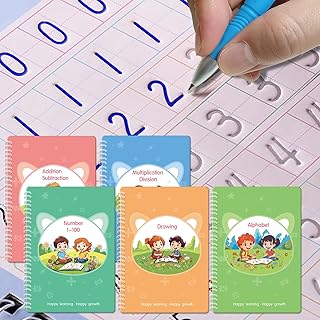
This is a handwriting drill tool, not a curriculum, and it’s honest about that. The grooved pages let a child trace letters repeatedly with a dry-erase marker, building muscle memory without the frustration of erasing mistakes off paper. The character edition adds varied stroke patterns beyond basic alphabet drills. For under $30 the reusable format saves money over a full school year compared to disposable workbooks. The con is durability — pages feel cheap and grooves can wear unevenly with heavy daily use. Skip it if your child already forms letters legibly and you’re looking for cursive transition work or composition practice instead.
Handwriting Without Tears Kick Start Kindergarten Bundle
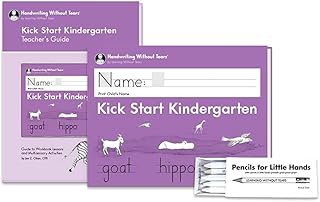
For parents whose five-year-old isn’t quite ready to hold a pencil correctly, this bundle is the on-ramp. It includes a student workbook, a teacher’s guide with short scripted lessons, a journal for free practice, and mini pencils sized for small hands — a detail that signals the designers understand developmental readiness. The 4.8 rating is well-earned: lessons are genuinely short enough to hold a kindergartener’s attention, and the multi-sensory approach keeps engagement high. The limitation is scope: this is preparation for writing, not full literacy instruction. Skip it if your child is already past pre-writing skills and actively decoding phonics.
Evan-Moor Daily Science Grade 3
A focused science supplement that works inside a literature-based homeschool or as the primary science source for families who want structure without a full boxed curriculum. The teaching edition includes lesson plans, vocabulary cards, and test-prep passages alongside student worksheets, so you don’t plan anything extra. Hands-on projects are included but limited — most pages are worksheet-driven. For under $20 it’s cheap enough to try without commitment. The con is depth: a curious third grader who asks “but why” at every turn will outgrow these explanations. Skip it if you need a full year’s science with experiments as the centerpiece rather than support.
Evan-Moor Daily Reading Comprehension Grade 2
This is the highest-rated reading resource in the group and earns it. Each daily lesson pairs a short fiction or nonfiction passage with a comprehension strategy — making predictions, identifying main idea, sequencing — so the skill progression is visible to parent and child alike. The teaching edition includes reproducible worksheets and lesson plans, meaning one book supports a small co-op or a family with two readers. The con: passages are generic and won’t hook a child bored by disconnected short texts. Skip it if you already run a full reading curriculum with its own built-in comprehension component.
Buying Guide
Daily Structure vs. Open-Ended Pacing
Kits that assign one activity per school day (180 Days, Calvert, Daily Reading Comprehension) reduce planning fatigue dramatically. Open-ended workbooks without a prescribed sequence transfer that burden entirely to you. If you work from home alongside your child or manage multiple grades, a daily-structured kit is worth paying extra for.
Subject Completeness vs. Modular Approach
Full bundles (Evan-Moor Grade 3, Calvert 4-Subject) cover more ground but often include subjects your child doesn’t need. A modular approach — buying single-subject workbooks like LWT Building Writers or Daily Science — lets you target gaps precisely and spend less overall. Choose bundles only when you want one purchase decision rather than eight separate ones.
Reusable vs. Consumable Materials
Grooved handwriting workbooks and dry-erase formats cut annual costs but wear unevenly over months of use. Paper workbooks are disposable but provide a record of progress that reusable pages can’t. For younger children with developing fine-motor control, consumable pages are less likely to feel like a chore than reusing a scratched-up copy sheet.
Our Verdict
The top pick is Calvert 1st Grade for families who want one decision and a complete structure from day one. The budget pick is Learning Without Tears Building Writers A — a 4.8-rated composition resource for under $20 that outperforms pricier full-curriculum writing units. If your child’s primary gap is fine-motor preparation rather than academic content, Handwriting Without Tears Kick Start Kindergarten wins on fit alone.
FAQ
Can I mix kits from different publishers?
Yes, and most experienced homeschoolers do. Combining a structured core like Calvert with targeted supplements such as Daily Science or Building Writers lets you fill gaps without purchasing redundant content. Just track which subjects are covered where so nothing gets skipped.
Do I need all 24 workbooks in the Evan-Moor Grade 3 bundle?
No. Many parents buy the bundle for convenience, then skip three or four titles their child doesn’t need. The value is in avoiding separate purchases, not in completing every book. Assess your child’s weak subjects before deciding which workbooks to rotate in.
How long should a daily lesson take for a kindergartener?
Ten to fifteen minutes per subject is realistic for ages five and six. Kits like 180 Days and Kick Start Kindergarten are designed around short bursts. If your child resists longer than twenty minutes, the problem is usually the material, not the child.
Are printable PDF resources as effective as physical workbooks?
For comprehension strategies and science content, yes. For handwriting and early writing, physical paper with texture matters — children need tactile feedback that a flat printout doesn’t replicate. The grooved Magic Copybook addresses this specifically.