Key takeaways
- The zipper pull junction – the point where two zipper tracks meet under tension is the single most common failure point. Overstuffed cases pull this junction apart within months.
- Corner seams on standing cases – the fold lines that let the case stand upright take repeated flexing stress. Reinforced bar-tack stitching at corners roughly doubles seam lifespan compared to a single straight stitch.
- Elastic pen loops – in roll-up cases, elastic loses tension after 6 to 12 months of daily use, especially with wide-barrel markers that overstretch them. Loops are a consumable, not a permanent feature.
The best large capacity pencil case for art supplies is a multi-layer canvas or EVA case with 300+ cubic inches of internal volume, holding 100 to 200 pens or markers depending on barrel diameter, while the best space-saving option for overpackers is a roll-up canvas case that trades standing visibility for a flat desk footprint under 2 inches thick.
Capacity claims on packaging are notoriously inflated, since “holds 150 pens” usually refers to thin ballpoints, not chunky alcohol-based markers like Copic or Ohuhu barrels. Below is a breakdown of what actually fits, how layout affects desk space, and where seams start to fail under heavy loads.
Our top picks
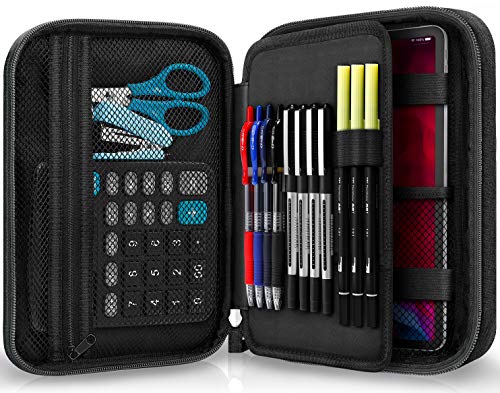 Zannaki Big Capacity Storage Pouch Marker Pen
- Upgraded Large Capacity, Ideal For Various Occasions: 9.2…
- Sandwich Cover Design & Shape Support, Quadruple Protection:…
- Premium Oxford Cloth, The Secret of Durable: This…
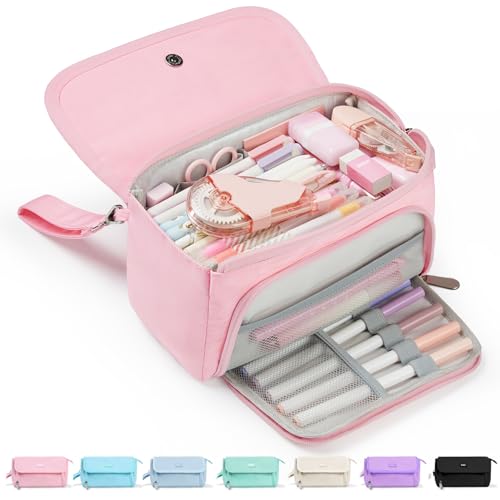 Sooez Super Large Pencil Case
- Most Convenient Storage: More Compartments
- Super High Capacity: Measures 8.46 x 3.74 x…
- Portable Design: Top wide-opening allows you to see…
 Sooez Big Capacity Pencil Case
- Truly Large Capacity: Quite probably the biggest one…
- Upgraded Canvas - Made to Last: Made of…
- Practical 3 Compartments: The main compartment uses for…
| Product | Key specs | |
|---|---|---|
| Zannaki Big Capacity Storage Pouch Marker Pen | Upgraded Large Capacity, Ideal For Various Occasions: 9.2… Sandwich Cover Design & Shape Support, Quadruple Protection:… Premium Oxford Cloth, The Secret of Durable: This… | Check price |
| Sooez Super Large Pencil Case | Most Convenient Storage: More Compartments Super High Capacity: Measures 8.46 x 3.74 x… Portable Design: Top wide-opening allows you to see… | Check price |
| Sooez Big Capacity Pencil Case | Truly Large Capacity: Quite probably the biggest one… Upgraded Canvas - Made to Last: Made of… Practical 3 Compartments: The main compartment uses for… | Check price |
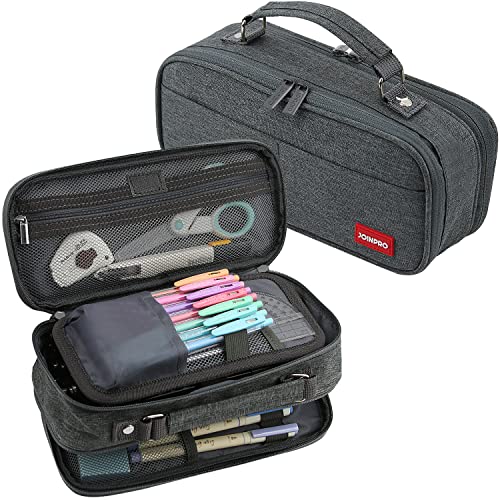 JOINPRO Large Capacity Pencil Case JOINPRO Large Capacity Pencil Case | [Large Capacity Storage] - Sized at 9.5 x… [4 Compartment Organizer Design] - Designed with 4… [Multiple Pockets and Elastic Loops] - Features a… | Check price |
As an Amazon Associate we earn from qualifying purchases at no extra cost to you.
How Capacity Claims Translate to Real Pens
Internal volume in cubic inches is the only honest way to compare cases, because pen counts shift wildly with barrel width. A standard Copic Sketch marker is about 0.55 inches in diameter and 5.5 inches long, so it occupies roughly 1.3 cubic inches including the wasted space between cylindrical shapes packed in rows. A slim gel pen at 0.35 inches diameter takes up closer to 0.5 cubic inches. That means a case advertised to hold “200 pens” based on slim gel pens will realistically hold 70 to 90 standard markers.
| Case Layout | Internal Volume | Verified Marker Count (0.55″ barrel) | Verified Slim Pen Count (0.35″ barrel) | Desk Footprint When Open |
|---|---|---|---|---|
| 3-layer standing case | 340 cu in | 120-150 | 220-260 | 10″ x 8″ (upright) |
| 4-layer standing case | 420 cu in | 160-200 | 280-320 | 10″ x 8″ (upright) |
| 2-layer flat zip case | 180 cu in | 60-80 | 120-140 | 9″ x 6″ (flat, closed) |
| Roll-up canvas case | 150 cu in | 48-60 | 90-110 | 14″ x 10″ (unrolled) |
| Large canvas pouch (bucket style) | 260 cu in | 90-110 | 170-190 | 7″ diameter base |
Only the 3-layer and 4-layer standing cases comfortably clear the 100+ marker mark without crowding. Below that volume threshold, you’re choosing between fewer pens or accepting a case so stuffed the zipper strains every time you close it.
Multi-Layer vs. Standing vs. Roll-Up: The Real Trade-Off
Multi-layer flat cases
These unfold like a book, with 2 to 4 fabric or mesh layers holding pens horizontally. They maximize volume relative to footprint when closed, but when open they need almost double their closed footprint on the desk. Good for people who set up at one desk and leave the case open for a session.
Standing (upright) cases
These unzip into a vertical fan or cylinder shape so pens stand on end, visible by cap color. They have the best capacity-to-footprint ratio while in use, since the base stays small even with 150+ markers loaded. The trade-off is structural: the stiffening board or plastic insert that holds the shape is the first thing to wear out, usually within 12 to 18 months of daily zip-and-unzip cycles.
Roll-up cases
Pens sit in individual fabric slots and the whole thing rolls into a tube secured by a strap or tie. These have the lowest volume-to-size ratio because the rolled slots waste space between pens, but they win on portability and protect barrel tips from impact better than any other style. They’re the right pick for overpackers who travel often rather than those who need maximum desk capacity.
Decision Matrix: Matching Case to Situation
| Your Situation | Recommended Layout | Why |
|---|---|---|
| 100+ Copic/alcohol markers, fixed desk | 4-layer standing case | Highest verified capacity, visible color sorting, stable footprint |
| Mixed media (pens, brushes, erasers), limited desk space | 3-layer standing case or bucket pouch | Mixed-depth compartments fit irregular items better than flat slots |
| Frequent travel, art classes, commuting | Roll-up canvas case | Flattest profile, best tip protection, fits in most bags |
| Budget-conscious, under 60 pens | 2-layer flat zip case | Lowest cost per cubic inch, adequate for moderate collections |
| Overpacker who keeps buying “just one more marker” | 4-layer standing case with expandable zip gusset | Gusset adds 15-20% volume without a new case purchase |
Where Seams and Zippers Actually Fail
Once a case holds more than about 85% of its rated volume, stress concentrates in three predictable places:
- The zipper pull junction – the point where two zipper tracks meet under tension is the single most common failure point. Overstuffed cases pull this junction apart within months.
- Corner seams on standing cases – the fold lines that let the case stand upright take repeated flexing stress. Reinforced bar-tack stitching at corners roughly doubles seam lifespan compared to a single straight stitch.
- Elastic pen loops – in roll-up cases, elastic loses tension after 6 to 12 months of daily use, especially with wide-barrel markers that overstretch them. Loops are a consumable, not a permanent feature.
Materials matter here too. Ballistic nylon and 600D polyester resist abrasion and hold stitching better than canvas under heavy daily loading, while canvas is lighter and fine for moderate collections under 100 pens. EVA molded cases (hard-shell, clamshell style) sidestep seam stress entirely since there’s no fabric to tear, but they’re heavier and don’t expand.
A Quick Volume Check Before You Buy
To estimate whether a case will actually fit your collection without overstuffing, measure one of your typical pens’ diameter, then use this rough packing rule: cylindrical pens packed in rows waste about 20% of volume to gaps between barrels. So a case needs roughly:
(number of pens) x (pen diameter)² x (pen length) x 1.2 cubic inches
For 120 standard Copic-width markers (0.55″ diameter, 5.5″ length): 120 x 0.3 x 5.5 x 1.2 ≈ 238 cubic inches minimum. That means a case rated at 240 cubic inches will be at its stress limit with that load, while a 340 to 420 cubic inch case gives comfortable room to add more without seam strain.
Bottom Line
If you’re past 100 markers and growing, a 4-layer standing case in the 400+ cubic inch range is the only layout that holds that volume without stressing seams. For moderate collections or frequent travel, a roll-up or 2-layer flat case keeps footprint small at the cost of total capacity. Price ranges generally run from $15 to $25 for 2-layer flat cases, $25 to $45 for 3- and 4-layer standing cases, and $20 to $35 for roll-up canvas cases, with EVA hard-shell options often landing $30 to $50 depending on size.