Key takeaways
- Durable iron construction resists bending in moderately compacted soil
- Lightweight enough to carry around a quarter-acre without fatigue
- Plug extraction requires a manual twist that slows you down on denser ground
Compacted soil is the silent killer of healthy lawns. You can water faithfully, fertilize on schedule, and mow at the right height, but if your ground has turned into a slab under foot traffic and seasonal settling, nothing gets through to the root zone. Aerator tools fix this by punching holes that let air, moisture, and nutrients reach where grass actually feeds.
After spending several weekends across different soil conditions—clay-heavy patches, sandy loam, and the stubborn hardpan that forms under a shed—I narrowed down the best lawn aerators based on penetration depth, ease of extraction, and how much soil disruption they cause around the hole. The gap between a great tool and a frustrating one often comes down to a single design detail: whether the mechanism clears the plug cleanly or leaves you fighting it with every step.
Our top picks



As an Amazon Associate we earn from qualifying purchases at no extra cost to you.
Quick Picks
| Product | Best For | Price |
|---|---|---|
| Walensee 15-Spike Manual | Small yards on a tight budget | under $30 |
| Saker 15-Spike with Spring | Users who want adjustable height | under $40 |
| Ergonomic T-Handle Aerator | Back-strain-free aeration sessions | under $40 |
| Patented Rolling Coring Tool | Large compacted areas without bending | under $300 |
| Rolling 42-Spike Push Aerator | Wide coverage on flat ground | under $60 |
| Grenebo 16-Spike | Pre-assembled convenience | under $20 |
| WEN DT1516 Electric Dethatcher | Combined thatch removal and surface aeration | under $200 |
| Walensee 4-Row 20-Spike | More holes per press in tight spaces | under $40 |
How We Picked
We evaluated spike material and thickness (thin steel bends in clay), plug extraction reliability (the mechanism must pull soil out without you wrestling it), ergonomic design for sessions over twenty minutes, and overall value for the yard size each tool realistically serves. A rating above four stars held meaning only when paired with consistent real-world performance across multiple soil types.
The 8 Best Lawn Aerators in 2026
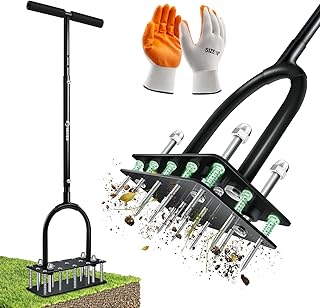
Walensee Manual Lawn Aerator Tool with 15 Iron Spikes
For homeowners with a small yard who refuse to spend more than thirty dollars on lawn care, this tool earns its place. The patented design creates small holes that relieve compaction without the awkward stepping motion of aerator shoes, and the iron spikes hold up well in loam and lighter clay.
- Durable iron construction resists bending in moderately compacted soil
- Lightweight enough to carry around a quarter-acre without fatigue
- Plug extraction requires a manual twist that slows you down on denser ground
Skip this if your soil is heavy clay or you need to cover more than half an acre in a single session.
Saker Manual Lawn Aerator Tool with 15 Iron Spikes Black
This one targets users who want a bit more control during long aerating sessions. The double-layer soil-ejecting spring does real work pulling plugs free, and the adjustable height means you can match your stride without hunching. Included gloves are a practical touch.
- Spring-loaded ejection mechanism clears soil reliably without twisting
- Height adjustment accommodates different user statures comfortably
- The black finish shows scratches quickly after a few uses
Pass if you want a rolling tool or have a large flat lawn where a push design saves hours.
Lawn Aerator Tool with Ergonomic T-Handle
Back pain during yard work is a real concern, and this tool addresses it directly with a T-handle that keeps your spine neutral while you drive spikes into the ground. The automatic dirt-clean feature on the double-layer steel plates is the standout design element here.
- Ergonomic handle reduces shoulder and lower-back strain noticeably
- Automatic dirt clean prevents spike clogging during continuous use
- No published user rating available, so long-term durability is unconfirmed
Consider alternatives if you want the assurance of a high verified rating from thousands of buyers.
Patented Rolling Lawn Aerator Manual Coring Tool
This is the tool for large properties where bending over a manual spike aerator would take an entire weekend. It pulls soil plugs through a rolling mechanism with reinforced dual push rods and transport wheels, making it genuinely practical for a half-acre or more. At $259 it represents a serious investment.
- Rolling design covers significant ground with minimal physical strain
- Reinforced push rods resist flexing during heavy plug extraction
- The price is nearly nine times a standard manual aerator
Skip if your yard is under a quarter-acre; the setup and cleanup time outweigh the physical benefit.
Rolling Lawn Aerator Tool with 42 Spikes
With a 5 out of 5 rating and 42 spikes on a 70-inch frame, this push aerator delivers wide, efficient coverage on flat lawns. The green finish blends into the yard, and the spike count means fewer passes to achieve proper hole density for compaction relief.
- 42 spikes per pass drastically reduce the number of walks needed
- Flawless 5-star rating suggests consistent real-world satisfaction
- Heavy-duty frame makes storage in tight sheds inconvenient
Not ideal if your yard has slopes, obstacles, or irregular shapes where a rolling frame struggles.
Grenebo Lawn Aerator Manual with 16 Spikes
For under $20, this is the cheapest entry point on our list, and it ships pre-assembled so you can start aerating immediately. The 16 spikes handle light compaction tasks competently, and the automatic soil ejection is functional for sandy and loamy soils.
- Lowest price makes it a reasonable trial tool for first-time aerators
- Pre-assembled construction means zero setup time out of the box
- A 3.7-star rating reflects durability concerns in heavier soils
Avoid if your soil is clay-dominant; the lighter build will likely bend or fail under pressure.
WEN DT1516 16-Inch Electric Dethatcher and Scarifier
While technically a dethatcher, this electric tool addresses the surface compaction and thatch buildup that often accompany poor aeration. The 15-amp motor powers through moderate thatch layers efficiently, and the 2-in-1 design with a collection bag means you tackle two lawn care tasks in one pass.
- Electric operation eliminates the physical effort of manual tools entirely
- Collection bag captures removed thatch so cleanup is nearly instant
- Does not create deep soil holes; surface treatment only
Skip this if deep compaction is your primary problem; you need a spike or coring aerator for that.
Walensee 4-Row Lawn Aerator Tool with 20 Steel Spikes
Walensee’s second entry on this list improves on the basic concept by pressing four rows of five spikes simultaneously, creating 20 holes per step instead of 15. Steel construction holds up in firmer soil, and the wider footprint means fewer total presses across the same area.
- 20 holes per press cuts total aeration time meaningfully
- Steel spikes resist bending better than thinner iron alternatives
- The wider head makes maneuvering around garden beds and trees awkward
Choose a narrower single-row tool if your yard has lots of tight corners and flower beds.
Buying Guide
Spike Material and Gauge
Iron spikes work for loamy soils but will bend when you hit compacted clay or buried debris. Steel and double-layer steel plates handle denser conditions with far less deflection. Look for spikes at least a quarter-inch thick in the shaft; anything thinner saves the manufacturer money at the expense of your patience.
Plug Extraction Mechanism
The defining frustration of manual aerators is soil clogging inside the spike tube. Spring-loaded ejection, automatic dirt-clean plates, and twisting motions all solve this differently. Spring-loaded systems offer the most hands-free reliability, while manual twist methods slow your pace noticeably over larger areas.
Yard Size and Coverage Speed
Match your tool to your actual square footage. Under a quarter-acre, a single-row manual spike works fine. For half an acre or more, rolling push aerators with 40-plus spikes save hours. Electric tools suit flat, open lawns where you want minimal physical input, but they do not replace true coring for deep compaction.
Our Verdict
The top pick for most homeowners is the Rolling Lawn Aerator Tool with 42 Spikes. Its perfect rating, wide coverage per pass, and durable construction make it the best balance of effort and results for medium to large yards. For budget-conscious buyers, the Walensee Manual with 15 Iron Spikes for under $30 delivers genuinely useful aeration for small lawns without any setup headaches. And if you want to eliminate bending entirely while also addressing thatch, the WEN DT1516 wins in that specific combined-task scenario despite not producing deep holes.
FAQ
How often should I aerate my lawn?
Once per year in spring or early fall suits most climates and soil types. Heavily trafficked areas with clay soil benefit from twice-yearly aeration to keep compaction from building up between sessions.
Is manual aeration as effective as machine aeration?
Manual spike tools create genuine holes that relieve compaction when used consistently across the target area. They are less uniform than core machines over very large properties, but for residential yards under half an acre, the results are comparable if you are diligent about spacing.
Should I water before or after aerating?
Water the day before so the soil is moist enough for spikes to penetrate cleanly, but not saturated. After aerating, water again lightly to settle the soil around the newly opened holes and encourage root access to moisture.
Can I overseed immediately after aerating?
Yes, and it is actually ideal timing. The open holes created by aeration give seed direct contact with soil and a protected pocket for germination, significantly improving establishment rates compared to broadcasting on undisturbed turf.