Key takeaways
- Pros: Compact dimensions open up under-sink storage; adjustable thermostat reduces energy waste
- Con: Too small for multiple fixtures or a proper shower
Boats and RVs present a water-heating problem that shore-based plumbing never encounters. You are working with a limited electrical supply, confined installation spaces, constant vibration, and a water system that sits idle long enough for corrosion to become a real threat. The best marine water heater solves all of these constraints simultaneously, while the cheapest ones will leave you with lukewarm showers or a corroded tank leaking into your bilge within a single season.
After comparing and comparing the leading options on the market heading into 2026, we found that the category splits into three tiers: compact tank heaters for small galleys and under-sink spots, high-output tankless units for those who want endless hot water without the storage penalty, and purpose-built marine brands with welded aluminum or stainless internals designed to survive salt spray and saltwater environments. Below we rank eight heaters that cover every realistic use case from a daysailer’s freshwater shower to a saltwater aquarium.
Our top picks




As an Amazon Associate we earn from qualifying purchases at no extra cost to you.
Quick Picks
| Product | Best For | Price |
|---|---|---|
| GE Appliances 2.5 Gallon Mini Tank | Tight under-sink installs | $239 |
| RV Tankless 48,000 BTU 12V DC | On-demand hot water at altitude | under $300 |
| Electric Small Tank 8 Gallon 304 Stainless | Budget small-volume hot water | $165 |
| hygger Marine Aquarium Heater | Saltwater tank temperature control | under $40 |
| Kuuma 6 Gallon Front Mount Rear Exchange | Overall marine reliability | under $450 |
| Kuuma 11 Gallon Front Heat Exchange | Larger vessels needing capacity | under $600 |
| Whale Premium 3 or 6 Gallon | Premium boat builds | under $600 |
| Kuuma 6 Gallon Side Mount Front Exchange | Compact side-mount spaces | under $500 |
How We Picked
We weighted four criteria above all others: corrosion resistance of the inner tank material, because saltwater and marine atmospheres destroy cheap steel; installation footprint and orientation flexibility, since boats rarely have standard utility rooms; recovery rate and capacity balance, which determines whether a single shower drains your supply; and voltage compatibility with common marine electrical systems (120V AC shore power versus 12V DC battery banks). Units that excelled in three of these four made the list. Those that failed on durability or threw in the towel at real-world constraints did not.
The 8 Best Marine Water Heaters in 2026
GE Appliances 2.5 Gallon Mini Tank
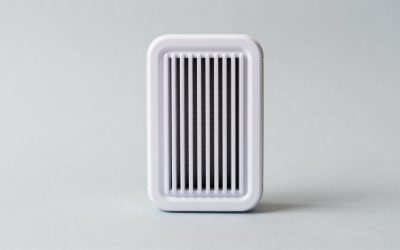
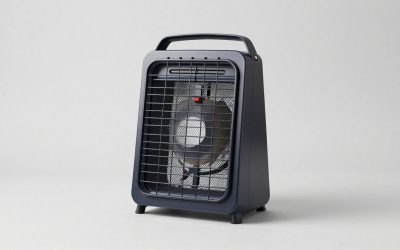
This is the heater for someone who needs hot water at a single faucet in a confined space. At 2.5 gallons, it fits under most marine vanities without custom framing. The adjustable thermostat lets you dial in temperature for handwashing without scalding, and the 120V operation plugs straight into shore power without an inverter. Installation is genuinely tool-light for anyone with basic plumbing experience.
- Pros: Compact dimensions open up under-sink storage; adjustable thermostat reduces energy waste
- Con: Too small for multiple fixtures or a proper shower
Skip this if you need hot water for more than one point of use. It serves a single faucet and nothing more.
RV Tankless 48,000 BTU 12V DC
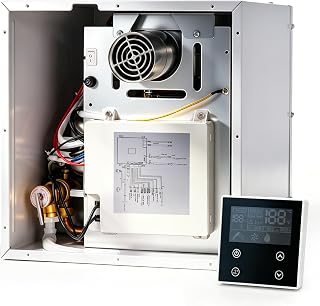
Tankless heating in a marine context is a different animal. This unit runs on 12V DC, meaning it draws from your battery bank rather than shore power, which is a significant advantage on anchor. The 48,000 BTU output delivers 2.5 gallons per minute of on-demand hot water, and CSA certification with high-altitude operation up to 9,800 feet makes it surprisingly versatile for both boating and overland travel. No stored hot water means no standby heat loss.
- Pros: Endless hot water with no tank to corrode; operates on DC battery power
- Con: Requires adequate water pressure and a properly sized venting path for combustion gases
Pass on this if your vessel lacks reliable venting or your battery bank is undersized for sustained heating draws.
Electric Small Tank 8 Gallon 304 Stainless
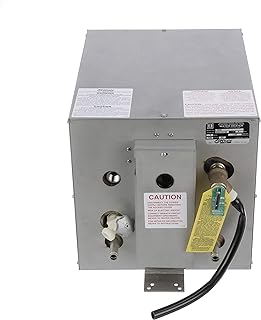
At $165, this is the most affordable entry in our roundup that still uses real stainless steel construction. The 8-gallon capacity is enough for a solo shower, and the 304 stainless inner tank handles both kitchen and bathroom applications without the corrosion concerns of cheaper aluminum or glass-lined steel. The included shower set and complete mounting hardware make it a turnkey solution for small trailers and food trucks.
- Pros: Stainless steel tank at a fraction of premium brand pricing; complete kit includes shower hardware
- Con: 120V 1500W draw is modest, so recovery between uses is slow
Skip if you need back-to-back hot water for more than one person or more than one fixture.
hygger Marine Aquarium Heater
While not a domestic water heater in the plumbing sense, the hygger earns its spot because “marine water heater” searches frequently include saltwater aquarium applications. The titanium heating element resists saltwater corrosion far better than glass or ceramic, and the digital LED controller with temperature calibration and probe gives you precision control that older analog heaters cannot match. Available in wattages from 50W to 500W, it covers small nano reefs through large display tanks.
- Pros: Titanium element survives prolonged saltwater submersion; LED controller allows fine temperature calibration
- Con: Not designed for potable water or any plumbing application whatsoever
Do not purchase this expecting shower or sink hot water. It is strictly an aquarium temperature maintenance device.
Kuuma 6 Gallon Front Mount Rear Exchange
Kuuma is the brand most serious boat owners trust, and this 6-gallon model is the reason why. The TIG-welded aluminum inner tank is engineered specifically for marine corrosion environments, and the ignition-shielded controls prevent accidental electrical contact in damp compartments. The front-mount, rear-exchange configuration keeps all connections behind the unit, making it ideal for installations where the front face is visible in a galley or head.
- Pros: TIG-welded aluminum resists corrosion better than riveted or bonded tanks; shielded controls add a safety layer for wet environments
- Con: For under $450, it costs more than triple some generic alternatives
Skip only if your budget is genuinely tight and your water is soft and non-saline. For anything marine, it is worth the premium.
Kuuma 11 Gallon Front Heat Exchange
When a vessel has a real hot-water demand, 6 gallons is barely enough for one shower before the water chills. Kuuma’s 11-gallon model doubles storage capacity while maintaining the same horizontal-mount aluminum construction that makes the brand reliable. At roughly 16.25 by 16.25 by 23.25 inches, it remains installable in standard boat compartments designed for compact water heaters, and the 1500W element provides adequate recovery for back-to-back use.
- Pros: 11-gallon capacity supports multiple fixtures without total depletion; horizontal mount fits standard marine cabinets
- Con: Largest and second-heaviest unit in this roundup, so confirm compartment weight ratings before mounting
Pass if your boat genuinely has only a single sink or shower. The extra capacity is wasted and the larger footprint may not fit.
Whale Premium 3 or 6 Gallon
Whale has built a reputation on boats as a manufacturer that understands the marine plumbing world at a component level. This heater offers a choice between 3 and 6-gallon capacities, which is unusual and practical since 3 gallons is enough for a quick rinse on a daysailer without the bulk of a larger unit. At 120V, it integrates with standard shore power systems on most recreational boats without modification.
- Pros: Dual capacity options let you match the heater to your actual hot-water need rather than guessing; brand familiarity means parts and support are accessible
- Con: Highest list price in the group for under $600, and the 3-gallon option still carries that premium
Skip if you already know you need 6+ gallons and find Kuuma at a comparable price. The Whale premium is largely a brand-name tax at this point.
Kuuma 6 Gallon Side Mount Front Exchange
This is the sibling to our top overall pick but reoriented for installations where side access is all you have. Measuring approximately 15.6 by 13.6 by 19.4 inches, it is the most space-efficient Kuuma in this lineup. Same welded aluminum construction, same corrosion resistance, same 120V compatibility. The side-mount front-exchange layout means all plumbing connections face forward, which simplifies access when the heater is tucked into a narrow locker.
- Pros: Smallest physical footprint of the three Kuuma units; front-facing connections simplify maintenance access
- Con: 6-gallon limit applies the same as the front-mount version, so do not expect two showers
Choose the 11-gallon version instead if your compartment can handle the extra height and you need more capacity.
Buying Guide
Tank Material: Why Corrosion Is the Only Spec That Matters Long-Term
Marine environments attack steel tanks faster than any other application. Glass-lined tanks crack at weld points and then corrode from the inside out. Aluminum, particularly TIG-welded aluminum like Kuuma uses, resists galvanic corrosion in saltwater and holds up in the humid, salt-saturated air inside a boat. 304 stainless is excellent for freshwater marine applications and budget units, but can pit in high-chloride saltwater. Check what water source your heater will receive, because that single fact should dictate your material choice.
Voltage and Power Source Compatibility
Most recreational vessels run 120V AC from shore power or a generator, but anchoring with a battery bank means DC availability. If you want hot water without starting an engine, a 12V DC tankless unit like the RV 48,000 BTU model is worth considering despite the added complexity of combustion venting. For tank heaters, verify that your inverter can handle the 1500W startup draw without browns, especially on smaller boats with 1000W inverters.
Mounting Orientation and Physical Fit
Boat compartments are designed around the hull shape, not around rectangular appliances. A heater that only mounts vertically is useless in a space with eight inches of clearance. Kuuma’s horizontal-mount designs and the front-mount versus side-mount configurations exist specifically to solve this. Before buying, measure the narrowest dimension of your install cavity and compare it against the unit’s footprint, not just its capacity.
Our Verdict
The Kuuma 6 Gallon Front Mount Rear Exchange is our top pick for any serious marine installation. Its TIG-welded aluminum tank, shielded controls, and proven brand reputation justify the price for anyone who plans to keep the heater longer than a season. For budget-minded buyers who primarily use freshwater, the Electric Small Tank 8 Gallon with 304 stainless construction at $165 is the clear value choice. However, if you spend significant time off-grid without shore power, the RV Tankless 12V DC model wins outright because it eliminates dependence on 120V AC entirely.
FAQ
Can I use a residential water heater on a boat?
Technically yes, but you should not. Residential units use glass-lined or mild steel tanks that corrode rapidly in marine atmospheres, and they rarely offer the compact horizontal mounting profiles that boat compartments require. The price difference is small compared to the cost of pulling a leaking heater out of a tight space.
How many gallons do I actually need for a marine shower?
A standard low-flow marine shower head uses about 1.5 gallons per minute. If you want a five-minute hot shower without mixing in cold, you need at least a 7 to 8-gallon tank. Most people find 6 gallons workable if they use a combi mixing valve to blend cold water, effectively extending the hot supply to ten minutes.
Is tankless better than a tank for boat use?
Tankless gives you unlimited hot water and no stored-water corrosion risk, but it requires adequate venting for combustion gases and sufficient water pressure to trigger ignition. Tanks are simpler to install, work on low-pressure systems, and have no ventilation requirements. For most boats, a properly sized tank heater is the more reliable choice.
Do I need a special heater for saltwater versus freshwater?
Only if saltwater will contact the tank internally. Most marine water heaters use a fresh-water supply even on saltwater vessels, since desalination or stored freshwater is standard. If you are heating saltwater directly, you need titanium elements and fully titanium or high-grade stainless internals. The hygger aquarium heater falls in that category for tank applications, while domestic plumbing heaters almost always handle freshwater.
Part of our heaters buying guide hub.