Key takeaways
- Unplug the machine before cleaning and follow the manual for access to sensors and rollers.
- Use the cleaning tools or brushes the maker supplies, and avoid liquid cleaners unless the manual allows them.
- Remove dust and paper fibres from the sensor windows regularly, because dirty sensors cause false counterfeit alarms and miscounts.
- Do not feed damp, stapled, taped or heavily folded notes.
- Keep the machine on a flat, stable surface away from heaters and direct sun.
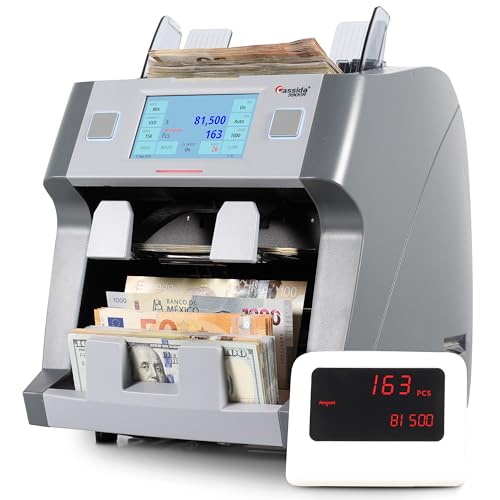
For a small shop, church, club or home-based seller counting a few hundred notes a day, a compact bill counter with basic counterfeit detection from an established brand such as Cassida, Royal Sovereign or Kolibri is usually enough, while a busy cash office that handles mixed denominations should look at a value counter with multi-sensor detection and a larger hopper. This guide explains how the main types differ, which features matter, and where each tier of machine makes compromises.
Our top picks



As an Amazon Associate we earn from qualifying purchases at no extra cost to you.
Money Counters at a Glance
| Type | Typical brands | Best for | Key stated features | Limits |
|---|---|---|---|---|
| Basic bill counter (budget) | Royal Sovereign, Kolibri, generic import brands | Occasional counting, one denomination at a time | Batch counting, add mode, small footprint, simple display | Detection often limited to ultraviolet or a single method; can jam on worn bills |
| Counter with counterfeit detection (mid-range) | Royal Sovereign, Cassida, Kolibri | Retail counters, small businesses, fundraisers | UV, magnetic and sometimes infrared or size checks; batch and add functions | Detection is an aid, not a guarantee; needs updates or calibration for new note designs |
| Value counter (premium) | Cassida, Semacon, Glory | Banks, cash rooms, high-volume venues | Counts mixed denominations to a total value, multi-sensor checks, larger hopper and stacker | Larger, heavier, more costly to service |
| Coin counter / sorter | Cassida, Royal Sovereign, Magner | Arcades, laundromats, vending routes, tip jars | Sorts and counts coins into tubes or bags by denomination | Noisy; does not handle bills; tokens may mis-sort |
| Hand-held or mechanical tally | Various | Very light use | Manual counting aids | Slow, no detection at all |
How Money Counters Work
Most bill counters pull notes one at a time from a hopper using rollers and count them with optical sensors. A basic unit simply counts pieces. A value counter also identifies the denomination and adds up a dollar total, which saves a lot of time if drawers are full of mixed notes. Because every machine relies on rollers and sensors, notes that are damp, folded, taped or torn are the most common cause of jams and miscounts, regardless of brand.
Makers usually list counting speed in notes per minute. Figures in the range of a thousand to fifteen hundred notes per minute are common for countertop models, but real-world speed depends on how flat and clean the stack is. Treat the stated speed as a ceiling rather than a daily average.
What to Look For
Counterfeit detection methods
Detection is where machines differ most. Ultraviolet checks look for fluorescent features, magnetic sensors look for magnetic ink, infrared sensors check how the note reflects or absorbs light, and some machines also measure note size or thickness. A model that combines several methods is generally harder to fool than one that relies on a single check. However, makers themselves note that these features reduce risk and do not replace staff training, so a visual and tactile check of suspicious notes remains sensible. Note designs change over time, so confirm the machine is listed for current note series and ask the maker how updates are delivered.
Hopper and stacker capacity
The hopper is where you load the stack, and the stacker is where counted notes land. Small hoppers force you to split large stacks. If you regularly count a few thousand notes at a time, choose a model with a deeper hopper and a stacker that does not overflow mid-batch.
Batch and add modes
Batch mode stops the machine at a preset number, such as one hundred notes to a strap. Add mode keeps a running total across several stacks. Both are standard on mid-range units and are worth having if you prepare bank deposits.
Display and controls
A large, readable display reduces counting mistakes. Look for clear count and total readouts, and for an external display option if the operator and customer sit on opposite sides of a counter.
Footprint and weight
Basic units are compact and can be tucked under a register. Value counters are heavier and deserve a dedicated spot. Check the maker’s listed dimensions against your counter space, plus clearance for loading notes.
Noise, cooling and duty cycle
Machines that run for long stretches can heat up. Some makers state a duty cycle or recommend rest breaks. If you count continuously through the day, a model designed for heavier use is a better match than a light-duty unit.
Budget Tier, Mid-Range and Premium Compared
Budget tier
Entry-level counters from Royal Sovereign, Kolibri and similar brands focus on counting speed and a small size. They suit home businesses, garage sales and occasional fundraisers. The trade-offs are simpler detection, lighter-duty rollers and less forgiving handling of worn notes. If you need counterfeit checks for a retail till, confirm exactly which sensors the model includes before buying.
Mid-range tier
Mid-range models add multi-method counterfeit detection, better displays, bigger hoppers and sturdier construction. This is the tier most small retailers, restaurants and community organizations consider. Cassida’s range is often discussed by reviewers in this tier for build quality and support, and Royal Sovereign offers a wide choice at a range of price points.
Premium tier
Value counters and heavy-duty units from makers such as Cassida, Semacon and Glory are built for cash offices. They count mixed denominations, perform several detection checks and tolerate heavy daily use. The cost is size, weight and the need for professional servicing, which is overkill for a shop that handles only a few hundred notes a day.
Care and Maintenance
- Unplug the machine before cleaning and follow the manual for access to sensors and rollers.
- Use the cleaning tools or brushes the maker supplies, and avoid liquid cleaners unless the manual allows them.
- Remove dust and paper fibres from the sensor windows regularly, because dirty sensors cause false counterfeit alarms and miscounts.
- Do not feed damp, stapled, taped or heavily folded notes.
- Keep the machine on a flat, stable surface away from heaters and direct sun.
Because the machine is mains powered, use the supplied cable and a protected outlet, and have an electrician check any wiring concerns rather than attempting repairs yourself.
Pick X If…
| Pick this | If you… |
|---|---|
| Budget bill counter | count notes occasionally, handle mostly one denomination, and want a small, simple machine |
| Mid-range counter with multi-method detection | run a shop, cafe or club till and want repeatable counts plus a basic safeguard against fakes |
| Value counter | handle mixed denominations in volume and need a dollar total rather than just a note count |
| Coin counter or sorter | collect large amounts of coins from machines, jars or fundraisers |
| Counting pens and manual checks | only need to spot-check an occasional suspicious note |
Alternatives to Consider
- Counterfeit detector pens and lights: inexpensive, fast spot checks for one note at a time. Pens react to starch in paper and can miss some fakes, so many cashiers combine them with a UV light and a close look at security features.
- Standalone counterfeit detectors: small units that check a single note without counting stacks. Useful at a busy till where counting is not needed.
- Bank deposit services and cash-handling partners: if you only count cash weekly, your bank or a cash-handling service may make owning a machine unnecessary.
- Coin wrappers and scales: low-cost options if coins are your only concern.
Buying Tips
Write down your daily note volume, the denominations you handle and whether you need counterfeit detection. Then match the tier to that need rather than the biggest feature list. Check the warranty length and whether the maker supports repairs and sensor updates, since a machine that cannot be serviced becomes unreliable quickly. Read the listed dimensions, power rating and supported currencies. If you plan to count notes from more than one country, confirm that the model supports each currency, because many are configured for a single currency.
Finally, remember that a counter is a productivity tool. It will not eliminate human error in handling cash, and on suspicious notes the final decision should follow your bank’s or local authority’s guidance.
Frequently Asked Questions
Can a money counter detect every counterfeit note?
No. Detection features reduce risk by checking one or more security characteristics, but makers do not promise perfect results, and fake notes keep improving. Treat an alarm as a reason to look closer, and follow your bank’s or local law enforcement guidance if you suspect a counterfeit.
What is the difference between a bill counter and a value counter?
A bill counter counts how many notes are in a stack, so it works best with one denomination at a time. A value counter recognises each note’s denomination and totals the monetary value of a mixed stack. Value counters are heavier and more expensive but save time in cash rooms.
How fast should a money counter be?
Many countertop models state speeds from about one thousand to fifteen hundred notes per minute. Real speed depends on note condition, so a clean, flat stack counts faster than worn or folded bills. For most small businesses, reliability matters more than the top stated speed.
Why does my counter keep jamming or flagging good notes?
Dirty sensors, worn rollers, damp or creased notes and stacks that are not squared up are the usual causes. Clean the sensors following the maker’s manual and feed neat, dry notes. If problems continue after cleaning, contact the maker’s support, because the machine may need calibration or service.
Do money counters work with notes from other countries?
Only if the model is configured for them. Many machines are set up for a single currency, and detection data is specific to that currency. Check the maker’s list of supported currencies before buying if you handle foreign cash.
How often should I clean a money counter?
Light users may clean it every few weeks, while daily heavy users often clean the sensors and rollers more frequently. Follow the schedule and method in the manual, unplug the unit first and avoid liquids unless the maker permits them.
FAQ
Can a money counter detect every counterfeit note?
What is the difference between a bill counter and a value counter?
How fast should a money counter be?
Why does my counter keep jamming or flagging good notes?
Do money counters work with notes from other countries?
How often should I clean a money counter?
More from Amazon
Programs that pair well with the guide above. Offers and eligibility are set by Amazon and may change.
Free shipping on eligible items, Prime Video and more. Eligible new members can start with a free trial.
Start a Prime free trialAudiobooks and podcasts to listen to on the go. Eligible new members can start with a free trial.
Try Audible freeAd-free music streaming. Eligible new subscribers can start with a free trial.
Try Music Unlimited freeA free business account with business pricing and bulk-buying tools for work, shop or home office.
Create a business accountAs an Amazon Associate we earn from qualifying purchases.