Key takeaways
- Stable base. A wide stance helps prevent tipping when children lean on the counter. Check whether the maker supplies a wall anchor for taller models and use it if so.
- Smooth edges and well-finished corners. Rounded edges matter for young children.
- Interactive parts. Clicking knobs, opening doors and a working faucet extend play, but they can be a weak point. Reviewers often mention that thin plastic knobs and hinges are what fail first.
- Included accessories. Pots, utensils and play food are bundled with some sets, which saves money, but the quality of included pieces varies. Many parents buy a separate accessory set.
- Batteries. Sounds and lights typically use batteries. Check whether they are included and how the compartment is secured, since a screw-closed compartment is standard on toys for younger children.
- Cleaning. Wipe-clean surfaces matter if your child will use play water or sticky pretend meals.
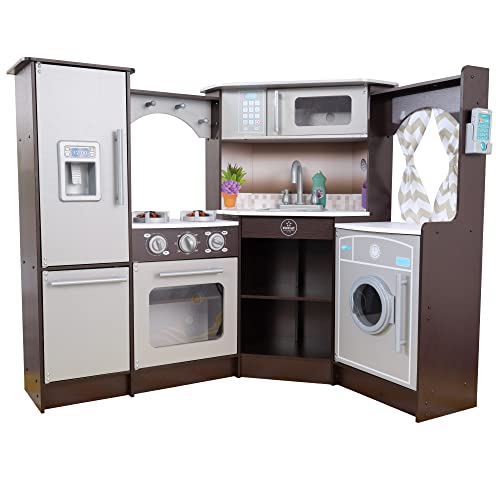
For most families a mid-sized wooden play kitchen from a brand such as KidKraft or Melissa and Doug is the safest all-round choice, a compact tabletop or fold-away set suits small homes, and a larger activity kitchen with lights, sounds and a faux-ice dispenser suits children who love interactive play. Which one fits depends on your child’s age, the floor space you have and how much assembly you are willing to do. This guide explains the main types, what to check on the maker’s listing and the trade-offs by budget tier.
Our top picks



As an Amazon Associate we earn from qualifying purchases at no extra cost to you.
Play Kitchens at a Glance
| Type | Best for | Typical stated details | Limits |
|---|---|---|---|
| Large wooden kitchen (KidKraft, Teamson, Step2 wood-style lines) | Toddlers through early school age, long-term use | Wood or MDF panels, working knobs, shelves, often an included accessory set | Heavy, long assembly, needs wall space |
| Plastic molded kitchen (Little Tikes, Step2) | Toddlers, families who want easy cleaning | One-piece plastic parts, wipe-clean surfaces, sounds or lights on some models | Less decorative, can fade in sunlight; batteries needed for sounds |
| Compact or tabletop kitchen | Apartments, gifts, short play sessions | Small footprint, a few burners and a sink | Fewer features; children outgrow it sooner |
| Foldable or corner kitchen | Small rooms, shared play spaces | Folds or tucks into a corner | Smaller work area; hinges need careful use |
| Outdoor mud kitchen | Garden play, messy exploring | Weather-resistant wood or plastic, basin sink | Needs outdoor space; wood may need sealing |
Choosing by Age
Toddlers around two to three years old do best with a lower, simpler kitchen with sturdy knobs and few tiny parts. Many makers publish a minimum age on the packaging; follow it, because small accessories such as play food are choking hazards for younger children. Preschoolers enjoy larger kitchens with more pretend appliances, while early school-age children often care about realistic details such as a clicking stove knob, a play microwave or a working timer. Choose height by comparing the counter height listed by the maker with your child’s current height; a counter that hits mid-chest is generally comfortable.
Wood Versus Plastic
Wooden kitchens usually look more like furniture, hold up well to repeated play and can fit into a living room. Many use engineered wood panels, so check whether the maker states the finishes meet applicable toy safety standards. Plastic kitchens clean easily and are usually lighter, which makes them better for families who move them between rooms. They also tend to be quicker to assemble. Neither material is automatically safer; look for statements of compliance with toy safety standards in your region and follow the age grading.
Features Worth Looking For
- Stable base. A wide stance helps prevent tipping when children lean on the counter. Check whether the maker supplies a wall anchor for taller models and use it if so.
- Smooth edges and well-finished corners. Rounded edges matter for young children.
- Interactive parts. Clicking knobs, opening doors and a working faucet extend play, but they can be a weak point. Reviewers often mention that thin plastic knobs and hinges are what fail first.
- Included accessories. Pots, utensils and play food are bundled with some sets, which saves money, but the quality of included pieces varies. Many parents buy a separate accessory set.
- Batteries. Sounds and lights typically use batteries. Check whether they are included and how the compartment is secured, since a screw-closed compartment is standard on toys for younger children.
- Cleaning. Wipe-clean surfaces matter if your child will use play water or sticky pretend meals.
Assembly and Space Notes
Large wooden kitchens can take one to a couple of hours to assemble with two adults, and some brands ship with many small fasteners. Read the assembly guide before buying and plan a space that is large enough for the finished footprint plus room for two children to play side by side. Corner and fold-away models help in small rooms. Avoid placing a kitchen next to radiators or in direct sunlight where plastic or finishes can warp or fade.
Safety Notes
Follow the age recommendation on the box and keep play food and small accessories away from children under the stated age. Check that stickers are firmly applied, and inspect knobs and hinges periodically for looseness. If a part breaks, stop using the toy until it is repaired or replaced. If your child is in the youngest age range, an adult should supervise play, especially around any item that can detach.
Popular Options Reviewers Mention
KidKraft wooden kitchens. The brand is widely discussed for larger, furniture-style kitchens with realistic touches. They generally sit in the mid-range to premium tier. Melissa and Doug. Often cited for simpler wooden kitchens and strong accessory sets. Little Tikes. Known for plastic kitchens with interactive features and easy cleaning. Step2. Offers plastic and wood-style kitchens in bright colors, usually mid-range. Teamson Kids. A common pick for styled, mid-range kitchens. Models change regularly, so confirm the current model name and dimensions on the maker’s own page before buying.
Pick X If …
| If you want … | Choose | Why |
|---|---|---|
| Something that looks like furniture | Large wooden kitchen | Sturdier look and feel, more detail |
| Easy cleaning and low assembly effort | Plastic kitchen | Wipe-clean surfaces and fewer pieces |
| A small footprint | Tabletop or corner kitchen | Fits in tight spaces |
| Realistic sounds and lights | Interactive kitchen with batteries | More cues for pretend play |
| Messy play outdoors | Mud kitchen | Built for water, soil and weather |
| Budget control | Compact set plus separate accessories | Add pieces over time as interest grows |
Budget Tiers
Budget: Compact plastic or tabletop sets. Good for short play sessions or for younger children who will outgrow them quickly. Mid-range: Larger plastic kitchens and many wood-style kitchens with a few interactive parts. This tier suits most families. Premium: Large wooden kitchens with detailed finishes, multiple appliances and included accessories. They look more like furniture and are better if the kitchen will be passed on to a sibling.
Alternatives
- Play food and cookware sets only: If space is the issue, a basket of pretend food, pots and a play mat can deliver much of the experience.
- Play market stand: A shop stand is a good add-on once a kitchen is in place, and it encourages role play outside the kitchen.
- Learning tower: If your child wants to help with real cooking, a sturdy step-up stand is a different but related option; follow the maker’s age and weight guidance and supervise at all times.
How to Compare Listings Fairly
Play kitchens are often listed with similar photos, so the written details matter more. Compare the overall width, depth and height, the counter height, the number of included accessories and the stated age grade. Look at whether the maker describes the material as solid wood, engineered wood or plastic, and whether batteries are included. Reviewers often point out that photos can make a kitchen look larger than it is, so measure the footprint on your floor with tape before ordering. Also compare the assembly time that buyers report, because a kitchen that takes several hours may be a poor fit for a gift needed quickly. Finally, check the return terms, since large items can be costly to send back, and keep the packaging until you are sure the kitchen is complete and undamaged.
Growing With Your Child
Children use play kitchens differently as they grow. Toddlers tend to open and close doors, turn knobs and move items between shelves, while older children build stories around cooking, shopping and restaurant play. A kitchen with open shelving, a clear counter and a few moving parts is generally more flexible than one packed with features that dictate how it must be used. Adding a play market stand, a tea set or a small table and chairs can extend the life of the set without replacing it. When interest fades, a wooden kitchen is also easier to pass on to a younger relative than a heavily branded plastic one, provided all parts are intact and the stickers are still secure.
Frequently Asked Questions
What age is a play kitchen suitable for?
Many makers grade play kitchens from about two or three years upward, but the exact minimum age varies by model. Follow the age on the packaging, because included play food and small accessories may not be suitable for younger children.
Is a wooden or plastic play kitchen better?
Neither is better for every family. Wood suits families who want a furniture-like look and long-term use, while plastic is lighter and easier to clean. Look for statements about toy safety compliance in either case.
How much space does a play kitchen need?
Large wooden models can be wide enough to take a whole wall section, while tabletop and corner models need far less. Check the width, depth and height listed by the maker and leave room for at least two children to stand beside it.
How do I stop a play kitchen from tipping over?
Place it on a flat surface and against a wall, and use any wall anchor the maker provides. Tell children not to climb on the kitchen, and check that all panels are tightened after assembly.
Are the included accessories enough?
Often they cover the basics, but many families add a separate set of pots, utensils and play food. Choose accessories that match the age grading and avoid sets with very small parts for toddlers.
How should I clean a play kitchen?
Wipe plastic surfaces with a damp cloth and mild soap. For wood, use a lightly damp cloth and dry it promptly, and avoid soaking. Always follow the maker’s care instructions for the specific model.
FAQ
What age is a play kitchen suitable for?
Is a wooden or plastic play kitchen better?
How much space does a play kitchen need?
How do I stop a play kitchen from tipping over?
Are the included accessories enough?
How should I clean a play kitchen?
More from Amazon
Programs that pair well with the guide above. Offers and eligibility are set by Amazon and may change.
Free shipping on eligible items, Prime Video and more. Eligible new members can start with a free trial.
Start a Prime free trialAudiobooks and podcasts to listen to on the go. Eligible new members can start with a free trial.
Try Audible freeAd-free music streaming. Eligible new subscribers can start with a free trial.
Try Music Unlimited freeA free business account with business pricing and bulk-buying tools for work, shop or home office.
Create a business accountAs an Amazon Associate we earn from qualifying purchases.