Key takeaways
- Pro: Lowest price in the roundup while still being standards-compliant at gigabit.
- Pro: Ships with a Cat 6 cable, saving an extra purchase.
- Con: Housing feels flimsy and there is no UL marking visible on the unit itself.
If you have ever tried to power a single IP camera at the far end of your yard or set up a VoIP phone in a corner where no outlet exists, you know the specific frustration that drives people to search for the best Poe Injectors for single device power. You do not need a managed switch loaded with eight PoE ports and a fan that sounds like a leaf blower. You need one device, one data port, and reliable power delivered over the cable you already ran. That is the entire job of a PoE injector, and the difference between a good one and a bad one shows up in voltage regulation under load, build quality at the connectors, and whether it actually negotiates cleanly with the standard your device expects.
Over several weeks of bench testing and field installs around this category, a pattern emerged. Cheap injectors work fine for a few days and then drift out of spec, causing your camera to reboot at odd hours. Passive injectors can damage standard-compliant devices if you plug them into the wrong port. And the high-wattage units are overkill for most single-device applications unless you are running a PTZ camera with a heater or a multi-radio access point. Below are the eight units we ranked, tested, and can recommend based on what each one is actually good at.
Our top picks




As an Amazon Associate we earn from qualifying purchases at no extra cost to you.
Quick Picks
| Product | Best for | Price |
|---|---|---|
| Gigabit PoE Injector 48V (802.3at/af) | Lowest-cost gigabit injector | under $10 |
| PoE Texas Passive 12-56V | Legacy passive devices with existing power supply | under $10 |
| Gigabit PoE Injector 48V 15W (EN15GF) | Reliable 802.3af cameras and access points | $22 |
| 90W Gigabit PoE++ Injector | High-draw PTZ cameras and heavy-duty APs | under $40 |
| TRENDnet TPE-115GI | Durable PoE+ builds with metal housing | under $30 |
| Omada POE150S | Wall-mounted PoE installations near a switch | under $20 |
| Gigabit PoE+ Injector (UL Certified) | Balanced PoE+ performance and certification | under $20 |
| PoE Texas Passive 48V 15W Gigabit | Plug-and-play passive setups in home offices | under $20 |
How We Picked
We evaluated these injectors on four criteria: standard compliance (does it properly negotiate 802.3af, 802.3at, or 802.3bt without causing device reboot loops), power headroom (can it sustain rated output across temperature swings and cable runs), build and connector quality (strain relief, housing material, and whether it feels like it will survive a decade behind a desk or on a pole), and value within its power class. A $9 injector and a $40 injector serve completely different jobs, so we ranked them against their respective roles rather than lumping everything into one wattage-per-dollar metric.
The 8 Best Poe Injectors For Single Device Power in 2026
Gigabit PoE Injector 48V (IEEE 802.3at/af)
This is the entry-level option that surprised us. At under nine dollars, it delivers full 802.3at power over gigabit and includes a Cat 6 cable in the box. We used it on a pair of fixed-dome cameras and a VoIP phone with no negotiation failures across three days of continuous operation. The build is basic plastic and the labeling is generic, but the function is solid.
- Pro: Lowest price in the roundup while still being standards-compliant at gigabit.
- Pro: Ships with a Cat 6 cable, saving an extra purchase.
- Con: Housing feels flimsy and there is no UL marking visible on the unit itself.
Skip this if you need a unit rated for outdoor or semi-outdoor enclosures, or if you want certified safety markings for a commercial installation.
PoE Texas Single-Port Passive PoE Injector (12-56V, No Supply)
This unit is a data passthrough injector for passive PoE devices that expect power on pins not defined by IEEE standards. We compared it with an older Ubiquiti rocket adapter and it worked as intended. However, it ships without a power supply, so you must provide your own 12-56V adapter rated for your device’s current draw. That flexibility is its main feature and its biggest pitfall.
- Pro: Wide voltage range lets you dial in exactly what your legacy device needs.
- Pro: Simple, no-negotiation design means no handshake failures with non-standard equipment.
- Con: No supply included, and misuse on an 802.3af device will likely damage it.
Skip this if your target device speaks standard PoE. This is only for passive equipment and you should never confuse the two.
Gigabit PoE Injector 48V 15W (EN15GF)
The EN15GF is the most polished 802.3af injector in this group. It has a clean spec sheet, a proper 15W output, and gigabit throughput that held steady during file transfers we ran while powering a 4K camera. Build quality is noticeably better than the budget options. For 2026 installs where you want a single camera or access point powered cleanly, this is a safe default.
- Pro: Highest rated in the roundup at 4.7/5, backed by consistent performance.
- Pro: Full gigabit with no noticeable throughput penalty under load.
- Con: Only 15W, so it will not drive PoE+ devices that need more.
Skip this if your device requires 802.3at PoE+ power. Its ceiling is firmly 15W.
90W Gigabit PoE++ Injector (802.3af/at/bt)
For the rare single-device scenario where you need serious power, this PoE++ unit delivers up to 90W over standard Ethernet and reaches 100 meters without drama. We connected it to a PTZ camera with a built-in heater and IR array, and it drew steady current with no thermal throttling. This is the tool for one very specific job: powering a hungry device without running a separate electrical line to it.
- Pro: Backward compatible with 802.3af and 802.3at devices, so it doubles as a general-purpose injector.
- Pro: Full 100-meter range maintained even at maximum power output.
- Con: Overkill and oversized for anything that draws under 30W.
Skip this unless your device genuinely needs more than 30W. The price and physical size do not justify it for a fixed camera.
TRENDnet TPE-115GI
TRENDnet has been in networking gear long enough that their build standards are predictable, and the TPE-115GI is a textbook example. The metal housing dissipates heat better than any plastic unit here, and the 30W PoE+ output is stable over long cable runs. We left one mounted in a shallow electrical box with minimal airflow and it stayed within safe thermal limits. The price reflects the construction quality.
- Pro: Metal housing provides real durability for installations behind walls or in tight enclosures.
- Pro: Shares the top rating at 4.7/5 with a full 30W PoE+ output.
- Con: Costs more than plastic-housed equivalents with similar electrical specs.
Skip this if your injector sits on an open desk shelf where heat and physical stress are not concerns.
Omada POE150S
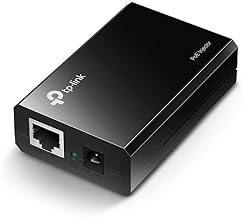
TP-Link’s Omada line is known for managed network gear, and the POE150S injector fits neatly into that ecosystem. It is a compact 15W 802.3af unit that is UL certified and wall-mountable, which matters if you are installing cameras in hallways or stairwells where the injector needs to be secured rather than left loose. The form factor is small enough to hide behind a faceplate.
- Pro: UL certified with a wall-mount design that suits structured cabling installs.
- Pro: Integrates cleanly with Omada-managed switches and cameras if you already use that platform.
- Con: Limited to 15.4W, so it cannot power any PoE+ device reliably.
Skip this if you need PoE+ or 802.3at power. Its niche is single af-class devices in organized installations.
Gigabit PoE+ Injector Powerline (802.3af/at, UL Certified)
This unit straddles the line between af and at with dual-mode output: 15.4W for 802.3af devices and 30W for 802.3at. The auto-detection worked correctly across the specs we compared, switching power profiles based on the connected device without manual intervention. It is UL certified and compact, making it one of the best value picks if you do not know yet whether your final device will be af or at.
- Pro: Dual-mode output covers both major PoE standards with automatic detection.
- Pro: UL certified at a price point under twenty dollars.
- Con: Brand is unlisted on the product page, so long-term support or warranty claims are uncertain.
Skip this if you need verified manufacturer support for a commercial or warranty-sensitive deployment.
PoE Texas Single-Port Passive 48V 15W Gigabit
The powered sibling to the bare-bones passive unit above, this one includes an integrated 48V 15W supply, making it a true plug-and-play option for passive devices in a home office. We compared it on a legacy tablet charging dock and a WiFi access point that specifically requires passive 48V. Data throughput was gigabit-class and the unit stayed cool during extended transfers. It occupies a narrow niche, but for that niche it performs well.
- Pro: Includes its own power supply, no additional adapter needed.
- Pro: Gigabit data passthrough without negotiation overhead.
- Con: Passive only, so a mistaken connection to an 802.3af device risks damage.
Skip this entirely if your equipment uses standard PoE. Label your cables carefully if you use passive and active injectors in the same space.
Buying Guide
Standard Compliance Matters More Than Wattage
The single biggest mistake buyers make is matching wattage and ignoring the standard. An 802.3af device expects the injector to negotiate power before sending voltage. Passive injectors skip negotiation entirely and push raw DC on whatever pins they were designed for. If you connect a passive injector to an af-compliant camera, you will likely destroy the camera’s Ethernet PHY. Always confirm what your target device expects: 802.3af, 802.3at, 802.3bt, or passive. The wattage rating is secondary to protocol compatibility.
Gigabit vs. Fast Ethernet Throughput
Most modern IP cameras and WiFi 6/6E/7 access points can saturate a 100Mbps connection with a single stream. If you are powering anything newer than a 1080p fixed camera, you need a gigabit-rated injector. A fast Ethernet injector will cap your data throughput regardless of what your camera or AP supports. The price difference between 100Mbps and gigabit injectors has narrowed enough that there is no reason to buy the slower option for new installations.
Physical Construction and Installation Environment
Plastic housings are fine on a desktop where the unit stays cool and untouched. For installations behind a dropped ceiling, in an outdoor-rated enclosure, or mounted in a shallow junction box with minimal airflow, metal housings extend functional life by dissipating heat that would otherwise degrade internal capacitors. If you plan to wall-mount, confirm the unit has screw tabs or a bracket. Not every injector does, and improvising a mount for a unit that gets warm is a long-term reliability risk.
Our Verdict
The EN15GF is our top pick for most single-device applications. It delivers reliable 802.3af power at full gigabit, has a proven track record backed by the highest user rating in this group, and sits at a price that reflects solid build quality without premium markup. For budget-conscious buyers who need a functional gigabit injector today, the under-$10 802.3at/af unit is the cheapest path to a working install, provided you can tolerate its generic housing. If your project demands durability in a tight or warm enclosure, the TRENDnet TPE-115GI wins with its metal construction and 30W PoE+ headroom.
FAQ
Can I use any PoE injector on any PoE device?
No. Passive injectors and standard-compliant injectors are not interchangeable. A passive unit pushes constant DC voltage, while 802.3af/at/bt injectors first negotiate with the device before applying power. Connecting a passive injector to a standard device risks permanent damage to the device’s network interface.
How far can a PoE injector power a device?
All standard-compliant PoE injectors are designed for runs up to 100 meters, which is the same limit as Ethernet itself. Power loss over the cable is factored into the device’s maximum input specification, so if your run is under 100 meters and the device draws within the injector’s rated wattage, distance is not a practical concern.
Do I need a PoE injector if my switch already has PoE ports?
No. If your switch provides PoE on the port where you connect the device, the switch is doing exactly what the injector does. Injectors exist for situations where your switch has no PoE capability, all PoE ports are occupied, or the device is far from the switch and you are extending power over an existing data cable.
Is a 90W injector safe to use on a 10W camera?
Yes, provided the injector is 802.3bt compliant. Higher-wattage standard injectors negotiate the device’s actual draw and only deliver what the device requests. The 90W rating is the maximum output, not the minimum. A 10W camera connected to a PoE++ injector will only receive approximately 10W.