Key takeaways
- Thickness: Makers list thickness in mil. Thicker material tends to last longer in sun and chemicals but is heavier to handle.
- Color: Clear, blue and dark options trade heat transfer against appearance and algae. Follow the maker’s color guidance.
- Size and shape: Most come as rectangles to cut to shape. Measure the water surface, not the deck, and trim slightly smaller so the cover can float freely.
- Reel: A reel makes storage much easier on larger pools. Without one, a heavy cover is awkward for a single person.
The best pool cover depends on its job: a mesh or solid safety cover suits owners who close the pool for winter, a solar cover suits owners who want to cut evaporation and trap heat in season, and an automatic cover suits buyers who want safety and convenience in one built-in system. Most pools end up using two different covers across the year.
Pool covers fall into a few families, and each solves a different problem. Mistaking one type for another is the most common buying error, since a solar blanket is not a safety device and a heavy winter cover is not designed for summer heating.
Our top picks


As an Amazon Associate we earn from qualifying purchases at no extra cost to you.
At a Glance
| Cover type | Best for | Key points | Limits |
|---|---|---|---|
| Solar (bubble) cover | Warming water, reducing evaporation | Floats on the surface, trims to size; brands include GLI, Blue Wave and Sun2Solar | Not a safety cover; cannot support weight |
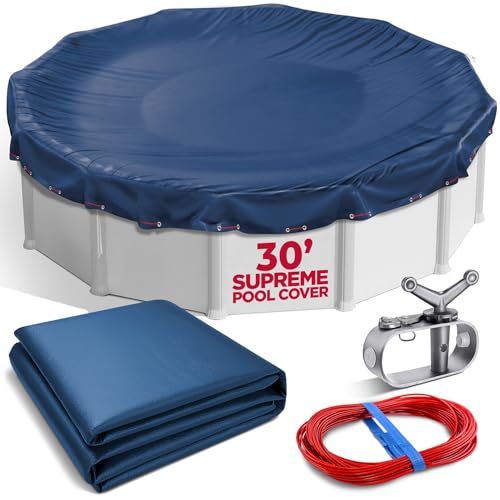
| Winter cover (solid tarp-style) | Closing an in-ground or above-ground pool for the cold season | Blocks sunlight and debris, held by water bags or cable | Needs pump for pooled water; not rated to support people |
| Mesh safety cover | Winter closing with drainage and debris control | Anchored to the deck with straps and springs; sold by makers such as Loop-Loc and Meyco | Professional installation usually advised; small particles pass through |
| Solid safety cover | Closing with maximum light and debris blocking | Anchored like mesh covers, built to support a defined load | Standing water must be pumped off |
| Automatic cover | Daily convenience, permanent safety barrier | Motorized track system from makers such as Coverstar and Cover-Pools | Highest cost tier; planned with the pool build or retrofit |
| Leaf net | Catching debris in autumn before the final closing | Lightweight net held with cable or water bags | Not a closure; no safety rating |
Solar Covers
A solar cover is a bubble sheet that floats on the water. Makers describe two benefits: it absorbs sunlight to help warm the water, and it limits evaporation, which also keeps chemicals and water from escaping as quickly. Independent pool-care outlets generally agree that evaporation control is where covers deliver the biggest, most reliable benefit, though the amount of warming depends on climate, sun exposure and cover thickness.
What to look at
- Thickness: Makers list thickness in mil. Thicker material tends to last longer in sun and chemicals but is heavier to handle.
- Color: Clear, blue and dark options trade heat transfer against appearance and algae. Follow the maker’s color guidance.
- Size and shape: Most come as rectangles to cut to shape. Measure the water surface, not the deck, and trim slightly smaller so the cover can float freely.
- Reel: A reel makes storage much easier on larger pools. Without one, a heavy cover is awkward for a single person.
Care
Remove the cover before shocking the pool or when the water chemistry is out of range, since high chlorine levels can degrade the material, and avoid leaving it in direct sun when off the pool. Store it dry and shaded. Never allow children or pets to walk on it: it will not support weight and it can hide someone who has fallen in.
Winter and Safety Covers
Winter closing covers keep debris and sunlight out, which helps the pool open cleaner in spring. There are two broad families. Tarp-style covers are held down by water bags or cable-and-winch systems on above-ground and in-ground pools. Safety covers are anchored with straps and brass or stainless anchors set into the deck, and they are engineered to support a defined load. The relevant industry benchmark in the United States is ASTM F1346, which covers performance of safety covers and related products. If you are buying a cover for its safety function, look for the maker’s statement of compliance and follow the installation instructions.
Mesh versus solid
- Mesh: Rainwater drains through, so there is no need for a pump. Fine silt can pass, and some light can reach the water.
- Solid: Blocks nearly all light and debris, which many owners prefer for a cleaner spring opening, but rain and melt water collect on top and must be pumped away.
Installation
Safety covers require precise anchor placement, accurate measurements and sometimes custom shapes. Many makers recommend certified installers, and warranties often depend on correct installation. Pool-industry reviewers commonly point out that a poor installation negates the safety value.
Automatic Covers
An automatic cover rides on tracks along the pool edges and opens or closes with a key switch. Makers such as Coverstar and Cover-Pools market them as safety barriers that also serve as thermal and debris covers. They sit in the premium tier, and the system is generally planned during construction or a major renovation. They reduce daily effort significantly, but they need regular inspection of tracks, motors and fabric, and professional service when anything misbehaves. For electrical components, rely on the maker’s manual and a licensed electrician.
Budget Tiers
- Budget: Basic solar blankets, standard winter tarps, leaf nets.
- Mid-range: Thicker solar covers with reels, heavier winter covers with better seams, entry-level custom mesh covers.
- Premium: Custom-fit safety covers installed by a professional and fully automatic systems.
Fit and Measurement Notes
For rectangular above-ground pools, the maker typically publishes the cover size to match the pool diameter or length plus overlap. Oval and round above-ground pools use a larger cover to allow for water bags or cable. In-ground custom shapes, steps and benches usually need a template or a site measurement. Always measure twice, and ask the maker how stated dimensions relate to the actual water surface.
Pick X If… Decision Table
| Pick this | If you… |
|---|---|
| Solar cover with reel | Want to extend the swim season and cut evaporation |
| Tarp-style winter cover | Have an above-ground pool and want straightforward closing |
| Mesh safety cover | Want drainage and a strong winter barrier and will hire an installer |
| Solid safety cover | Want the cleanest spring opening and can pump the cover |
| Automatic cover | Want everyday convenience and a permanent barrier, and have the budget |
| Leaf net | Mainly need to catch autumn debris before the pool closes |
Safety First
- A cover is not a substitute for fencing, alarms and supervision. Follow local pool-barrier codes.
- Never let anyone walk or swim under a cover, and keep a cover fully open or fully closed.
- Remove standing water from covers regularly: it is a hazard for children and pets.
- Ask your local building authority which barrier requirements apply to your pool.
Alternatives
- Liquid solar blankets: chemical products that claim to reduce evaporation. Independent reviewers are mixed on how well they perform compared with physical covers.
- Pool heater: if warming is the main goal, a heater or heat pump does more than a blanket, and a cover can then reduce its running time.
- Pool fencing and alarms: if safety is the primary driver, these can complement a cover.
Matching a Cover to Your Pool Type
Above-ground pools and in-ground pools use different closing methods. Above-ground pools usually take a tarp-style winter cover held by a cable and winch or by water bags, since there is no deck to anchor into. In-ground pools with a deck can use anchored safety covers, and those with a vinyl liner, fiberglass shell or concrete finish each have their own installation notes in the cover maker’s guide. Fiberglass shells and vinyl liners both affect how anchors are set and where straps run.
Climate also shapes the choice. In freezing regions, a winter cover must handle ice, snow load and thaw cycles. In warm regions, the pool may stay open year-round, and a solar cover or automatic cover for evaporation and heat retention becomes the main goal. Owners in leafy areas often add a leaf net, or choose a solid cover that stops debris from reaching the water.
Cover Maintenance Through the Year
- Spring: remove the cover, clean it, let it dry fully and fold it loosely to avoid creases.
- Summer: use a solar cover during cool nights and cloudy periods, and take it off when chemistry is adjusted.
- Autumn: clean the pool, balance the water and install the closing cover on a calm day.
- Winter: remove snow and standing water in line with the maker’s instructions, and do not walk on any cover that is not rated as a safety cover.
A careful routine extends cover life and prevents expensive replacements.
Frequently Asked Questions
Does a solar cover really heat a pool?
Makers and pool-care outlets say it can add warmth by absorbing sunlight and keeping heat from escaping. The effect varies with climate, shade and how many hours it stays on. Its largest benefit is typically reduced evaporation.
Can a solar cover be used as a safety cover?
No. A solar cover floats and cannot support weight. Only products that state they meet a recognized safety standard, such as ASTM F1346, and that are properly anchored should be used as safety covers.
Should I choose a mesh or a solid winter cover?
Mesh drains rain on its own and needs less attention, while solid covers block more light and debris but need pumping. Your climate and willingness to monitor the cover usually decide.
How long do pool covers last?
Lifespan depends on material, sun and chemistry. Makers publish warranty periods, and those give a rough guide, but proper storage and chemical balance matter as much as the product.
Can I install a safety cover myself?
Some systems are sold for do-it-yourself installation, but many makers advise professional installation because anchor placement determines safety and warranty coverage. Read the manual and decide with the maker’s guidance.
Are automatic covers worth it?
Owners who open and close the pool daily often value the convenience and built-in barrier. The cost, planning and maintenance requirements are significant, so compare them with a simpler cover and your budget.
FAQ
Does a solar cover really heat a pool?
Can a solar cover be used as a safety cover?
Should I choose a mesh or a solid winter cover?
How long do pool covers last?
Can I install a safety cover myself?
Are automatic covers worth it?
More from Amazon
Programs that pair well with the guide above. Offers and eligibility are set by Amazon and may change.
Free shipping on eligible items, Prime Video and more. Eligible new members can start with a free trial.
Start a Prime free trialAudiobooks and podcasts to listen to on the go. Eligible new members can start with a free trial.
Try Audible freeAd-free music streaming. Eligible new subscribers can start with a free trial.
Try Music Unlimited freeA free business account with business pricing and bulk-buying tools for work, shop or home office.
Create a business accountAs an Amazon Associate we earn from qualifying purchases.