
When the power goes out or you are miles from the nearest outlet, a reliable portable power station is the difference between staying comfortable and scrambling for alternatives. In 2026, battery-based solar generators have largely replaced noisy gas generators for camping, van life, and short-term home backup, offering silent operation, pure sine wave AC power, and the ability to recharge from the wall, car, or sun.
We focused on compact, camping-friendly models with enough capacity for phones, lights, laptops, and small appliances without requiring a truck to haul them. After comparing capacity, inverter power, port selection, weight, and solar-charging efficiency, these five stand out for real-world use at the campsite and during unexpected outages.
Our top picks




As an Amazon Associate we earn from qualifying purchases at no extra cost to you.
⚡ Save on Your Next PC — Amazon Prime
Prime members get fast free shipping on the systems above, plus early access to Prime Day & Black Friday PC deals. New members get a 30-day free trial.
Watch: Best Portable Generators for Camping and Power Outages — Video Review
How to Choose
- Capacity (Wh): Match watt-hours to your needs. 100 to 150Wh covers phones and lights for a weekend, 290 to 300Wh adds laptop and fan runtime, and 1000Wh+ can run a mini-fridge or CPAP overnight.
- Inverter Output (W): Check continuous and peak watts. A 200W inverter handles DC and USB loads, while 300W to 1500W is needed for AC devices like TVs, blenders, or a small refrigerator.
- Ports and Charging: Look for a mix of 110V AC outlets, regulated DC, and fast USB ports including USB-C PD. Multiple charging inputs (AC, car, and solar) add flexibility.
- Weight and Portability: Under 8 pounds is ideal for tent camping and backpacking, 8 to 13 pounds balances capacity and carry weight, and over 20 pounds is better suited for car camping or home backup.
- Solar Input: Confirm solar panel compatibility, input wattage, and charging time. A 30W to 100W panel can recharge a 111Wh to 300Wh unit in 4 to 8 hours of good sun with MPPT control.
The Best Picks Reviewed
Jackery Explorer 1000 v2
For home backup and extended camping, the Jackery Explorer 1000 v2 is the most capable pick here with 1070Wh capacity and a 1500W pure sine wave inverter (3000W surge). At about 23 pounds, it is designed for car camping, RVs, and emergency use rather than backpacking. It runs a 60W portable fridge for roughly 14 to 16 hours, powers a full-size TV for 8 to 10 hours, and handles power tools or induction cookers that smaller units cannot. It offers two AC outlets, USB-A, USB-C PD, and a DC car port, with pass-through charging and quiet operation. Paired with 100W to 200W solar panels, it recharges in 5 to 8 hours of direct sun, making it our top choice for power outages.
Jackery Explorer 300
The Jackery Explorer 300 hits the sweet spot for most campers. With 292Wh and a 300W inverter (500W peak), it weighs just 7.8 pounds and fits easily in a tote or tent vestibule. It can charge a smartphone 15 to 18 times, keep a laptop running for 3 to 4 full charges, or power LED lights and a small fan all weekend. You get two AC outlets, multiple USB ports including USB-C, and a DC car port, all with a regulated pure sine wave output safe for sensitive electronics. Wall recharge takes about 4 to 5 hours, and it pairs efficiently with a 60W to 100W solar panel for off-grid topping. It is powerful enough without being bulky.
EnginStar 296Wh Portable Solar Generator
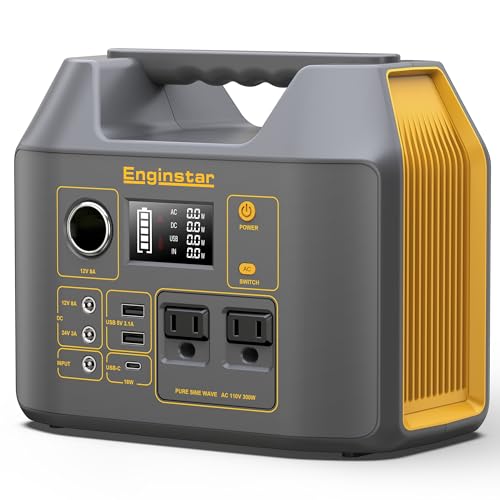
The EnginStar 296Wh is a direct competitor to the Jackery 300 with a similar 296Wh capacity and pure sine wave AC output, but with a slightly more versatile port layout for its class. It typically provides two 110V AC outlets, two DC outputs, and three USB ports including a fast-charge USB-C, plus a built-in LED light with SOS mode for camping. Weighing around 7 to 8 pounds, it reliably charges drones, cameras, and laptops and can run a 32-inch TV for 3 to 4 hours or a CPAP for one night with the right settings. Recharge via AC takes about 5 to 6 hours, with efficient solar charging from a 60W to 100W panel. It is a strong value for weekend trips and overnight outages.
FF Flashfish 200W Portable Power Station
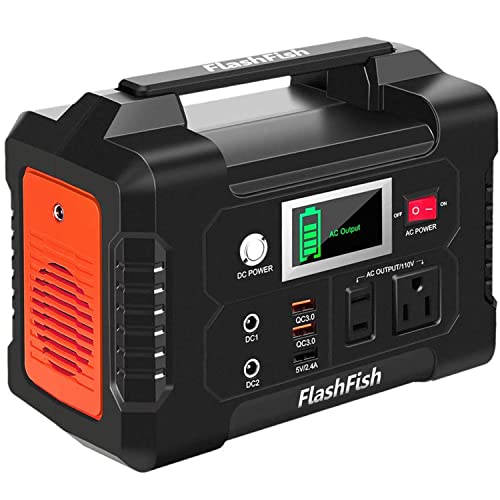
The FF Flashfish 40800mAh Portable Power Station delivers 151Wh at 200W continuous output (250W peak) and stands out for everyday carry and light backup. Despite its compact size at under 4 pounds, it includes two 110V AC outlets, two DC ports, and three USB ports for broad compatibility. It will charge phones 10 to 12 times, power Wi-Fi routers for 8 to 10 hours during an outage, and run LED camp lights, fans, and small projectors. The pure sine wave inverter protects laptops and cameras, and the digital display clearly shows remaining capacity and input/output watts. It recharges from AC in about 5 hours and supports 50W to 60W solar input for daytime campsite charging. Best for minimalists and short outages.
MARBERO 111Wh Solar Generator with 30W Panel Included
The MARBERO 111Wh Solar Generator is the most portable and beginner-friendly kit because it includes a 30W folding solar panel in the box. The power station itself weighs about 3 pounds, with 111Wh capacity, 120W continuous output, and multiple outputs including AC, DC, USB-A, and USB-C. It is ideal for keeping phones, tablets, GPS units, headlamps, and cameras charged on a two to three day trip, providing 6 to 8 smartphone charges or 2 to 3 action camera charges per cycle. The included 30W panel recharges it in about 6 to 7 hours of full sun, while AC charging takes roughly 3 to 4 hours. If you want a grab-and-go solar kit without buying panels separately, this is the easiest entry point.
Frequently Asked Questions
What size portable power station do I need for camping?
For phone and light-only trips, 100 to 150Wh is enough. If you need to charge a laptop, run a fan, or power a portable fridge for a few hours, aim for 290 to 300Wh. For a family campsite or overnight fridge and CPAP support, 1000Wh or more gives you comfortable headroom without constant recharging.
Can these power stations run a refrigerator during an outage?
Small, efficient 12V portable fridges (35 to 60W) can run for 4 to 6 hours on a 290 to 296Wh unit and 14 to 18 hours on a 1070Wh unit like the Jackery Explorer 1000 v2. Full-size home refrigerators draw 100 to 200W running and 400 to 800W on startup, so they require at least a 1000W inverter and 1000Wh capacity for meaningful runtime.
How long does solar charging take?
Solar charge time depends on panel wattage and sunlight. A 30W panel can recharge a 111Wh unit in 6 to 7 hours, a 60W to 100W panel recharges a 292 to 296Wh unit in 5 to 8 hours, and a 100W to 200W panel recharges a 1070Wh unit in 6 to 10 hours. MPPT controllers and direct sun significantly improve speed versus partial shade.
Are portable power stations safe to use indoors?
Yes. Unlike gas generators, battery power stations produce no exhaust or carbon monoxide and operate silently, so they are safe for indoor use, tents, and RVs. All picks here use lithium batteries with pure sine wave inverters and built-in battery management systems for overcharge, short-circuit, and temperature protection.
Final Thoughts
For most campers, the Jackery Explorer 300 and EnginStar 296Wh offer the best balance of weight, capacity, and AC power without overpacking. If you need true outage protection for a fridge, router, and medical devices, step up to the Jackery Explorer 1000 v2. For ultralight trips or a first solar kit, the MARBERO 111Wh with its included 30W panel is hard to beat.








Write Your Review
No reviews yet. Be the first to share your experience!