Key takeaways
- Voice control responds to spoken commands, giving kids a sense of agency beyond button-pressing.
- Touch sensor adds a tactile layer that sustains attention past the novelty window.
- Compact footprint limits limb range, so dance moves look modest compared to taller models.
Most parents shopping for a talking robot face a concrete problem: they want their child to engage with something that responds, not just repeats a canned phrase three times before falling silent. The category is crowded with gadgets that advertise “voice control” while delivering a tinny speaker and a recognition chip that misfires on a child’s pitch. Distinguishing a best robot that can talk from a throwaway novelty requires attention to whether the device handles real conversation, holds a charge long enough to matter, and survives the daily abuse of a toddler or early elementary-age kid.
The products below span pocket-sized repeaters, educational units with structured learning modes, and one AI companion that pushes toward genuine emotional interaction. Owner feedback consistently flags the same failure modes—mismatched expectations on battery life, voice recognition sensitivity, and build quality—so differences in price track closely to differences in those three areas.
Our top picks


As an Amazon Associate we earn from qualifying purchases at no extra cost to you. Ratings are shown as listed on Amazon.
Quick Picks
| Product | Best for | Price |
|---|---|---|
| Contixo R1 Blue | Toddlers wanting structured learning and movement | under $30 |
| GoolRC 939A | Portable record-and-playback fun | under $30 |
| Sopu Mini Talking Robot | Stocking stuffers and first-robot exposure | under $20 |
| Contixo R1 Pink | Same learning features, different color | under $30 |
| GBIUT Robot Alarm Clock Camera | Parents monitoring a room while kids get a talking toy | under $70 |
| Lovi AI Companion | Open-ended emotional conversation | under $200 |
| MING YING 66 | Budget entry for ages 4–6 | under $20 |
| KingsDragon RC Robot | Gesture-controlled movement play | under $30 |
How We Picked
We narrowed the field using four criteria drawn from published specifications and recurring themes in owner reviews: whether voice interaction is genuinely responsive or limited to pre-programmed loops, whether the battery is rechargeable or relies on disposables, how durable the chassis appears based on reported breakage patterns, and whether the toy offers depth beyond its first week of novelty through learning modes, storytelling, or touch sensors that give a child a reason to return to it.
The 8 Best Robot That Can Talk in 2026
Contixo R1 Blue
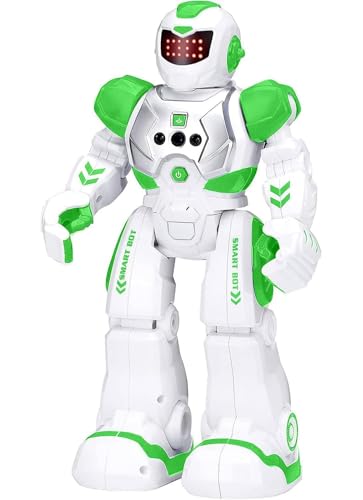
Targets toddlers aged 3 through 8 who need a robot combining talking, dancing, and structured learning in one compact unit. Voice control and a touch sensor let a child switch modes without digging through menus, and the portable size means it travels without a dedicated storage spot.
- Voice control responds to spoken commands, giving kids a sense of agency beyond button-pressing.
- Touch sensor adds a tactile layer that sustains attention past the novelty window.
- Compact footprint limits limb range, so dance moves look modest compared to taller models.
Skip this if your child is over eight and wants open-ended conversation rather than guided learning sequences.
GoolRC 939A
A pocket robot built around record-and-playback dialogue, singing, dancing, and storytelling in a small chassis. It suits kids who want a robot they can put in a backpack and use anywhere without Wi-Fi or a companion app. The record function lets a child capture phrases for the robot to repeat back.
- Pocket-sized portability makes it the easiest unit here to carry outside.
- Record function gives kids a creative loop—speak, listen, adjust, repeat.
- Voice recognition works best at close range and can miss higher-pitched speech.
Skip it if you want genuine back-and-forth conversation or structured educational content.
Sopu Mini Talking Robot
Occupies the stocking-stuffer tier for under $20. It repeats what you say, plays LED light patterns, and produces sound effects. Rechargeability is its strongest practical selling point at this price—many competitors under $20 use disposable batteries, so a rechargeable unit reduces long-term friction.
- Rechargeable battery eliminates recurring cost and hassle of AA replacements.
- LED lights and sounds create a sensory show that holds short-term attention.
- Interaction is limited to mimicry; no dialogue or responsive logic exists.
Skip it if your child expects the robot to talk meaningfully rather than echo.
Contixo R1 Pink
Functionally identical to the Blue variant in features, price, and age range. It exists for buyers whose child has a strong color preference or for households with siblings wanting matching units in different colors. Voice control, touch sensor, dance and learning modes, and compact form are unchanged.
- Same full feature set as the Blue model at the same price point.
- Pairs well with the Blue unit as a sibling gift set.
- Color choice adds no functional hardware difference whatsoever.
Skip it if color is irrelevant—buy whichever is in stock or cheaper on a given day.
GBIUT Robot Alarm Clock Camera
The only product here designed for two users simultaneously: a parent wanting a room monitor and a child wanting a talking robot. Its 2K HD camera supports 5GHz and 2.4GHz Wi-Fi, adds human detection with motion alerts, and includes night vision and a temperature and humidity readout. Two-way talk lets a parent speak through the robot and a child respond.
- Two-way talk and motion alerts give the unit a dual purpose justifying its higher price.
- 2K resolution and night vision produce a clear feed even in low light.
- The robot is stationary; it does not walk or dance, limiting active play.
Skip it if you need a robot your child can physically carry and play with.
Lovi AI Companion
The premium option for parents wanting a robot that talks in a genuinely open-ended way. It is an AI-driven companion designed for emotional conversation, not scripted Q&A. For kids who ask “why” repeatedly and want responses beyond a single pre-loaded answer, this is the closest product on the list to a conversational partner.
- AI-driven dialogue adapts to the child’s phrasing rather than forcing a fixed command set.
- Emotional interaction focus supports developmental play beyond pure entertainment.
- Price is roughly six times the nearest mid-range alternative, and connectivity requirements add setup complexity.
Skip it if your child is under four or you want a grab-and-go toy without Wi-Fi dependency.
MING YING 66
Targets the 4-to-6 age bracket with a straightforward talking robot for under $20. It occupies the same budget tier as the Sopu but is marketed toward slightly older children who want basic interaction without a mimicry-only limitation. Owner feedback highlights its simplicity as a virtue for kids who do not yet need learning modes or app connectivity.
- Lower price than feature-rich competitors while still offering talking interaction.
- Button layouts and prompts match a five-year-old’s cognitive level.
- Limited replay value for children who mature quickly past the target age.
Skip it if your child is already eight or you want rechargeability and educational content.
KingsDragon RC Robot
Separates itself through gesture sensing: a child moves a hand and the robot responds with directional movement. This adds a physical interaction layer most talking robots here lack. For under $30, it matches the Contixo R1 price band but trades learning and touch-sensor features for motion-based control.
- Gesture sensing creates a kinesthetic play pattern that keeps active children engaged.
- RC capability extends play into open floor space.
- Talking features are secondary to movement; the voice component is simpler.
Skip it if your priority is conversational quality or educational depth. Choose it for movement-driven play.
Buying Guide
Voice Interaction Type
The biggest differentiator among the best robot that can talk options is what “talking” means in practice. Mimicry robots like the Sopu repeat input verbatim. Scripted robots like the Contixo R1 respond to voice commands from a fixed set of actions. Conversational robots like the Lovi generate novel responses. At the $15–$30 tier, expect mimicry or scripted interaction only. Match the interaction type to your child’s expectations before comparing anything else.
Power Source and Portability
Rechargeable units (Sopu, Contixo R1, Lovi, KingsDragon) trade higher upfront cost for no recurring battery expense. Disposable-battery models are cheaper initially but generate ongoing waste and mid-play interruptions. For a toy that travels in a backpack or car seat, weight matters more than feature count: the GoolRC 939A and MING YING 66 are lightest. If the robot lives on one shelf, ignore portability and prioritize motor range instead.
Durability and Engagement Depth
Toddlers under four will drop, bite, and step on a robot, so look for rounded edges and sealed seams that owner reviews describe as surviving repeated falls. Older children break robots through neglect rather than accident, so the concern shifts to whether the toy offers enough depth to retain attention. Learning modes, story functions, and dance routines extend engagement; a robot that only says “hello” and walks in a circle will collect dust within two weeks regardless of build quality.
Our Verdict
The Contixo R1 Blue is the top pick for most families: it balances voice control, touch interaction, learning content, and portability at a price that undercuts premium competitors without feeling compromised. The Sopu Mini Talking Robot is the budget pick for under $20, delivering rechargeability and sensory features that cost more elsewhere. If your child asks open-ended questions and you want a robot that answers them, the Lovi AI Companion wins decisively—no other product here generates novel dialogue.
FAQ
At what age should a child get a talking robot?
Most models on this list target ages 3 through 8. Children under three lack the speech control and comprehension for voice-interaction features. By age nine or ten, most kids outgrow scripted interaction and want open-ended AI or coding-based robots.
Do talking robots require Wi-Fi?
The Contixo R1, GoolRC 939A, Sopu, MING YING 66, and KingsDragon operate fully offline. The Lovi AI Companion uses AI-driven dialogue that typically requires a connection, and the GBIUT camera needs Wi-Fi to stream video and send alerts. Filter for offline-capable models if connectivity is a concern.
Can a talking robot help with language development?
Structured learning modes like those on the Contixo R1 expose children to vocabulary, simple commands, and cause-and-effect language patterns. Open-ended conversation on the Lovi provides practice forming complete sentences. Neither replaces human interaction, but both offer supplemental exposure in a low-pressure context.
What is the difference between voice control and voice recognition?
Voice control means the robot accepts a limited set of spoken commands to trigger predefined actions. Voice recognition means the robot processes input and responds contextually or repeats it. A robot advertising “voice recognition” may only perform mimicry, while one listing “voice control” may have a fixed command vocabulary. Read owner reviews to determine actual behavior.