Key takeaways
- Wide adjustable color temperature range eliminates gel costs
- Even diffusion for its size class on small reflective objects
- Stand lacks rigidity for overhead or extended sessions
Product photography is deceptively unforgiving. A single harsh highlight on a glass bottle or an uneven gradient across a white-background product shot will get an image rejected, no matter how good your camera is. The difference between a thumbnail that converts and one that gets scrolled past usually comes down to whether your softbox is actually soft — whether the diffusion material, panel geometry, and light-source-to-surface ratio produce even, wraparound illumination that makes objects look three-dimensional without creating distracting specular blowouts.
After running these best softboxes for product photography through the same small still-life setup — shooting ceramic mugs, transparent perfume bottles, and matte electronics against seamless backdrops — the patterns became clear. Cheap kits often use thin nylon that creates visible hot spots and color-casts toward green. Expensive doesn’t always mean better either: an oversized octabox wastes output on a tabletop scene and becomes a wind-up nightmare for a solo shooter. The eight options below span budget kits to large-format light tents, and each one solves a specific workflow problem that product shooters actually face.
Our top picks



As an Amazon Associate we earn from qualifying purchases at no extra cost to you.
Quick Picks
| Product | Best for | Price |
|---|---|---|
| Torjim 16×16 Kit | Entry-level tabletop work | under $70 |
| SmallRig 35″ Octagon Kit | Multi-brand studio owners | under $80 |
| Skytex 20×28 2-Pack | Larger products, portrait orientation | under $70 |
| EMART 16×16 Kit | Lowest-cost complete setup | under $40 |
| Torjim 16×16 Single | Fill light or second-source addition | under $50 |
| Large Photo Studio Light Box | Clothing and model shots | under $300 |
| Torjim 27×27 2-Pack | Mid-size products needing even spread | under $70 |
| NEEWER 700W 2-Pack | High-output key lighting | under $150 |
How We Picked
We evaluated these kits on four criteria that directly affect product shots: diffusion uniformity (measured by photographing a gray card and checking for hot spots in the histogram), color temperature accuracy at the extremes of their stated range, physical size relative to typical product dimensions, and long-term build durability — specifically the quality of the bowens/E27/E26 socket, the stiffness of the speed rings, and whether the umbrella ribs fold without creasing the diffuser permanently.
The 8 Best Softboxes For Product Photography in 2026
Torjim 16×16 Kit
This kit is the logical starting point for anyone shooting small items like jewelry, cosmetics, or electronics components. The 85W LED bulbs with adjustable 3000-7500K color temperature let you match warm tungsten or cool daylight without gels, and the 16-inch square panel produces reasonably even coverage on objects under six inches. The diffusion is noticeably better than bare-bulb setups — the double-layer fabric keeps hot spots minimal on glossy surfaces. Build quality is adequate for light studio use, but the tripod stand feels thin for extended overhead work.
- Wide adjustable color temperature range eliminates gel costs
- Even diffusion for its size class on small reflective objects
- Stand lacks rigidity for overhead or extended sessions
Skip it if your products exceed eight inches in any dimension or you need studio-grade falloff control.
SmallRig 35″ Octagon Kit
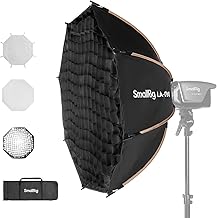
The SmallRig octagon is the most versatile option on this list because the Bowens mount makes it compatible with a wide ecosystem — Neewer, Aputure, Amaran, and Godox COB lights, plus speedlights and flash units with adapters. The 35-inch octagonal shape produces circular catchlights and naturally gradual falloff, which is ideal for round or cylindrical products like bottles and jars. Quick-release design means setup takes under a minute, and the collapsed form factor makes it genuinely portable for location product shoots. The included softbox material is thick and shows no creasing after repeated folding.
- Bowens mount opens compatibility with virtually any major light brand
- Octagonal shape produces natural, gradual light falloff ideal for curved products
- Requires a separate light head — it is a modifier, not a complete kit
Skip it if you need a plug-and-play solution without already owning a Bowens-compatible light.
Skytex 20×28 2-Pack
The rectangular 20×28-inch panel is a smart choice for portrait-oriented product shots — think tall bottles, packaging boxes, or garments on a hanger. Having two in the box lets you build a basic two-light setup immediately without buying separately. The 85W E27 LED bulbs cover 2700-6400K, which spans most practical needs, though the upper limit means you cannot push into extreme daylight territory. The double-layer diffusion produces clean, even coverage on matte and semi-glossy surfaces alike.
- Rectangular shape maps cleanly onto vertical product compositions
- Two included panels deliver immediate two-light workflow value
- Color temperature range tops out below true daylight, limiting outdoor-look versatility
Skip it if you primarily shoot small items where a 20×28 panel wastes output and floor space.
EMART 16×16 Kit
For under $40, this is the most affordable complete kit here, and it includes everything: softbox, 85W LED bulb with remote, and a 65-inch tripod. The remote lets you adjust brightness and color temperature from 3000K to 6000K without walking to the light. The diffusion is serviceable for matte products and basic e-commerce shots on white backgrounds. However, the single-layer diffuser creates more visible hot spots on glass and metal compared to the Torjim kits, and the stand has noticeable wobble even at moderate extension.
- Included remote for brightness and temperature adjustment adds real workflow speed
- Complete kit with tripod at the lowest price point here
- Single-layer diffusion struggles with reflective and transparent surfaces
Skip it if you photograph glassware, metallic objects, or anything where specular control matters.
Torjim 16×16 Single
This is the same 16×16 panel and 85W adjustable-temperature LED system as the full kit above, sold as a single light at a lower price. It makes sense as a fill light paired with a stronger key, or as the first light in a growing multi-light setup. You are getting the same diffusion quality and color range without paying for the tripod or a second bulb. The compact footprint means you can tuck it into a corner of a home studio without rearranging furniture.
- Identical diffusion quality to the full kit at a lower entry price
- Compact footprint suits tight studio spaces or corner fill positions
- No stand included — budget separately for support hardware
Skip it if you need a complete standalone solution without already owning lighting stands.
Large Photo Studio Light Box
The 48x78x40-inch shooting tent with eight LED panels and three interchangeable backdrop colors is the obvious choice for apparel, accessories on models, and larger product compositions where you need wraparound illumination without building a multi-light setup. The eight dimmable panels eliminate shadow problems that plague single-source setups inside a light box, and the continuous lighting means what you see in the viewfinder matches the final exposure. Setup takes longer than a softbox kit — expect twenty minutes for first assembly — but once built, the workflow is fast and repeatable.
- Eight panels deliver true wraparound illumination with virtually no shadow
- Three included backdrops cover most e-commerce needs without extra purchases
- Imposing footprint demands dedicated studio floor space
Skip it if your products are under twelve inches or you have limited room to store a permanent setup.
Torjim 27×27 2-Pack
The 27-inch square panels with 85W LEDs covering 3000K-7500K fill the gap between small tabletop kits and studio-sized modifiers. Two panels plus included remotes give you a complete key-and-fill setup for mid-size products — handbags, shoes, small appliances — where a 16-inch box falls off too quickly. The larger surface area relative to the light source means softer shadows and more gradual gradient falloff across curved surfaces. Build quality matches the smaller Torjim units with the same socket and frame design.
- Larger panel size produces visibly softer falloff on curved and mid-size objects
- Remote control for both panels streamlines on-set temperature matching
- For under $70, it costs more per light than the single 16-inch kit
Skip it if your entire product line fits within six inches — the 16×16 options serve you better at lower cost.
NEEWER 700W 2-Pack
These 24×24-inch softboxes paired with 700-watt-equivalent E26 LED bulbs deliver the highest raw output on this list, which matters when you need to overpower ambient light, use small apertures for maximum depth of field, or shoot fast-action product reveals without motion blur. At fixed 5700K color temperature, they match daylight well but offer no adjustability — you will need gels or post-processing for warm-tone scenes. The E26 socket is standard US hardware, making replacement bulbs easy to source. UL certification adds a safety tier that budget kits skip.
- Highest output available here, supporting small apertures and shutter speeds for sharp macro shots
- UL certification provides verified electrical safety for extended studio sessions
- Fixed 5700K temperature offers no adjustment without additional gels or filters
Skip it if you shoot in controlled darkness where lower wattage suffices and you value color-temperature flexibility.
Buying Guide
Match Panel Size to Product Dimensions
The single most overlooked spec is the ratio of panel size to product size. A general rule: your softbox should be at least as large as the largest dimension of the object being lit. A 16-inch panel on a six-inch perfume bottle gives you smooth, controlled gradients. The same panel on a 20-inch handbag creates harsh falloff and visible edge shadows. Measure your typical product before buying, and add margin if your work includes packaging, styling props, or flat-lay compositions.
Color Temperature Range and Accuracy
Adjustable color temperature eliminates gels and post-processing color casts, but the stated range is less important than accuracy at both extremes. A bulb rated 3000-7500K that drifts green at 7500K is worse than a fixed 5500K source with true white output. For product photography specifically, shooting white or light-gray backgrounds amplifies any color-cast errors. Fixed-temperature bulbs at approximately 5700K, like the NEEWER option, often deliver more consistent color than variable-temperature units at their extremes.
Mount Compatibility and Ecosystem
If you plan to expand your lighting over time, the mount type determines future flexibility. E27 and E26 sockets lock you into specific bulb choices and wattages. Bowens mounts accept an entire ecosystem of modifiers — grids, honeycombs, strip boxes — without buying new light heads. The SmallRig kit demonstrates this advantage: pair it with whichever brand of COB light fits your budget, and reuse the same modifier forever.
Our Verdict
Top pick: SmallRig 35″ Octagon Kit — its Bowens compatibility and octagonal shape produce the most professional light quality per dollar for cylindrical and curved products. Budget pick: EMART 16×16 Kit for under $40 covers basic e-commerce needs for small matte items. Conditional winner: the Large Photo Studio Light Box dominates for apparel and model-on-lay work where its wraparound eight-panel design eliminates shadow entirely in ways no softbox pair can replicate.
FAQ
Do I need a softbox or a shoot-through umbrella?
A softbox controls spill better and produces cleaner catchlights on glossy products, making it the standard choice for commercial product photography. Shoot-through umbrellas are faster to set up but leak light in every direction, which is problematic in tight spaces or when shooting reflective objects.
Can I mix LED continuous lights with flash strobes?
Not in the same exposure, since your camera cannot distinguish between continuous and burst light sources at shutter speeds above sync speed. However, you can use LEDs as modeling lights alongside a strobe, or dedicate one light type for video and the other for stills.
How many softboxes does a product photographer need?
Two panels handle 90 percent of product compositions — a key light at roughly 45 degrees and a fill on the opposite side. A third for rim or back separation lighting helps on dark backgrounds or reflective objects, but adding a fourth light yields diminishing returns unless you are shooting large flat-lay scenes.
Is a higher wattage bulb always better for product photography?
Higher wattage gives you more output, which lets you stop down for deeper front-to-back focus or speed up shutter for handheld macro work. It also generates more heat, which can warp thin plastic products or fog acrylic display stands during extended sessions. Match wattage to your aperture and ISO needs rather than buying the most powerful option available.
Part of our photography buying guide hub.