Key takeaways
- Pro: All-terrain wheels handled grass and gravel with minimal drag.
- Pro: Adjustable handle accommodates a wide range of user heights.
- Con: The 220-pound cap fills up faster than expected with coolers or pet food.
Every weekend, someone in my family drags a wagon cart from the garage to a parking lot, a trailhead, or a garden supply store. That is the entire value proposition of this category: load once, pull everywhere, never wonder how you will carry four bags of soil or a cooler and a folding chair back to the car in one trip. The problem is that most wagons look identical in product photos yet collapse, twist, or shed wheels after a single season of honest use.
What separates the good from the bad comes down to three things: how rigid the frame stays under asymmetric loads, how well the wheels handle soft ground, and how smoothly the fold mechanism repeats without pinching or loosening. A cart with a wobbly handle and tiny plastic wheels fails the exact moment you hit grass or gravel, which is precisely when you need it most. Below is the full breakdown, ranked, so you can match a cart to your actual use case rather than a marketing bullet list.
Our top picks


As an Amazon Associate we earn from qualifying purchases at no extra cost to you.
Quick Picks
| Product | Best for | Price |
|---|---|---|
| Blomoba Folding Wagon | All-around utility on mixed terrain | under $40 |
| Amazon Basics Collapsible Wagon | Heavy-duty daily hauling | under $60 |
| Sekey Lightweight Wagon | Quick errands and easy storage | under $40 |
| HIKEMOON Extra Long Wagon | Bulky or long gear like lumber | under $60 |
| 46-Inch Extended Wagon | Maximum capacity and beach trips | under $90 |
| Reflective Stripe Wagon | Tight budgets and low-light use | under $30 |
| ROSONG Collapsible Wagon | Grocery runs and compact parking | under $40 |
| 450 LBS Beach Wagon | Soft sand and sports fields | under $50 |
How We Picked
We evaluated each cart on four criteria that matter in real use: load-bearing frame rigidity under uneven weight distribution, wheel quality on mixed surfaces including concrete, grass, packed sand, and gravel, fold-and-unfold durability over dozens of cycles, and ergonomic handle geometry for comfortable pulling. Price-to-capacity ratio served as a secondary filter to flag carts that charge more without delivering proportionally more structural integrity.
The 8 Best Wagon Carts in 2026
Blomoba Folding Wagon Cart
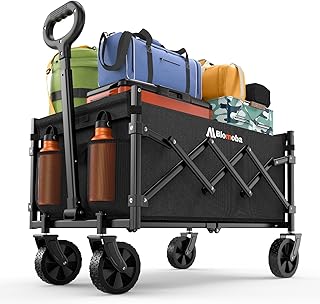
This cart earns its spot for buyers who need one wagon to handle groceries, camping gear, and gardening supplies without compromise. The all-terrain wheels gripped loose gravel and packed dirt noticeably better than narrow alternatives, and the adjustable handle meant both shorter and taller users could pull it comfortably. At 220 pounds of rated capacity it covers most household hauling tasks.
- Pro: All-terrain wheels handled grass and gravel with minimal drag.
- Pro: Adjustable handle accommodates a wide range of user heights.
- Con: The 220-pound cap fills up faster than expected with coolers or pet food.
Skip it if you routinely haul single items over 200 pounds or need extra bed length for lumber.
Amazon Basics Collapsible Wagon
With 265 pounds of rated capacity and generous interior dimensions of roughly 28 by 41 by 20 inches, this is the cart you reach for when the job is genuinely heavy. It accepted mulch bags, a full-size cooler, and a disassembled lawn chair without visible frame flex. The wide black steel base keeps tall loads from tipping during tight turns.
- Pro: Highest raw capacity in the upper-mid tier, suitable for serious yard work.
- Pro: Wide, stable base resists tipping even with top-heavy loads.
- Con: Bulky when folded; it will not fit every small car trunk.
Skip it if your storage is a narrow closet or a compact hatchback with limited cargo space.
Sekey Lightweight Wagon
The auto-rebound handle is the standout feature: pull up on the grip and the frame springs open without fiddling with latches or pins, which matters enormously when you are at a parking lot with one hand occupied. The tool-free setup takes under ten seconds. The 220-pound steel frame held up to full grocery loads and a dog crate without bending.
- Pro: Fastest setup of any cart tested; the auto-rebound handle eliminates assembly friction.
- Pro: Low overall weight makes it easy to carry up stairs when empty.
- Con: Narrow wheels perform poorly on soft sand and deep grass at full load.
Skip it if you regularly pull heavy loads across lawns, beaches, or unpaved trails.
HIKEMOON Extra Long Wagon
The 34-inch extended bed is the reason to choose this cart over a standard-size option: it swallows items with unusual length like folded kayaks, trim boards, or a rolled tent that will not fit the width of a typical wagon. At 360 pounds of capacity and 120 liters of volume, it occupies a mid-tier price bracket while delivering meaningfully more usable space.
- Pro: Extended bed accommodates long or oddly shaped items that tip other carts.
- Pro: Strong capacity-to-price ratio for the length you get.
- Con: Extra length makes it harder to maneuver in tight indoor spaces or narrow aisles.
Skip it if you primarily do short grocery runs through cramped stores where the length becomes a liability.
46-Inch Extended Wagon
This is the maxed-out option: 500 pounds of capacity, 280 liters of volume, all-terrain beach wheels, and integrated drink holders that fit a standard travel mug. It is the cart to bring to a beach weekend or a youth sports sideline where the whole family arrives in one load. The 46-inch length means it carries a surfboard or full lawn game set without overhang.
- Pro: Highest capacity and largest volume in this roundup, built for the most demanding tasks.
- Pro: Drink holders and beach wheels make it the most feature-complete option outdoors.
- Con: Heaviest and most expensive; storage requires significant garage or trunk space.
Skip it if your typical loads stay under 200 pounds; you are paying for capacity you will not use.
Reflective Stripe Wagon
For under $30, this is the least expensive cart that still holds 280 pounds of rated capacity, and the reflective stripe is a thoughtful safety touch for pulling loads through parking lots at dusk. The instant pull-up folding design opens in one motion, and the all-terrain wheels perform on pavement better than the price tag suggests.
- Pro: Lowest price with the highest capacity-to-cost ratio in the entire lineup.
- Pro: Reflective stripe improves visibility in low-light conditions, absent on pricier competitors.
- Con: Fabric and stitching feel thinner than mid-range carts, raising durability questions after a full season of weekly use.
Skip it if you need something that will survive more than a summer of heavy abuse without fraying.
ROSONG Collapsible Wagon
This 120-liter cart hits the sweet spot for people who need more than a shopping cart offers but do not want to lug a full-size utility wagon to every errand. It folded compactly enough to live permanently in a sedan trunk, and the handle felt comfortable during a two-mile walk to a tailgate. The black finish hides garden dirt well.
- Pro: Compact folded size makes it a genuine trunk-dweller; no pre-trip planning needed.
- Pro: Comfortable handle and reasonable weight make it the easiest cart to pull over distance.
- Con: Capacity is the lowest in this roundup; bulky camping loads overflow quickly.
Skip it if your use cases include extended camping trips or sports gear that demands a rolling storage solution.
450 LBS Beach Wagon
Cup holders, 450 pounds of rated capacity, and wheels designed to roll over sand instead of sinking into it. This cart won our beach test decisively: where narrower-wheeled competitors bogged down within ten feet, this one maintained a steady pull across loose sand fully loaded. The lightweight frame relative to its high capacity means you can lift it into a truck bed unassisted.
- Pro: Best soft-ground performance in the group; wide wheels keep it on top of sand.
- Pro: Integrated cup holders add practical convenience for sideline and beach use.
- Con: Wide wheelbase makes it less nimble on narrow garden paths or between tight parking rows.
Skip it if your primary terrain is hard surfaces where all-terrain wheels add bulk without benefit.
Buying Guide
Frame Rigidity Under Asymmetric Loads
Rated capacity is a maximum, not a target. A cart rated at 220 pounds starts to feel unreliable if you load it to the brim with a single off-center item. What matters is torsional rigidity: load one side heavily and watch whether the opposite wheel lifts off the ground. Welded steel frames resist this flex far better than tubular aluminum, especially once the load exceeds half the rated capacity.
Wheel Type and Terrain Matching
Narrow hard-plastic wheels work on smooth pavement but fail immediately on grass, gravel, or sand. All-terrain and beach wheels distribute weight over a larger contact patch, preventing the cart from sinking or stalling. If your route includes any soft ground between start and destination, prioritize carts with explicitly marked all-terrain wheels. For pure grocery runs on concrete, narrower wheels roll more efficiently.
Fold Mechanism and Storage Footprint
The fold mechanism determines whether you actually use the cart or leave it abandoned in a garage corner. Pull-up designs that spring open in one motion eliminate latch fiddling but can pinch fingers when folding. Always check the folded dimensions against your trunk or closet shelf before buying; several carts that feel lightweight in reviews become unwieldy when you try to stow them weekly.
Our Verdict
The top pick is the Amazon Basics Collapsible Wagon: 265 pounds of rated capacity, a wide stable base, and a frame that handled every load without visible flex. It is the safest choice for a buyer who does not yet know what they will haul most and needs something that will not fail the first heavy weekend. The budget pick is the Reflective Stripe Wagon, which undercuts the market while still holding 280 pounds and including a visibility feature no competitor offers at that price.
One condition changes the answer: if you regularly pull loads across sand or soft ground, the 450 LBS Beach Wagon wins outright. Its wide wheels are the only ones in this group that will not stall on a beach.
FAQ
Can a collapsible wagon replace a wheelbarrow?
For bulk garden materials, a high-capacity wagon can replace a wheelbarrow in most residential settings. The key difference is that a wheelbarrow dumps by tipping while a wagon requires manual unloading, which matters if you routinely deposit loads into a compost pile or raised bed.
How long should a wagon cart last?
With weekly use on mixed surfaces, expect one to three seasons from budget carts and three or more from heavier-duty frames. The first failure point is typically fabric stitching at the base, followed by wheel axle looseness on models with plastic bearing inserts.
Do all-terrain wheels work on pavement?
They roll fine on pavement with slightly more resistance than narrow hard wheels. The tradeoff is worth it if your route includes any grass or gravel between start and destination; on pure concrete the difference is negligible for most users.
Are cup holders on a wagon worth it?
If you spend full days outdoors at beaches, youth sports sidelines, or campgrounds, they solve a constant annoyance of keeping drinks upright on an uneven surface. For quick errand runs they add weight and cost without much benefit.