Key takeaways
- Pro: 4K video capability at the lowest price in this lineup
- Pro: Wi-Fi and Bluetooth for phone-based transfers and remote control
- Con: No in-body stabilization; relies entirely on the lens IS
If you have ever wondered what is a mirrorless camera and why they have largely replaced DSLRs in the enthusiast market, the short answer is that they ditch the internal mirror assembly in favor of an electronic viewfinder and sensor-based image processing. The result is a body that is typically smaller, quieter in operation, and far more capable in live preview and video than the reflex design it replaced. But “mirrorless” covers a massive spread of machines — from sub-$600 beginner kits to full-frame workhorses that cost several times more — so knowing where a particular model sits on that spectrum matters before you commit.
This roundup compares eight current Canon and Sony mirrorless kits using published specifications, listed prices, and aggregated owner feedback. We looked at sensor format, resolution, autofocus capability, video output, included glass, and value per dollar. The goal is to help you match a specific camera to the photography or videography you actually plan to do, rather than simply buying the most expensive body or the flashiest lens bundle.
Our top picks



As an Amazon Associate we earn from qualifying purchases at no extra cost to you.
Quick Picks
| Product | Best For | Price |
|---|---|---|
| Canon EOS R100 (RF-S 18-45mm) | Absolute beginners on a tight budget | n/a |
| Canon EOS R6 Mark II (RF 24-105mm) | Professional hybrid photo and video work | n/a |
| Canon EOS R100 Bundle | First-time buyers wanting a complete kit | $549 |
| Canon EOS R50 (18-45mm) | Content creators stepping up from a phone | $799 |
| Canon EOS R50 Double Lens Bundle | Travelers needing wide and tele reach | $1049.95 |
| Canon EOS RP (RF 24-105mm) | Full-frame image quality at an accessible price | $1149 |
| Sony ZV-E10 (16-50mm) | Dedicated vloggers who prioritize video | $798 |
| Sony Alpha a6400 (16-50mm) | Fast-focus action and sports shooting | under $800 |
How We Picked
We weighted four criteria: sensor format and resolution (because they govern low-light performance and cropping latitude), autofocus system design (phase-detect coverage and eye-detection reliability separate modern mirrorless from older bodies), video specification (frame rates, codec, and whether the camera can actually sustain 4K recording without overheating), and bundle value (the lens included with the body can add hundreds of dollars of cost, so the sticker price must be judged against what you receive in the box).
The 8 Best What Is A Mirrorless Camera in 2026
Canon EOS R100 with RF-S 18-45mm f/4.5-6.3 IS STM
Canon’s entry point into the RF mirrorless ecosystem, built around a 24.1-megapixel APS-C CMOS sensor. It records 4K video and connects via Wi-Fi and Bluetooth for easy transfers. The kit lens is light and sharp enough for daylight work, though the small sensor limits high-ISO output compared to full-frame options.
- Pro: 4K video capability at the lowest price in this lineup
- Pro: Wi-Fi and Bluetooth for phone-based transfers and remote control
- Con: No in-body stabilization; relies entirely on the lens IS
Skip it if you need reliable low-light performance or plan to shoot a lot of indoor events.
Canon EOS R6 Mark II with RF 24-105mm f/4-7.1 IS STM
A full-frame hybrid designed for photographers who also shoot video. The 24.2-megapixel CMOS sensor balances resolution with high-ISO cleanliness, and the body is built to handle professional workflows. This is the most capable camera in the group by a wide margin, with a lens that covers a useful travel-zoom range.
- Pro: Full-frame sensor delivers shallow depth of field and strong low-light results
- Pro: Hybrid design handles both photo assignments and video production competently
- Con: Price is significantly higher than every other entry-level or mid-tier option listed
Skip it if your budget is under a thousand dollars or if you only need a camera for casual family photos.
Canon EOS R100 Bundle with RF-S 18-45mm Lens
The same 24.1-megapixel APS-C body as above, sold as a bundle at a listed price of $549. For that money you get a functional 4K-capable mirrorless camera with Wi-Fi connectivity and a stabilized kit zoom. Among first-time buyers, this represents the most affordable on-ramp to interchangeable-lens photography in 2026.
- Pro: Lowest confirmed price of any full kit here, making mirrorless accessible
- Pro: Beginner-friendly controls without sacrificing 4K video output
- Con: Single kit zoom with a narrow aperture range limits creative flexibility
Skip it if you already own RF-S lenses or want a touch-screen for composing at odd angles.
Canon EOS R50 with 18-45mm Lens Bundle
Positioned above the R100, the R50 offers a newer sensor and a more responsive autofocus system aimed at creators who want to jump from smartphone video to a proper mirrorless body. At $799 it undercuts many competitors while delivering a compact, lightweight package. The kit lens remains the same 18-45mm, so the upgrade is in the body itself.
- Pro: More advanced autofocus than the R100 with better subject tracking
- Pro: Compact and lightweight, easy to carry for a full day of shooting
- Con: Same modest kit zoom, so long-lens reach requires an extra purchase
Skip it if full-frame bokeh is a hard requirement for your work.
Canon EOS R50 Double Lens Bundle (18-45mm and 55-210mm)
The R50 body paired with two lenses at $1049.95, covering wide-angle to telephoto in one purchase. For travel photographers and hobbyists who do not want to think about switching glass, this eliminates the most common frustration of kit-only bundles. The second lens adds significant weight and bulk, though, so portability takes a hit.
- Pro: 18-210mm effective zoom range without buying lenses separately
- Pro: Better value than purchasing the two lenses individually at list price
- Con: Total bundle weight makes it noticeably bulkier than the single-lens R50
Skip it if you already own a telephoto RF-S lens or prefer the lightest possible travel setup.
Canon EOS RP Full-Frame with RF 24-105mm f/4-7.1 IS STM
The most affordable path to full-frame Canon glass at $1149. The RP is compact and light for a full-frame body, making it popular with travel photographers and vloggers who want the shallow depth of field and clean high-ISO images that larger sensors provide. The kit zoom is variable-aperture, so maximum sharpness at the telephoto end is modest.
- Pro: Full-frame sensor at a price below several APS-C competitors here
- Pro: Compact and lightweight for a full-frame interchangeable-lens system
- Con: Variable f/4-7.1 zoom gets slow at the long end in dim conditions
Skip it if you need fast burst rates for sports or wildlife, as the RP is designed for deliberate shooting.
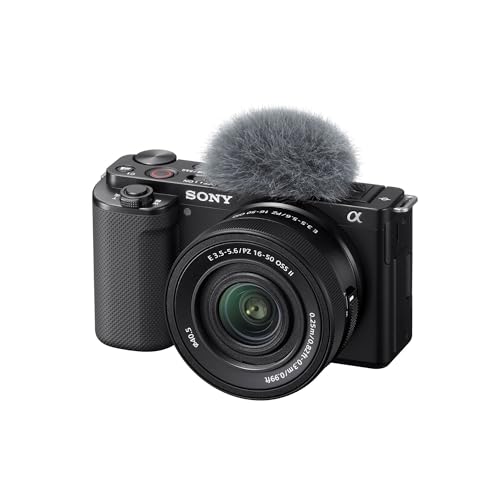
Sony ZV-E10 with 16-50mm Lens
Sony’s vlogger-specific APS-C mirrorless at $798. It prioritizes video ergonomics — a flip-out screen, background defocus button, and a product showcase mode — over traditional stills features. The 16-50mm kit lens is compact but optically simple. For creators whose primary output is YouTube, Reels, or TikTok, the feature set is unusually well-targeted.
- Pro: Purpose-built video controls including a flip screen and dedicated vlogging modes
- Pro: E-mount gives access to a huge third-party lens ecosystem for future expansion
- Con: No electronic viewfinder; bright outdoor shooting becomes screen-dependent
Skip it if most of your work is stills photography, especially in variable lighting where an EVF helps.
Sony Alpha a6400 with 16-50mm Lens
A compact APS-C body for under $800 that punches well above its weight in autofocus performance thanks to real-time eye detection and wide phase-detect coverage. The 4K video and flip screen round out a package suited to hybrid shooters who move quickly between photo and video. Owner feedback consistently praises its reliability for events and portraits.
- Pro: Real-time eye autofocus locks on subjects with high consistency
- Pro: Flip screen and 4K video make it a capable hybrid for content creators
- Con: Menu system is older-generation and less intuitive than Sony’s latest bodies
Skip it if you find Sony’s legacy menu layout frustrating or want a fully articulating screen for selfie-video.
Buying Guide
Sensor Format: APS-C vs Full-Frame
APS-C sensors (found in the R100, R50, ZV-E10, and a6400) are smaller, lighter, and cheaper but deliver less background blur and noisier images above roughly ISO 3200. Full-frame sensors (R6 Mark II, RP) provide a wider dynamic range, cleaner high-ISO performance, and shallower depth of field at equivalent apertures. If you shoot mostly outdoors in good light, APS-C is perfectly sufficient and saves money for glass. If you photograph events, weddings, or dim interiors, the full-frame advantage becomes practical rather than theoretical.
Autofocus and Subject Tracking
Mirrorless cameras rely on on-sensor phase-detect or hybrid AF systems. Sony’s real-time eye autofocus in the a6400 is among the most proven in this price bracket, tracking both human and animal eyes with minimal fuss. Canon’s Dual Pixel AF in the R50 and above is similarly dependable for portraits and general use. The R100 uses a more basic contrast-detect approach that can hunt in low contrast scenes. Match the AF sophistication to your subject matter: portraits and events benefit most from eye-detection; landscapes and studio work are far less demanding.
Bundled Lens Value and Future Expansion
A kit lens that stops at f/5.6 or narrower will not let you isolate subjects strongly or shoot comfortably indoors without a flash. The R50 double-lens bundle and the RP with its 24-105mm zoom give the most reach and flexibility out of the box. Sony E-mount offers the broadest third-party lens market (Sigma, Tamron, Viltrox), meaning you can acquire quality glass at a fraction of first-party cost over time. Canon RF-S options are more limited and often pricier for equivalent optics.
Our Verdict
For most buyers, the Canon EOS R50 with 18-45mm bundle at $799 is the strongest all-round choice: modern autofocus, compact body, 4K video, and a price that leaves room for a fast prime later. Budget-conscious beginners should grab the R100 bundle at $549 and put the savings toward their first fast lens. If you already own or plan to buy multiple Sony E-mount glass, the a6400’s eye autofocus and lens ecosystem make it the better long-term investment despite its older interface.
FAQ
What is a mirrorless camera in simple terms?
A mirrorless camera captures the image directly on the sensor and displays it on an electronic viewfinder or rear screen, eliminating the physical mirror and optical prism found in DSLRs. This makes the body smaller and gives you a real-time preview of exposure, white balance, and depth of field before you press the shutter.
Are mirrorless cameras good for beginners?
Yes, arguably more so than DSLRs because the live electronic preview helps new photographers understand how settings affect their image without trial and error. Entry-level kits like the Canon R100 or R50 also tend to be lighter and less intimidating to carry.
Do mirrorless cameras have worse battery life than DSLRs?
Generally yes, because powering a sensor and electronic display continuously drains the battery faster than an optical viewfinder that requires no electricity. Carrying one spare battery per shooting day is a common recommendation for mirrorless owners, especially during long events.
Can I use old DSLR lenses on a mirrorless camera?
In most cases yes, with the appropriate adapter. Canon EF lenses mount natively on RF bodies, and third-party adapters exist for Nikon F-mount, Sony A-mount, and other legacy systems, though autofocus speed and accuracy may vary depending on the adapter and lens combination.